




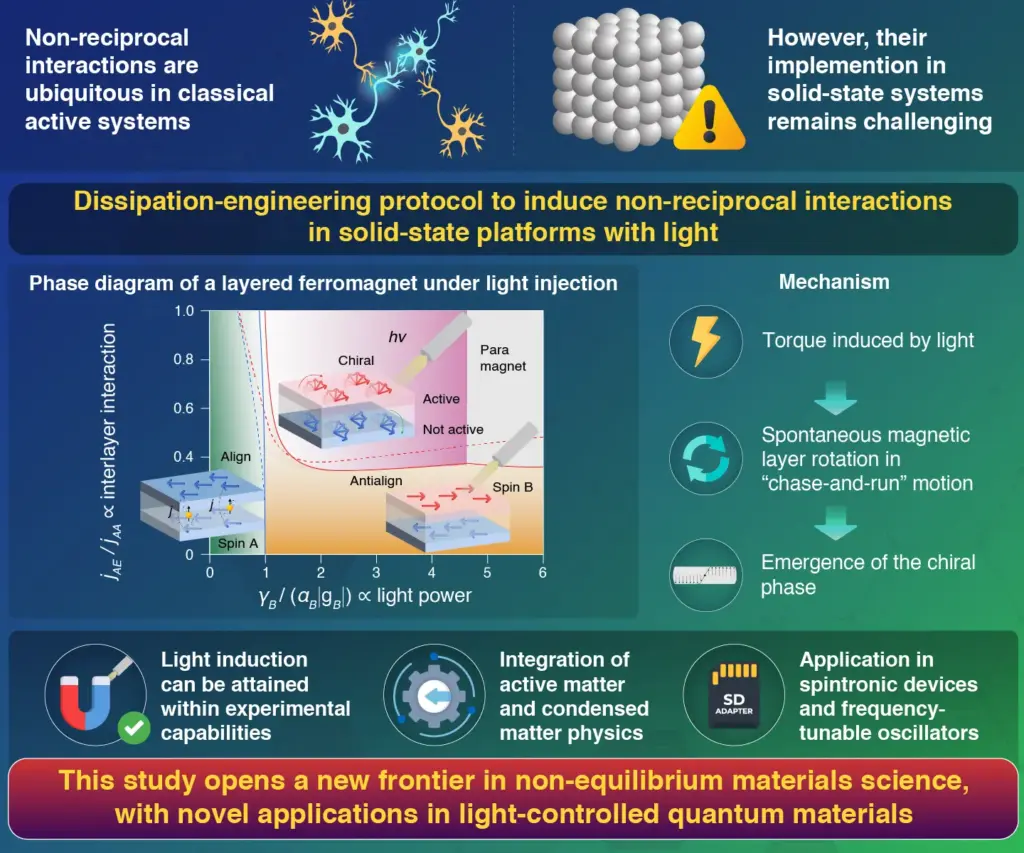
Researchers from Japan have unveiled a groundbreaking theoretical framework that predicts the emergence of non-reciprocal interactions in solids using light, effectively challenging Newton’s third law. By irradiating light of a specific frequency onto magnetic metals, the researchers demonstrate the induction of a torque that drives two magnetic layers into a spontaneous, persistent “chase-and-run” rotation. This discovery opens new avenues in non-equilibrium materials science and hints at novel applications in light-controlled quantum materials.
Understanding Non-Reciprocal Interactions
In equilibrium, physical systems typically adhere to the law of action and reaction, guided by the principle of free energy minimization. However, in non-equilibrium systems, such as biological entities or active matter, interactions that appear to violate this law—known as non-reciprocal interactions—are prevalent. Examples include the asymmetric interactions between predator and prey, or the non-reciprocal dynamics observed in colloids within optically active media.
The question arises: Can such non-reciprocal interactions be implemented in solid-state electronic systems? A research team led by Associate Professor Ryo Hanai from the Institute of Science Tokyo, in collaboration with colleagues from Okayama University and Kyoto University, has answered affirmatively. Their findings, published in the journal Nature Communications on September 18, 2025, propose a method to induce these interactions using light.
Theoretical Framework and Experimental Insights
“Our study proposes a general way to turn ordinary reciprocal spin interactions into non-reciprocal ones using light,” explains Hanai. The team focused on the Ruderman–Kittel–Kasuya–Yosida (RKKY) interaction in magnetic metals, demonstrating that it can acquire a non-reciprocal character when irradiated with light at a frequency that selectively opens decay channels for certain spins.
Driven by the prevalence of active and non-reciprocal phenomena in nature, the researchers developed a dissipation-engineering scheme. This approach uses light to selectively activate decay channels in magnetic metals, which possess localized spins and freely moving conduction electrons. The activation creates an energy imbalance, resulting in non-reciprocal magnetic interactions.
Non-Reciprocal Phase Transition
Applying this scheme to a bilayer ferromagnetic system, the researchers predicted a non-equilibrium phase transition termed a non-reciprocal phase transition. This phenomenon, characterized by a spontaneous and continuous rotation of magnetization, was previously introduced by Hanai and collaborators in the context of active matter. The required light intensity for inducing such transitions is reportedly within current experimental capabilities.
“Our work not only provides a new tool for controlling quantum materials with light but also bridges concepts from active matter and condensed matter physics,” concludes Hanai.
Implications for Future Technologies
This research not only advances the understanding of non-reciprocal interactions in solid-state systems but also holds potential implications for next-generation technologies. The ability to control quantum materials with light could lead to developments in spintronic devices and frequency-tunable oscillators. Moreover, the concepts could be applied to Mott insulating phases, multi-band superconductivity, and optical phonon-mediated superconductivity.
Overall, the study sheds light on the vast possibilities of non-reciprocal interactions and their role in innovative technological advancements. As researchers continue to explore these interactions, the future of material science and quantum technology looks promising, with light playing a central role in unlocking new capabilities.