




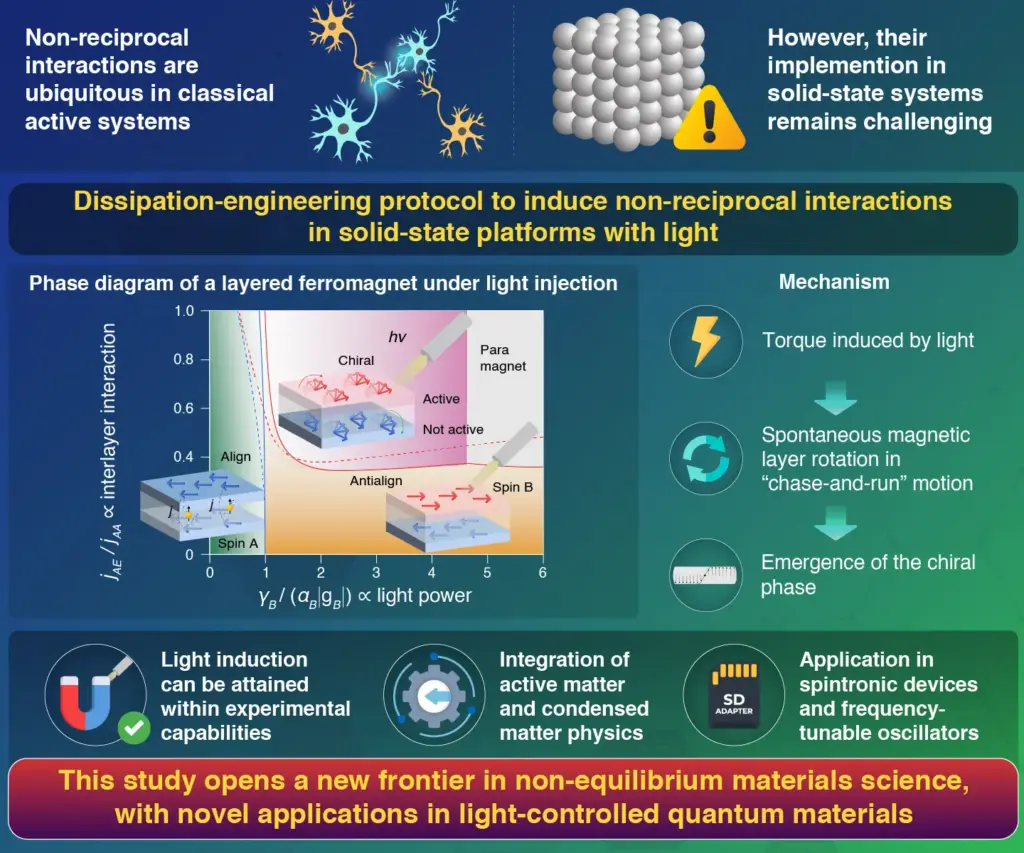
Researchers from Japan have unveiled a theoretical framework predicting the emergence of non-reciprocal interactions in solids using light, effectively challenging Newton’s third law. By irradiating magnetic metals with light at a specific frequency, the team demonstrated that a torque can be induced, causing two magnetic layers to engage in a spontaneous, persistent “chase-and-run” rotation. This groundbreaking discovery opens new avenues in non-equilibrium materials science and suggests innovative applications in light-controlled quantum materials.
The study, led by Associate Professor Ryo Hanai from the Institute of Science Tokyo, in collaboration with Associate Professor Daiki Ootsuki and Assistant Professor Rina Tazai, was published in the journal Nature Communications on September 18, 2025. The research proposes a method to induce non-reciprocal interactions in solid-state systems using light, a concept previously common in biological or active matter systems.
Artificial Induction of Non-Reciprocal Interactions
In typical equilibrium systems, the law of action and reaction holds firm. However, non-equilibrium systems often display non-reciprocal interactions, such as those seen in the brain’s neural networks or predator-prey dynamics. The question of whether such interactions can be applied to solid-state electronic systems has long intrigued scientists.
According to Hanai, “Our study proposes a general way to turn ordinary reciprocal spin interactions into non-reciprocal ones using light.” The team focused on magnetic metals, where the Ruderman–Kittel–Kasuya–Yosida (RKKY) interaction can be altered by light to exhibit non-reciprocal behavior. This is achieved by selectively opening decay channels for certain spins while leaving others off-resonant.
Exploring the Non-Reciprocal Phase Transition
The researchers developed a dissipation-engineering scheme using light to activate decay channels in magnetic metals. These metals, characterized by localized spins and conduction electrons, experience spin-exchange coupling. By creating an energy imbalance between different spins, non-reciprocal magnetic interactions emerge.
Applying this scheme to a bilayer ferromagnetic system, the team predicted a non-equilibrium phase transition, termed the non-reciprocal phase transition. This transition, previously introduced in the context of active matter, involves one magnetic layer aligning while the other anti-aligns under light irradiation, leading to continuous magnetization rotation—a “chiral” phase with persistent dynamics.
“Our work not only provides a new tool for controlling quantum materials with light but also bridges concepts from active matter and condensed matter physics,” Hanai notes. “It could be applied to Mott insulating phases, multi-band superconductivity, and optical phonon-mediated superconductivity.”
Implications for Future Technologies
The implications of this research are profound, potentially paving the way for new spintronic devices and frequency-tunable oscillators. The required light intensity for inducing these non-reciprocal phase transitions is within reach of current experimental capabilities, making practical applications a tangible prospect.
This study not only advances our understanding of non-reciprocal interactions in solid-state systems but also highlights their potential in developing next-generation technologies. By bridging the gap between active matter and condensed matter physics, the research offers a fresh perspective on controlling quantum materials with light.
As the scientific community continues to explore the boundaries of non-equilibrium materials science, the findings from Hanai and his team provide a critical foundation for future innovations in the field.