


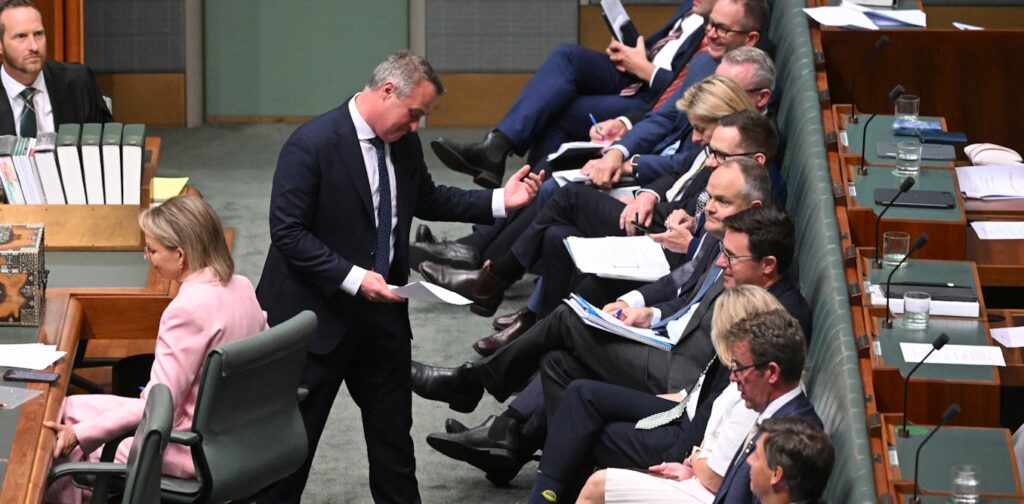
As the Australian Liberal Party grapples with internal divisions and the pressure to develop robust policies, the question arises: can the Liberals effectively tackle industrial relations without risking political disaster? Under the leadership of Sussan Ley, the opposition is tasked with crafting a policy agenda that balances detail with adaptability, particularly as Ley prepares to unveil her immigration policy before Christmas.
The challenge for Ley is to present a policy that is neither too vague nor overly detailed. A detailed policy risks becoming obsolete in a rapidly changing political landscape, while a general approach invites criticism for lack of substance. This delicate balancing act is symptomatic of a deeper ideological split within the party, as conservatives and moderates vie for influence over the party’s direction.
Internal Struggles and Policy Development
The Liberal Party’s current predicament is partly a result of its internal ideological battles. The party is divided between conservatives and moderates, each faction eager to establish its vision for the party’s future. This division is most evident in the formulation of immigration policy, where the need for immediate policy responses clashes with the party’s long-term strategic goals.
Adding to the complexity, Ley faces the challenge of crafting a broad policy pitch that resonates with the electorate. In a major speech in September, she argued against the growing expectation of government dependency, a sentiment that aligns with traditional Liberal values of fiscal restraint. However, advocating for reduced government spending during an election campaign is fraught with political risk, especially amid a cost-of-living crisis.
Industrial Relations: A Historical Minefield
Industrial relations have historically been a contentious issue for the Liberal Party, with past missteps casting long shadows. The legacy of John Howard’s WorkChoices, a policy widely regarded as an overreach, continues to influence the party’s approach to industrial relations. The comparison between Howard’s aggressive reforms and Labor’s more gradual approach highlights the risks of radical policy shifts.
Tim Wilson, the opposition spokesman on industrial relations, employment, and small business, is tasked with navigating this complex terrain. Wilson, who regained his Melbourne seat of Goldstein after losing it to a “teal” independent, has signaled a departure from past approaches. In a speech to the HR Nicholls national conference, he emphasized the need for innovative solutions in industrial relations, drawing parallels to the potential of nuclear power in transforming the economy.
“If the future of Australia’s economy can be fuelled by nuclear power, we should be looking for equally innovative solutions in industrial relations that are about how we build a focus on simplification, empowerment and alignment to promote harmony.”
Future Directions and Challenges
Wilson’s vision for industrial relations involves creating a new playing field that mobilizes employers and advocates for reform. He argues that engaging small businesses, particularly in the context of technological advancements like artificial intelligence, could redefine the employment market. However, the question remains whether small businesses have the capacity to push back against union influence, a challenge that has stymied larger corporations.
The broader political implications for the Coalition are significant. Any proposed changes to industrial relations or government dependency will likely face fierce opposition from unions and could provoke voter backlash. The experience of Bill Shorten, whose policy proposals in the 2019 election included unpopular cuts, serves as a cautionary tale for the Liberals.
As the opposition seeks to refine its policy platform, the stakes are high. The party must balance the need for bold, innovative solutions with the political realities of voter sentiment and union power. How the Liberals navigate this complex landscape will be crucial in determining their electoral prospects in the coming years.