



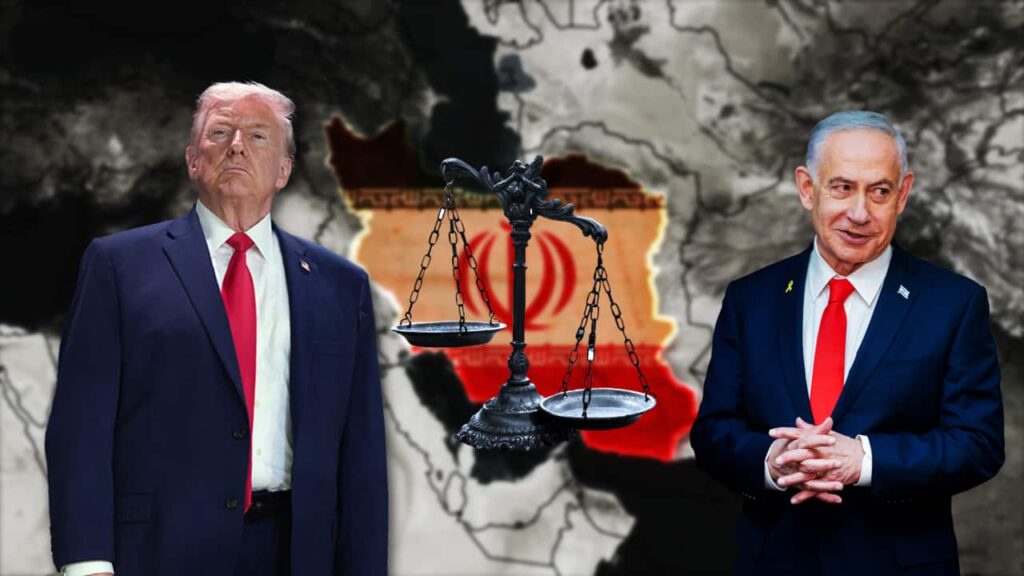
Leading legal and human rights experts have raised concerns about the legality of recent United States-Israeli military strikes on Iran, arguing that these actions may breach international law. As the US military launched a series of strikes against Iranian targets on Saturday, Israeli Defense Minister Israel Katz stated that the military had “launched a pre-emptive strike against Iran to remove threats against the State of Israel.”
The US and Israel, both nuclear-armed nations, have consistently warned against Iran’s nuclear ambitions and its support for Hezbollah, a group they classify as a terrorist organization. Under international law, military force is generally justified only in self-defense if a country is under attack or if such action is authorized by the United Nations Security Council.
International Law and the Use of Force
Ben Saul, Challis Chair of International Law at the Sydney Law School, criticized the US and Israeli actions, suggesting they violate the fundamental prohibition on aggressive force as outlined in the United Nations Charter. “This is the most basic rule of international order since 1945, which is being rapidly eroded by actions like this,” he told SBS News. “This is aggression by Israel against Iran. There’s no conceivable argument under international law that this is self-defense.”
The US and Israel have defended their actions as preventive measures to stop Iran from acquiring a nuclear weapon and to counter its support for terrorism through Hezbollah and other proxy groups. However, Saul, who also serves as the United Nations Special Rapporteur on Human Rights and Counter-terrorism, argued that these justifications do not meet the legal criteria for self-defense under international law.
“This case does not fall anywhere close to (the argument of) self-defense against an imminent attack,” Saul explained. “Iran has not yet enriched uranium to the point of building any kind of nuclear device. Experts agree that Iran does not have a nuclear weapon.”
Expert Opinions and International Reactions
Don Rothwell, a professor of international law at the Australian National University, echoed these concerns, stating there is no evidence of an armed attack or that Iran was preparing to attack Israel or the United States. “There’s no evidence that Iran had nuclear weapons capable of launching such an attack,” he said, noting that the UN Security Council had not authorized any attack on Iran.
Emily Crawford, a professor of international law at the University of Sydney, also criticized the actions as non-compliant with international law. “Every colleague I’ve been speaking to, every bit of research that I’ve been seeing says that there was no evidence to suggest that Iran was going to strike the US in any way such that it would justify the US striking them,” she said.
Meanwhile, Australia has expressed support for the US’s efforts to prevent Iran from obtaining a nuclear weapon. Prime Minister Anthony Albanese, however, refrained from commenting on the legality of the strikes. “Those judgments and statements (are) for the United States and for those involved directly in the attack,” he stated.
Global Diplomatic Responses
Other countries have been more vocal in their criticism. Switzerland expressed deep alarm over the strikes and urged respect for international law, offering to host diplomatic talks. Norway’s foreign minister condemned the strikes as violations of international law, emphasizing the need for a diplomatic solution.
“The attack is described by Israel as a pre-emptive strike, but it is not in accordance with international law. A pre-emptive attack would require the existence of an imminent threat,” Espen Barth Eide said in an email to Agence France-Presse.
Saul criticized the Australian government’s silence, suggesting it undermines the country’s stated support for international law and its aspirations for a seat on the UN Security Council. “To be silent on this, I think, is extremely problematic,” he said. “Australia says it supports international law, supports the rules-based international order, yet is in the business of trashing the United Nations Charter and international law.”
Implications and Future Outlook
The US justified the campaign as targeting Iranian missiles and naval capabilities, following repeated warnings of further strikes if Iran continued its nuclear and missile programs. Last year, the US claimed to have set back Iran’s nuclear program by decades through similar strikes.
Crawford questioned the logic of the recent strikes if the previous ones were as effective as claimed. “It does leave you to kind of wonder, ‘well, if you’d set it back decades, why are you doing it again?’ So I think the ‘Iran is about to get the bomb’ [argument] is quite a furphy,” she said.
She also noted that international law does not support regime change as a justification for intervention. “I know a number of people who actually work in international nuclear security, and they’re quite open about saying Iran was nowhere near this and was never going to be, but this is all just a cover for regime change.”
Trump declared that “justice” had been served by the killing of Iran’s supreme leader Ali Khamenei in the strikes. “This is not only Justice for the people of Iran, but for all Great Americans, and those people from many Countries throughout the World, that have been killed or mutilated by Khamenei and his gang of bloodthirsty THUGS,” he wrote on his social media channel.
Rothwell argued that if Khamenei had committed international crimes, he should have been subject to arrest by the International Criminal Court or an equivalent body. “There’s no evidence at all that Khamenei is subject to an international arrest warrant,” he said. “And in any event, even if he was, this would be an example of what’s called an extrajudicial killing.”
As the international community grapples with the implications of these strikes, the debate over their legality under international law continues to unfold, with potential consequences for global diplomatic relations and the future of international legal norms.