




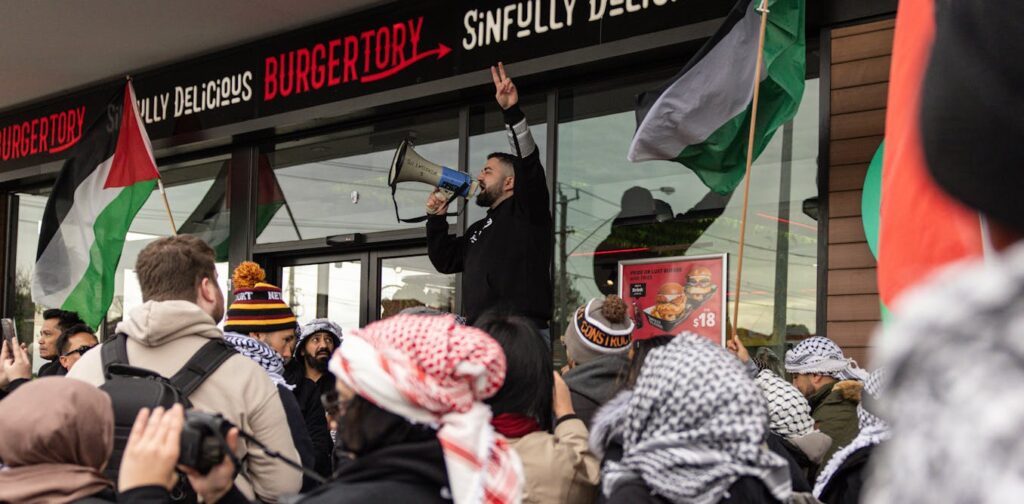
As both federal and state governments across Australia enact laws to combat hate speech, the debate over the boundaries of permissible speech continues to intensify. In a landmark decision, the Victorian Civil and Administrative Tribunal (VCAT) has set a precedent by ruling that chanting “all Zionists are terrorists” at a Melbourne rally constitutes unlawful racial and religious vilification.
The case, known as Vorchheimer vs Tayeh, was presided over by Vice President Judge Tran, who determined that initiating such a chant at a pro-Palestinian protest violated sections of Victoria’s Racial and Religious Tolerance Act. This ruling offers a detailed perspective on how the judiciary is navigating these complex issues.
Understanding the Tribunal’s Findings
The tribunal’s focus was not on Zionism or Israel’s military actions but rather on whether the chant “all Zionists are terrorists” at a large Melbourne rally could incite “hatred, serious contempt, revulsion, or severe ridicule” against Jewish people based on racial or religious grounds. Judge Tran concentrated on three key words: “terrorists,” “Zionists,” and “all.”
Judge Tran described “terrorists” as “one of the most extremely negative labels it is possible to attach to a person,” suggesting that it implies societal acceptance of hatred and justification for violent action. While acknowledging that “Zionist does not mean Jew,” the tribunal recognized a “deep connection with Jewish people” historically and statistically. Evidence presented showed that most Australian Jews identify as Zionists, leading Judge Tran to conclude a “very strong association” between Zionists and Jewish people in the minds of rally participants.
The use of “all” was particularly significant, as it suggested “de-individuation, a hallmark of racism,” allowing no room for nuance or human complexity. The tribunal considered the rally’s full context, including Holocaust imagery and antisemitic tropes on placards. These elements, though not explicitly naming Jews, reinforced the association between “Zionists” and Jewish identity.
Political Speech vs. Personal Attack
The tribunal emphasized that the Racial and Religious Tolerance Act does not aim to outlaw criticism. Hasheam Tayeh, who led the chant, argued it was a form of political protest. However, the tribunal ruled that there is “no right to a catchy rally slogan” if it inherently incites hatred. The chant targeted “all supporters of the continued existence of Israel as a Jewish state,” which, given the tribunal’s findings, likely stirred hostility toward a group closely associated with Jewish identity.
The political protest defense failed as the conduct was not shown to be reasonable and in good faith. The ruling clarifies that while ideas may be attacked, speech that stirs hostility against people based on their identity is not protected.
National Implications of the Ruling
The Victorian tribunal’s decision sets a clear doctrinal boundary: labeling a group closely associated with Jewish identity as “terrorists” can constitute unlawful vilification. Although this ruling applies only within Victoria, its reasoning is likely to influence national discourse.
Most Australian jurisdictions have laws against racial vilification, and at the federal level, section 18C of the Racial Discrimination Act sets a lower threshold for conduct likely to “offend, insult, humiliate or intimidate” on racial grounds. The decision comes amid a noticeable increase in antisemitic incidents across Australia since late 2023, with community organizations reporting unprecedented levels of threats, vandalism, and intimidation.
The Bondi terror attack, targeting a Hanukkah gathering, heightened national concerns about extremist rhetoric and community safety.
In this climate, courts are increasingly tasked with distinguishing between protest and incitement.
Words in Context
This ruling contrasts with a previous Federal Court decision in Wertheim v Haddad, where certain lectures by preacher William Haddad were found to convey antisemitic imputations, such as claims that Jews control the media and politicians. However, other remarks criticizing Israel and “Zionists” were treated as political commentary.
Judge Tran’s approach in the Victorian case did not treat “Zionist” as an abstract ideological label but examined its function within social and historical contexts, particularly the antisemitic atmosphere of the rally. This highlights a judicial approach that considers the real-world impact of language.
Context with Consequences
The ruling contributes to the ongoing debate on regulating hate speech in Australia, demonstrating that existing laws can address coded vilification, not just explicit slurs. The tribunal was careful to note that criticism of Israel is not unlawful, nor is opposition to Zionism automatically considered hate speech.
The legal boundary is crossed when rhetoric assigns a heinous criminal identity to an entire class of people associated with a racial or religious group, especially when hatred is the likely outcome. In a polarized environment, this boundary will remain contested. However, this decision signals that courts will look beyond labels to evaluate how language operates in context, recognizing that in the real world, context can have tangible consequences.