




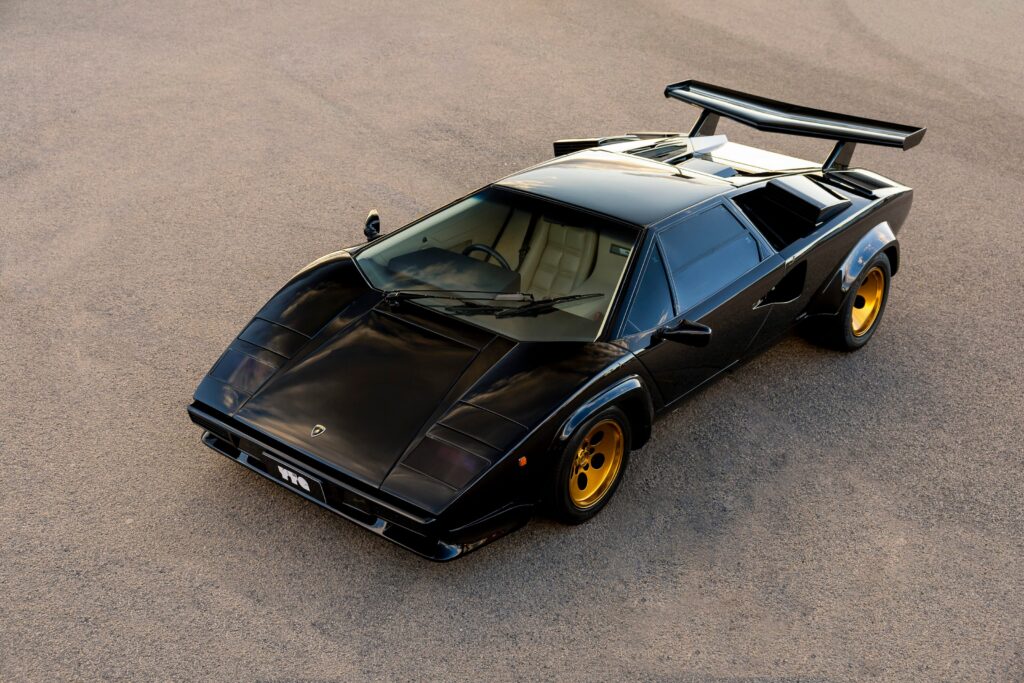
Supercars typically have a fleeting presence in the automotive world, their allure often fading as quickly as it emerges. However, Lamborghini’s Countach defied this norm, remaining in production for an impressive 16 years. Introduced at the 1971 Geneva Motor Show, the Countach’s debut was closer in time to the Ford Model T than to today’s automotive innovations. Yet, even now, it commands attention, its radical design more striking than ever amidst today’s conservative car aesthetics.
The Countach’s compact form, much shorter than a modern Toyota 86, and its unique blend of flat planes and muscular curves, represent a design language that has become rare in contemporary car design. Its styling is a testament to a bygone era, where boldness and extremity were celebrated. To understand the Countach’s significance, one must first consider its predecessor, the Miura, which established Lamborghini’s reputation for audacious styling.
The Legacy of the Miura and the Birth of the Countach
The Miura was not the first supercar, nor the first mid-engined coupe, but it taught Lamborghini a valuable lesson: extremity sells. Designed by Marcello Gandini, the Miura’s proportions were rumored to have been influenced by Giorgetto Giugiaro, with Gandini refining the final details. The success of the Miura set the stage for the Countach, which required a revolutionary approach both in design and manufacturing processes.
Ferruccio Lamborghini realized that to surpass the Miura, the company needed to innovate. Prior to the Countach, Lamborghini’s vehicles were assembled at various locations, with bodies fabricated by external coachbuilders and technical components built in-house. This changed with the construction of new factory buildings in 1968, allowing for a more integrated production process.
Design Revolution and Engineering Challenges
The Countach’s development marked a seismic shift in design ethos. As Gandini explained in a 2021 interview, “The original mechanical setting of the Miura conditioned its shape while with the Countach it was the opposite: the shape conditioned the mechanics.” Chief Engineer Paolo Stanzani developed a complex semi-monocoque spaceframe for the LP500 prototype, addressing the Miura’s shortcomings in weight distribution and aerodynamic stability.
The LP500 prototype, unveiled at the 1971 Geneva Show, was initially met with skepticism. Many considered it an impractical fantasy destined for museums. However, Lamborghini’s persistence paid off, and the Countach evolved from a show car to a production model, with significant engineering refinements along the way.
Evolution of a Supercar Icon
The first production Countach, the yellow LP400, debuted at the 1974 Geneva Show. It featured numerous changes from the prototype, including a smaller 3929cc V12 engine for durability reasons. The LP400’s design was further refined with integrated brake cooling ducts and a unique three-pane window layout, addressing the challenges of its extreme tumblehome.
Despite financial struggles, Lamborghini found a benefactor in Canadian businessman Walter Wolf, whose modifications to his Countach influenced the design of the 1978 LP400 S model. This iteration featured a more aggressive styling direction, with wider wheels and fender flares, setting the stage for future models.
Technological Advancements and Market Competition
In 1982, Lamborghini introduced the Countach LP500 S, with a larger 4.8-litre V12 engine. This update was crucial as Ferrari prepared to launch the Testarossa, which boasted a class-leading 287kW. Lamborghini’s response was the Countach LP5000 QV, featuring a four-valve cylinder head and increased power output, solidifying its place as a formidable competitor.
The LP5000 QV’s 335kW at 7000rpm and 500Nm at 5200rpm marked a significant leap in performance, making it the ultimate Countach iteration for many enthusiasts.
The Countach’s Legacy and Cultural Impact
The Countach’s influence extended beyond its technical achievements. It became a cultural icon, a poster car for a generation, and a symbol of automotive aspiration. Despite initial skepticism, the Countach proved its mettle on the road and track, with media outlets eventually acknowledging its capabilities.
As the Countach evolved, it faced competition from Ferrari’s Testarossa, but it held its ground, often outperforming its rival in acceleration and handling tests. The Countach’s enduring appeal is reflected in its current market value, with collectors recognizing its rarity and significance.
“No other car before or since has ever captivated so many people and seduced them with the magic of what a car could do, could be and could represent,” a testament to the Countach’s lasting impact.
Today, the Countach stands as a testament to Lamborghini’s daring vision and commitment to pushing the boundaries of automotive design. Its legacy continues to inspire, reminding us of a time when cars were not just modes of transportation, but expressions of art and innovation.