




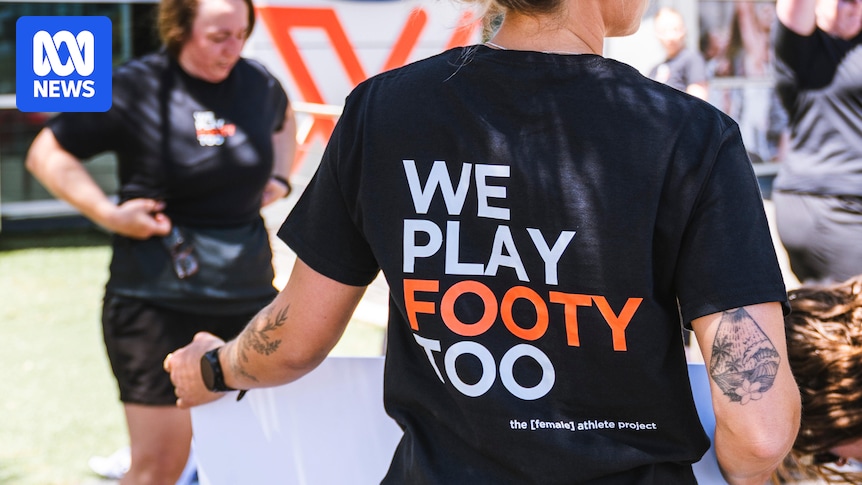
After a public saga lasting more than a year, the women’s football team formerly known as the Kyneton Women’s Football Club has been green-lit to play in the Central Victorian Football League (CVFL). This decision marks a significant victory for the group of more than 30 Victorian women who defected from the Kyneton Football Netball Club in late 2024, citing a “horrible, volatile environment.” They were left in limbo with nowhere to play for the 2025 season.
Denied entry into three local leagues last season, the AFL has now announced that they can join the CVFL under a new name, the Wedge-Tailed Eagles Football Club. This development comes at a time when women and girls are playing footy in record numbers, yet many are dropping out or being turned away due to negative experiences at local clubs.
The Broader Context of Gender Inequality in Sports
The announcement follows widespread reports of gender inequity in sports. Wedge-Tailed Eagles club president Natalie Korinfsky revealed that their story resonated with many across the country. “We were contacted by people from clubs across the country — women, men, and gender-diverse people, players, coaches, and volunteers — sharing similar stories of exclusion, inequity, and powerlessness,” Korinfsky said.
“It felt as though the first article had lifted the lid on something that had existed for a long time but was rarely spoken about openly,” Korinfsky noted.
Despite the growing participation of women in sports, a new report from Federation University and Victoria University highlights the challenges they face. The study, which interviewed 15 Australian women and girls, found that while participation rates are increasing, retention rates remain much lower than for men and boys.
Expert Insights on Gender Disparities
Rochelle Eime, a professor of sport science at Federation University and author of the report, explained that many clubs have not adapted to the inclusion of women. “These clubs were traditionally male-only clubs. They were set up by males for males, and there’s some of the older generations who don’t maybe accept that they’re a space and a place and environment for women and girls now,” Eime told ABC Sport.
“They want to still be the boys’ club. And sometimes, there’s a prioritisation for the boys and the men that they get the best fields and courts and coaching, and the girls sort of get whatever’s left,” Eime added.
The Change Our Game State of Play survey further underscores these issues. More than a quarter (28 percent) of women playing community sport considered leaving their club due to inequitable treatment. Of the 670 Victorians canvassed, over half reported gendered discrimination, and 55 percent experienced or witnessed sexist language and jokes.
Challenges on the Ground
On the ground, the challenges are palpable. A local player from Melbourne, who wished to remain anonymous, shared her experiences with the ABC. She described the disparity in treatment between men’s and women’s teams, noting that men often dominated training spaces. “The men just run into our side [anyway], not really giving a f***,” she said.
Sophie Ulcoq, a player at North Brunswick Football Club, echoed these sentiments. She highlighted issues such as late fixture releases and inequitable resource allocation. “I wouldn’t even know where to go if I needed to talk to someone about issues,” Ulcoq said.
The Path Forward
Korinfsky emphasized that the biggest barrier to women’s sport is not participation but governance. “Women and girls are already showing up in record numbers. The barrier is governance; the policies, structures, and cultural assumptions that have not evolved at the same pace as the game itself,” she stated.
“When we turn up to play sport in our communities, we deserve to know the environment is safe, respectful, and equitable. That is not a big demand. It is a basic right,” Korinfsky asserted.
The Kyneton women’s story is emblematic of a broader struggle for gender equality in sports. It raises questions about whether women and gender-diverse people truly have the same freedom to shape their sporting futures as their male counterparts.
Looking Ahead
As the Wedge-Tailed Eagles prepare to take the field, their journey underscores the need for systemic change in community sports. The hope is that their story will inspire others to advocate for a more inclusive and equitable sporting environment.
Community sport is for everyone, and ensuring that this principle is reflected in practice, not just policy, remains a challenge for the future. The Kyneton women’s team has taken a significant step forward, but the journey for equality in sports continues.