




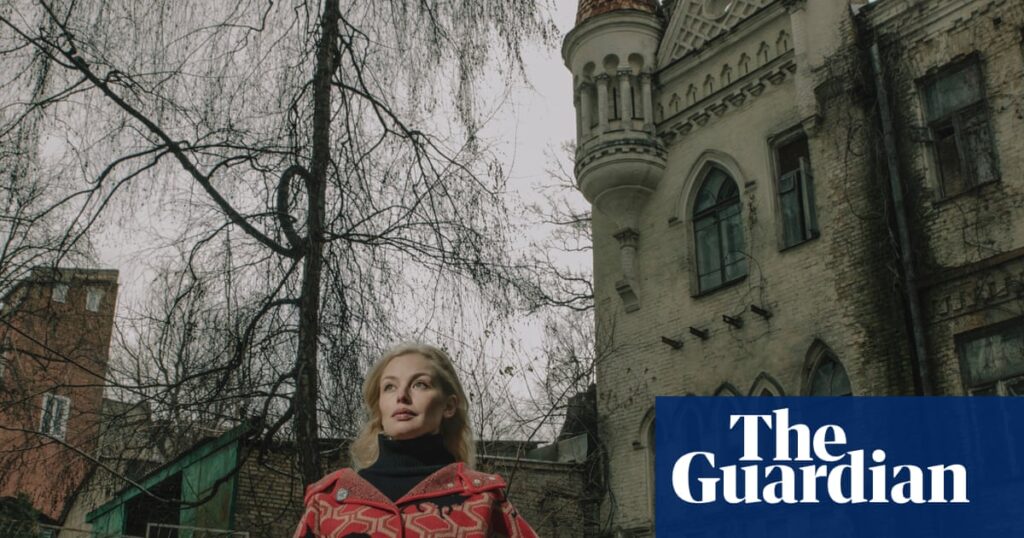
Lesia Danylenko proudly displayed her newly restored front door, a symbol of resilience in the heart of Kyiv. Volunteers affectionately dubbed its transom window the “croissant” due to its elegant curve. “I think it’s more of a peacock,” she mused, admiring the intricate branch-like details. This restoration, part of a broader project to revive one of Kyiv’s early 20th-century art nouveau houses, was celebrated by residents with two lively pavement parties.
For Danylenko, this was more than a renovation; it was an act of defiance against the ongoing Russian aggression. “We are trying to live like normal people despite the war,” she explained. “It’s about arranging our life in the best possible way. We’re not afraid of staying in Ukraine. I could have left the country and moved away to Italy or Germany. Instead, I’m here. The new entrance shows our commitment to our homeland.”
Preserving Heritage Amid Conflict
Saving Kyiv’s architectural heritage might seem paradoxical when Russian missiles and drones frequently target the capital, causing widespread devastation. Since early 2025, the Kremlin has intensified its aerial assaults. After each attack, workers rush to board up shattered windows with plywood, striving to salvage what remains of residential buildings.
Amidst this turmoil, a dedicated group of activists is determined to preserve the city’s historic mansions, built in the distinctive style known as Ukrainian modernism. Danylenko’s home, located in the central Shevchenkivskyi district, was constructed in 1906 for a wealthy fur dealer. Its facade is adorned with horse chestnut leaves and delicate camomile flowers, symbols of Kyiv’s rich history.
“They are symbols of Kyiv. These properties are quite rare nowadays,” Danylenko remarked.
Challenges Beyond the Battlefield
However, Russian aggression is not the only threat to Kyiv’s architectural treasures. Preservation campaigners face challenges from unscrupulous developers eager to demolish listed buildings, corrupt officials, and a governing class often indifferent to the city’s cultural legacy. The harsh winter climate further exacerbates these challenges.
Dmytro Perov, an activist with the Heritage Kyiv group, voiced his concerns: “Kyiv is a city where money wins. We don’t have real political will to save our heritage.” He criticized the city’s mayor, Vitali Klitschko, alleging connections with developers who destroy important buildings. “Klitschko lives in an illegal building with a striptease club. His vision for the capital comes straight out of the 90s and Tony Soprano,” Perov alleged. Klitschko denies these claims, attributing them to political adversaries.
Perov highlighted the absence of many civic-minded activists who once defended Kyiv’s historic properties. Many are now on the frontlines or have been casualties of the war. The prolonged conflict has strained financial resources, even influencing judicial decisions that favor questionable new developments.
“The longer this goes on, the more we see degradation of our society and governing institutions,” Perov argued.
The Battle for Kyiv’s Soul
Perov guided observers to one of the most glaring demolition sites in the Podil neighborhood. Once home to classical 19th-century houses, the area now faces rapid transformation. A developer had pledged to preserve the brick facade of one property, only for diggers to tear it down a day after Russia’s 2022 invasion. Recently, a crane was seen excavating the foundations for a new shopping and business center, under the watchful eye of a security guard.
Anatolii Pohorily, another Heritage Kyiv supporter, expressed little hope for the remaining turquoise-painted houses. Developers often demolish old properties under the guise of “archaeological research.” The Soviet era also inflicted significant damage on Kyiv, reconstructing its Khreshchatyk thoroughfare post-World War II to accommodate tanks and military parades.
Carrying the Torch of Preservation
Serhiy Mironov, a prominent advocate for Kyiv’s historic buildings and a tour guide, was killed in 2022 while fighting in Bakhmut. His colleague, Nelli Chudna, continues his preservation efforts alongside other volunteers. Originally, Kyiv boasted 3,500 brick-built mansions, many constructed for affluent sugar barons. Today, only 80 of their original doors remain.
“It wasn’t Russian rockets that got rid of them. It was us,” Chudna lamented. “The war could go on for another 20 years. If we don’t defend architecture now, nothing will be left.”
Chudna recently aided in restoring a characterful, creeper-covered house built in 1910, now serving as the headquarters of her True Kyiv organization. The building, with its new red door and authentic railings, doubles as a film set and museum, showcasing period bathrooms and antique mirrors.
The building’s tenant, artist Yurii Pikul, described his home as “very cool and a little bit cold.” Reflecting on why many Ukrainians may not value their architectural past, he noted, “Unfortunately, they lack education and taste. It’s all about business. We are trying as a country to go to the west. But we are still some distance away from civilization.” Soviet-era mindsets persist, with a reluctance to take personal responsibility for the built environment.
As Kyiv continues to navigate the challenges of war and preservation, the city’s architectural heritage stands as a testament to resilience and cultural pride, offering a glimpse into a past that many are determined to protect for future generations.