


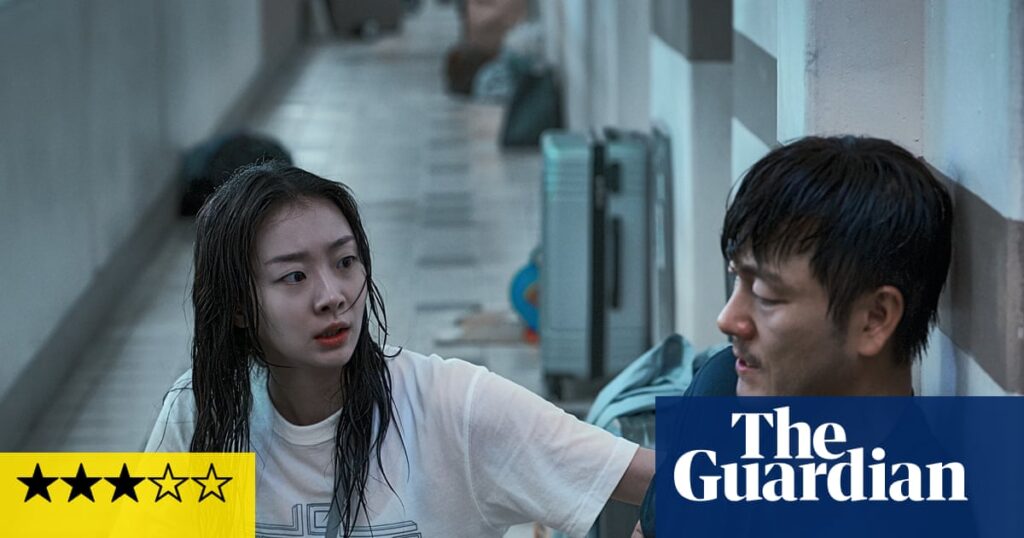
Kim Byung-woo’s latest cinematic venture, “The Great Flood,” initially presents itself as a conventional apocalypse narrative. Set against the backdrop of a deluge consuming Seoul, the film quickly shifts gears, delving into complex themes of social stratification and sinister scientific undertones. As the waters rise, a beleaguered mother, An-na, portrayed by Kim Da-mi, attempts to escape her 30-story apartment block, only to reveal her pivotal role in a groundbreaking research project.
The film’s transformation is marked by the revelation of An-na’s true identity as a second-ranking science officer. This narrative pivot leads the audience into a labyrinthine plot that intertwines elements of science fiction with apocalyptic drama. As the story unfolds, An-na’s son, Ja-in, played by Kwon Eun-seong, experiences a surreal fulfillment of his swimming dreams amidst the flooding chaos. Their desperate climb is interrupted by Hee-jo, a corporate security officer, who unveils the catastrophic cause: an asteroid impact in Antarctica triggering civilization-ending rains.
The Sci-Fi Shift and Cinematic Influences
As the characters ascend to the rooftop, the film’s direction shifts dramatically. The revelation of An-na’s involvement in a secret UN lab, crucial to humanity’s survival, propels the narrative into a speculative realm. This transformation bears the hallmarks of influences from films like “Edge of Tomorrow” and Christopher Nolan’s “Interstellar,” with its mega-tsunamis and melancholic tone.
Kim Byung-woo’s storytelling draws heavily from these cinematic predecessors, crafting a recursive narrative that challenges traditional apocalyptic tropes. The film’s exploration of emotional calibration in response to relooping events suggests a commentary on the future of entertainment, particularly in the context of algorithm-driven content.
Algorithmic Entertainment and Human Fallibility
The film’s thematic exploration extends beyond its sci-fi veneer, probing into the realm of algorithmic entertainment. As An-na encounters various characters, including a girl trapped in a lift and a woman in labor, her initially selfish reactions undergo a transformation. This narrative device hints at the possibility of calibrating emotional responses, aligning with the film’s Netflix Original identity.
However, the storytelling occasionally falters, particularly in its failure to establish a clear antagonist. This narrative gap underscores the persistence of human fallibility, even in an optimized future. Kim’s reluctance to fully condemn this future suggests a deeper complicity with the very systems the film critiques.
Implications and Future Perspectives
“The Great Flood” presents a multifaceted narrative that challenges viewers to reconsider the boundaries of apocalyptic storytelling. By merging elements of sci-fi and social commentary, Kim Byung-woo crafts a film that is as much about the future of humanity as it is about the evolution of cinematic experiences.
As audiences grapple with the film’s complex themes, “The Great Flood” invites reflection on the role of technology and human agency in shaping our collective future. The narrative’s recursive structure and thematic depth position it as a significant contribution to the genre, prompting discussions on the implications of algorithmic entertainment and the enduring nature of human imperfection.
In conclusion, Kim Byung-woo’s “The Great Flood” stands as a thought-provoking exploration of apocalyptic narratives, enriched by its sci-fi elements and commentary on the future of entertainment. As the film reaches its climactic moments, it leaves viewers contemplating the delicate balance between technological advancement and human emotion, a theme that resonates deeply in today’s rapidly evolving digital landscape.