
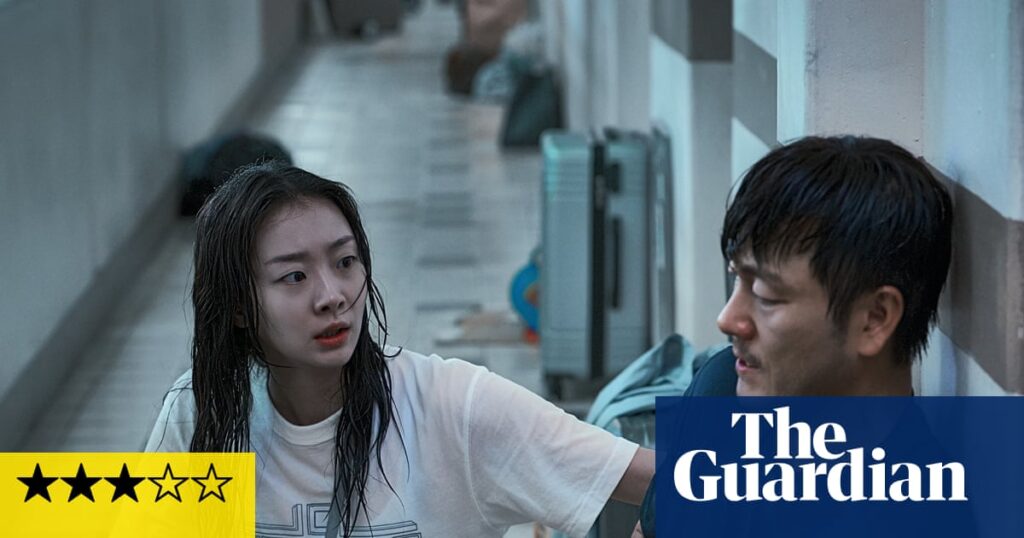
Kim Byung-woo’s latest feature, The Great Flood, begins as a seemingly conventional apocalypse movie, with a catastrophic deluge engulfing Seoul. However, as the narrative unfolds, it transitions into a sinister sci-fi thriller, exploring themes of social stratification and human survival. The film’s protagonist, An-na, portrayed by Kim Da-mi, is a second-ranking science officer embroiled in a high-stakes research project that holds the key to humanity’s future.
The film opens with An-na and her son, Ja-in, played by Kwon Eun-seong, facing the overwhelming floodwaters. Initially, Ja-in’s fascination with swimming seems trivial, but it quickly becomes a survival skill as they navigate their inundated apartment building. Their escape is interrupted by Hee-jo, a corporate security officer, who reveals that an asteroid impact in Antarctica has triggered the apocalyptic rains threatening civilization. Yet, salvation appears in the form of a helicopter, dispatched to evacuate An-na and her son due to her crucial role in a clandestine UN lab.
A Shift from Apocalypse to Sci-Fi
As the narrative progresses, the film veers into unexpected territory. Upon reaching the rooftop, An-na’s involvement in the secretive research project becomes clear, transforming the storyline into a complex sci-fi narrative. Kim Byung-woo draws inspiration from films like Edge of Tomorrow and Interstellar, weaving a tale that challenges viewers’ perceptions of reality and time.
Kim’s storytelling technique, reminiscent of Charlie Kaufman’s intricate narratives, invites audiences into a labyrinthine plot where the boundaries of time and space are blurred. This narrative choice reflects a broader trend in contemporary cinema, where filmmakers explore existential themes through the lens of science fiction.
Exploring Human Emotion in a Digital Age
As An-na navigates her new reality, the film delves into the emotional complexities of human interaction. Her initial reactions to those she encounters—a girl trapped in an elevator, a woman in labor—are recalibrated, suggesting a commentary on the nature of emotional responses in a world increasingly dominated by technology.
This thematic exploration aligns with the film’s release as a Netflix Original, hinting at a future where entertainment is tailored to individual emotional responses. The narrative suggests that our engagement with digital content may become increasingly algorithmic, raising questions about the authenticity of human emotion in a technologically advanced society.
The Future of Entertainment and Humanity
While The Great Flood offers a gripping sci-fi narrative, it also serves as a reflection on the future of entertainment. The film’s recursive storytelling and reliance on digital effects mirror the evolving landscape of media consumption, where algorithms play a significant role in shaping viewer experiences.
“The often brittle storytelling, especially the failure to designate a helpful antagonist, does suggest human fallibility is alive and well, though. Or perhaps this reluctance to condemn our optimised future means Kim is already complicit to the nth degree.”
This observation highlights the tension between human creativity and technological advancement, a theme that resonates throughout the film. By embracing this duality, Kim Byung-woo crafts a narrative that is both a cautionary tale and a celebration of the possibilities that lie ahead.
As audiences engage with The Great Flood, they are invited to consider the implications of a future where entertainment and reality are increasingly intertwined. The film challenges viewers to reflect on their own emotional responses and the role of technology in shaping their perceptions of the world.
In conclusion, The Great Flood is a bold exploration of the intersection between apocalypse and science fiction, offering a thought-provoking commentary on the future of humanity and entertainment. As Kim Byung-woo navigates these complex themes, he invites audiences to ponder the evolving relationship between technology and emotion, leaving them with much to consider long after the credits roll.