



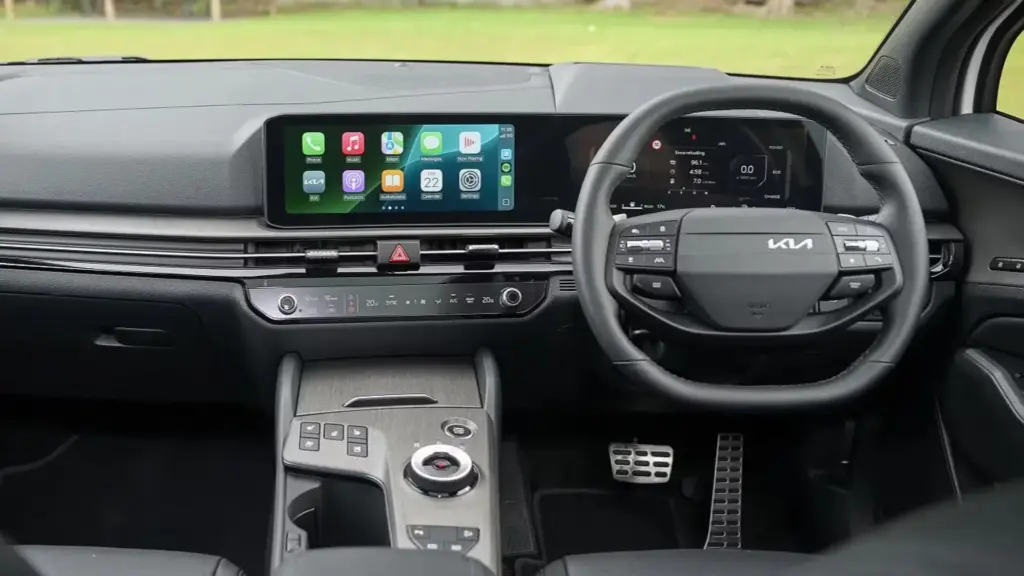
The Korean automotive giant Kia has announced its commitment to maintaining physical buttons for essential controls in its vehicles, even as it embraces larger touchscreens and advanced technology. The decision reflects a strategic balance between innovation and user safety, as articulated by Jochen Paesen, Kia’s interior design chief, in a recent interview with Autocar.
“There are certain functions you need to find straight away and you don’t want to mess up, so we keep them physical. Now we’re learning from that to increase the digital and experiential component,” Paesen stated, highlighting the company’s approach to integrating technology without compromising on user accessibility.
Industry Trends and Kia’s Unique Approach
As the automotive industry increasingly shifts towards touchscreens for controlling vehicle functions, many manufacturers have moved away from physical buttons. Some brands have even adopted touch-sensitive controls on steering wheels. However, Kia’s decision to retain physical shortcuts sets it apart from several of its competitors.
“There are brands that get away with just digital and it works for them, but Kia sells globally and we have studios that research markets everywhere, and when you bring it all back together, it’s quite simple: we’re all the same,” Paesen explained. This global perspective informs Kia’s design philosophy, ensuring that the vehicles meet the diverse needs of their international customer base.
The Balance of Technology and Usability
Paesen emphasized the importance of user-friendly interfaces, noting that overly complex menu systems can be frustrating and potentially dangerous. “If to get to a function you have to go down three steps [in a menu], that’s bad for everybody,” he remarked. This sentiment underscores Kia’s commitment to intuitive design, where essential functions remain easily accessible.
“In the future, when you will have more features, how does the car go from being a tool where you have to learn how to use it to actually helping you and make sure tasks take fewer steps? Nobody has cracked it yet, but that’s the way we try to look at it.”
Learning from Global Innovations
Paesen acknowledged the influence of Chinese automotive brands, which have been at the forefront of introducing novel features that enhance the driving experience. “Chinese brands are pushing ideas where you go ‘I didn’t know I needed that’,” he noted, while also recognizing the element of novelty in such innovations.
Despite these advancements, Paesen cautioned against over-reliance on touchscreen interfaces, particularly for critical functions like air-conditioning controls. “Having HVAC [air-conditioning] controls [on the touchscreen] doesn’t really make sense. It’s perfectly fine when the car is stationary, but when it’s driving you should be able to grab it without noticing it,” he argued, emphasizing the importance of safety in design.
Future Implications for Kia and Hyundai
This commitment to a hybrid approach in vehicle controls is expected to influence future models from both Kia and Hyundai, as they share the same parent company. By maintaining a mix of physical and digital controls, these brands aim to cater to a wide range of consumer preferences while prioritizing safety and usability.
As the automotive landscape continues to evolve, Kia’s strategy highlights the ongoing challenge of integrating cutting-edge technology with practical, user-centric design. The company’s approach serves as a reminder that while innovation is crucial, it should never come at the expense of driver safety and convenience.