



After the body of 24-year-old Rani Gvili was returned to Israel from Gaza this week, the territory now holds no hostages from the October 7 massacre after two-and-a-half years. Returning all hostages was a significant objective of the Netanyahu government to bring an end to the war. However, this pivotal moment raises questions about the future direction.
Uncertainty looms over the administration of the Gaza Strip, with sticking points on key issues such as Hamas’s disarmament and the withdrawal of Israeli Defense Force assets. The question remains: has the war truly ended?
Fragile Truce and Ongoing Violations
Earlier this month, the White House announced that the fragile truce in Gaza had entered its next phase, three months after being agreed upon by Israel and Hamas. Both sides have accused each other of repeatedly violating the deal. Since the truce came into force on October 10 last year, Palestinian health authorities report that 488 people have been killed in Gaza, and 1,350 have been injured due to Israeli attacks.
In the same period, four Israeli soldiers were killed by Hamas, and the Israeli government had insisted it would not advance the deal until Hamas returned the bodies of all its hostages.
This process concluded on Monday with the discovery of Gvili’s remains in a cemetery in the east of Gaza City. The ceasefire’s progression is now contingent upon the next steps in the demilitarization process.
Driving Forces Behind the Next Phase
At the World Economic Forum in Davos last week, Jared Kushner, former President Donald Trump’s son-in-law, outlined the plan for “New Gaza,” featuring glossy images of skyscrapers along the Gaza coastline. Kushner, involved in the ceasefire negotiations, emphasized the role of the new Palestinian technocratic government appointed to run the strip.
“We have a new government in Gaza; this government will be working with Hamas on demilitarization to truly advance the principles agreed upon,” Kushner stated. The process will be managed by the National Committee for the Administration of Gaza (NCAG).
Hamas spokesman Hazem Qasem confirmed the group’s willingness to cooperate with the new government. “Hamas is genuinely interested in handing over power to this independent committee,” he said, although he acknowledged that much work remains to achieve disarmament.
Hamas’s Disarmament: A Complex Challenge
As part of Trump’s 20-point plan to end the war, an international stabilization force is proposed to deploy to Gaza. However, Qasem expressed that the idea of this force handling Hamas’s weapons is unacceptable. “This must be resolved through internal national agreement and dialogue,” he asserted.
“These arms are legitimate according to international law to protect our Palestinian people,” Qasem emphasized, highlighting the need for internal Palestinian discussions.
Responsibility for disarming Hamas falls to Palestinian police under the NCAG’s auspices. Jordan and Egypt have been identified as trainers for these officers. However, contention remains over which countries will comprise the stabilization force.
Progress and Remaining Challenges
While demilitarization remains a sticking point, progress has been made in other areas. The head of the NCAG, Ali Shaath, announced the reopening of the Rafah border crossing between Gaza and Egypt, the only entry and exit point not leading into Israel.
Israeli Prime Minister Benjamin Netanyahu faced pressure to keep Rafah closed until the return of the final Israeli hostage. With Gvili’s discovery, Netanyahu insists disarming Hamas is now the priority.
Israel continues to control over 50% of the strip, marked by the Yellow Line. Palestinians crossing it are often labeled “suspicious” by the Israeli military, with some shot, including children.
Hamas accuses Israel of moving the Yellow Line further into Gaza, seizing more land. Satellite imagery supports these claims, complicating the phased withdrawal of Israeli forces.
Local Perspectives and Future Prospects
On the ground in Gaza, skepticism abounds regarding the next phase. Muhammed Abu Alqumsan, a 25-year-old resident, expressed doubts about the tangible effects of phase two. “Until now, all that is in the media is just words on paper,” he said.
Ahmad Jalal, 38, anticipates the opening of the Rafah crossing. “We were waiting for the Israeli army to withdraw from new locations, for freedom of movement for the sick and wounded,” he noted, highlighting the unmet expectations.
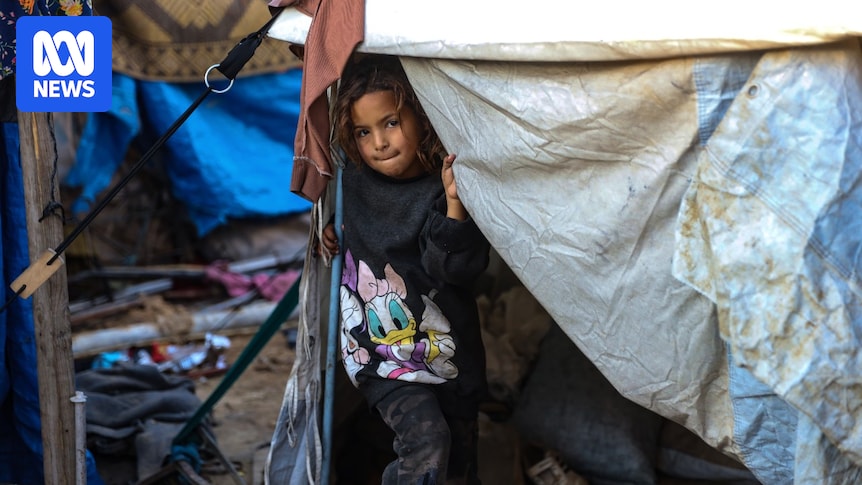
Israel has rejected claims from humanitarian agencies about blocking essential supplies. However, UNICEF confirmed the entry of learning kits for Palestinian children, a first in two years.
As the ceasefire enters its next phase, the international community watches closely. The outcomes of ongoing negotiations and the actions of the NCAG will significantly impact the region’s future stability.