

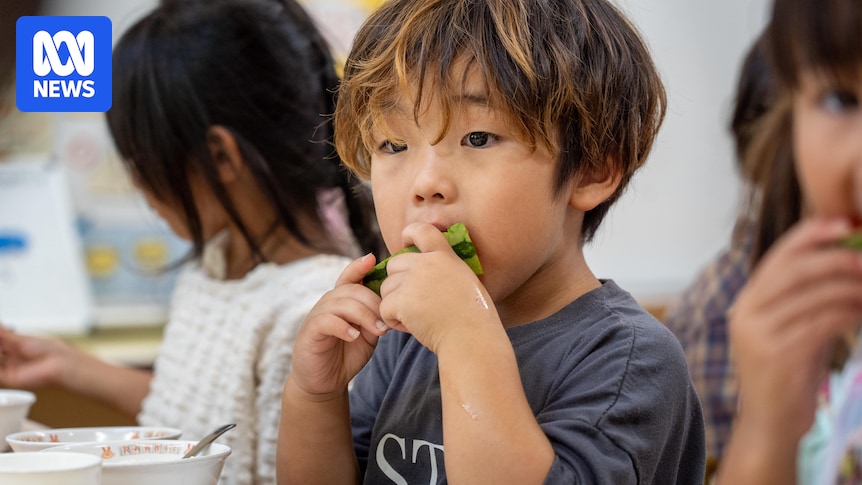
A team of cooks at Tokyo’s Shikama Kodomo En kindergarten is preparing a meal that has been meticulously planned for two months. The menu features chicken with soy sauce, mixed vegetables, and rice, followed by watermelon for dessert. This meal is not just about taste; it represents a carefully calculated balance of proteins, fats, carbohydrates, and essential micronutrients like calcium, iron, and vitamins A, B, and C.
“The exact calculations are based on ensuring that 45 percent of the daily energy intake is provided through school meals,” explains staff nutritionist Natsuko Hattori. Two months before serving, Ms. Hattori submits her menu plans for approval to a local panel that includes nutritionists, principals, and a nurse. Despite the rigorous process, she finds joy in contributing to children’s growth.
The emphasis on nutrition in Japan’s childcare system has drawn international attention, especially when contrasted with the less healthy options often found in other countries. Japan’s approach not only focuses on balanced meals but also on instilling lifelong healthy eating habits in children.
Shokuiku: The Foundation of Japan’s Food Education
Japan’s educational system has long prioritized the importance of quality food, adopting the concept of “shokuiku,” or food education. This philosophy, which has been around for over a century, was formalized in 2005 through laws that apply from childcare centers to aged care homes. The goal is to ensure that children are well-nourished and develop healthy eating habits that last a lifetime.
At Shikama Kodomo En, children are encouraged to try vegetables before moving on to meat or rice. “Even if they take just one bite, they will realize that it tastes good,” says principal Konomu Sawada. This approach not only benefits the children but also raises awareness among parents about healthy eating practices.
Cultural Emphasis on Nutrition
Mika Ikemoto, a childcare expert at the Japan Research Institute, notes that the emphasis on quality food is deeply rooted in Japanese culture. “In Japanese households, it’s taken for granted that mothers provide nutritionally balanced meals,” she explains. This cultural norm contributes to Japan’s low obesity rates, with fewer than one in five children being overweight, compared to much higher rates in other developed countries.
The Crisis of ‘Baby Hotels’ and the Shift to Regulated Childcare
Japan’s current childcare system emerged from a crisis. For years, long waiting lists forced families to rely on unregulated childcare centers, known as “baby hotels,” where standards were often dangerously low. In 2010, the waiting list for public, regulated daycare was over 26,000. The government responded by doubling spending on childcare, reducing the waiting list to just over 2,500 today.
While this expansion has been a relief for working parents, Ikemoto points out that the focus has been more on reversing Japan’s declining birthrate than on the best interests of children. She highlights the need for improvements in caregiver-to-child ratios and mandatory background checks for childcare workers.
Challenges and Comparisons with Australia
Japan’s caregiver-to-child ratios are comparable to those in Australia, with improvements in recent years. However, the ratio increases significantly for older children, which Ikemoto sees as a major issue. Additionally, Japan has been slow to implement mandatory background checks, a move that will finally be addressed by the end of next year.
Despite these challenges, Japan’s system remains a model in many respects, particularly in its emphasis on nutrition and affordability. Childcare is free for children over three, and costs for younger children are income-based, making it accessible to low-income families.
Looking Ahead: The Future of Japan’s Childcare System
Back at Shikama Kodomo En, the children have finished their lunch, and the focus shifts to teaching manners and responsibility. Nutritionist Natsuko Hattori reflects on her role in promoting children’s health. “I feel it is a very important part of my job to be involved in laying the foundation for their health,” she says proudly.
As Japan continues to refine its childcare system, the lessons learned from its journey from unregulated “baby hotels” to a model of nutritional excellence offer valuable insights for other countries grappling with similar challenges.