




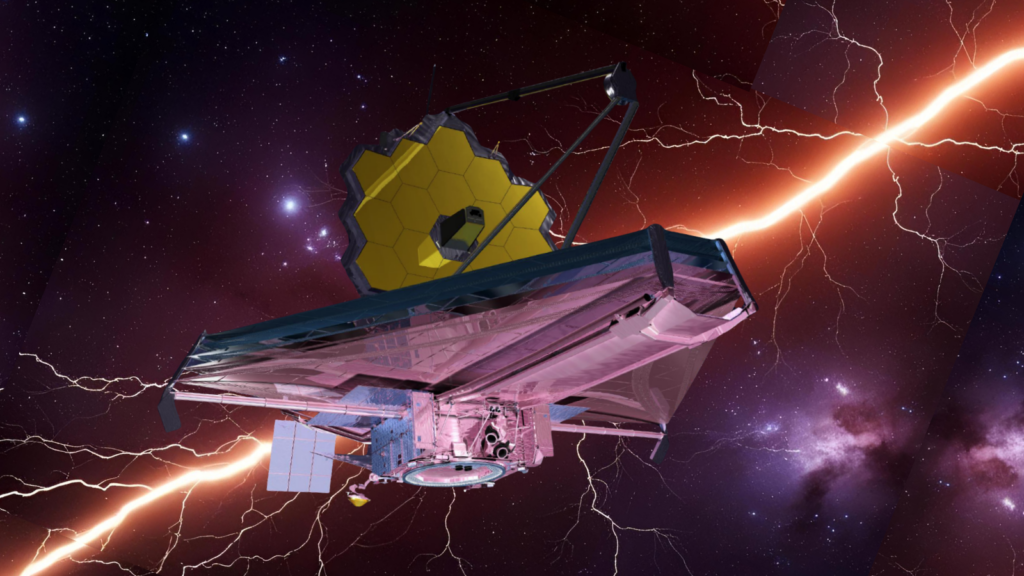
Since its launch in 2022, the James Webb Space Telescope (JWST) has revolutionized our understanding of the universe, particularly shedding light on its early stages. However, the elusive nature of dark matter—an enigmatic substance thought to constitute 85% of the universe’s mass—remains largely unexplored by the telescope. Recent research suggests this may soon change.
Dark matter’s invisibility stems from its lack of interaction with electromagnetic radiation, rendering it undetectable by traditional means. This characteristic indicates that dark matter particles differ fundamentally from the protons, neutrons, and electrons that form the visible universe. Despite numerous hypotheses, the search for a definitive dark matter particle has been elusive.
New Insights from Elongated Galaxies
Scientists infer dark matter’s presence through its gravitational effects on space-time, influencing both ordinary matter and light. A study published in Nature Astronomy proposes that dark matter’s gravitational pull may cause young galaxies to exhibit unexpectedly elongated shapes. Investigating these shapes could help identify the particles constituting dark matter.
According to the research team, studying these elongated galaxies with the JWST might provide crucial insights. “In the expanding universe defined by Einstein’s theory of general relativity, galaxies grow over time from small clumps of dark matter that form the first star clusters and assemble into larger galaxies via their collective gravity,” explained Rogier Windhorst of Arizona State University.
“But now the JWST suggests that the earliest galaxies may be embedded in marked filamentary structures, which—unlike cold, dark matter—smoothly join the star-forming regions together, more akin to what is expected if dark matter is an ultralight particle that also shows quantum behavior.”
Challenges in Simulating Early Universe Galaxies
Simulations of early galaxy formation typically show cool gas coalescing along dark matter webs, forming mostly spheroid galaxies seen in the modern universe. However, JWST observations reveal filamentary, elongated galaxies that challenge these models. To address this, Windhorst and his team explored simulations with alternative dark matter models beyond the widely accepted Lambda Cold Dark Matter (LCDM) model.
Their findings suggest that “fuzzy dark matter,” composed of ultralight axion particles, might explain the elongated galaxies observed by the JWST. “If ultralight axion particles make up the dark matter, their quantum wave-like behavior would prevent physical scales smaller than a few light-years from forming for a while, contributing to the smooth filamentary behavior that JWST now sees at very large distances,” stated Álvaro Pozo of the Donostia International Physics Center.
Exploring Alternative Dark Matter Models
The team’s modeling also indicated that faster-moving “warm dark matter” particles, such as sterile neutrinos, could produce early filamentary galaxies. Both wave dark matter and warm dark matter scenarios suggest that these particles create smoother filaments than cold dark matter, allowing gas and stars to flow along them and form elongated galaxies.
As the JWST continues to explore these peculiar galaxies, researchers on Earth are refining simulations of the early universe. This collaborative effort could ultimately unlock the secrets of dark matter, a goal that has long eluded scientists.
Implications for the Future
The potential to illuminate dark matter’s mysteries represents a significant shift in our understanding of the universe. By combining JWST observations with advanced simulations, scientists hope to identify the elusive particles that make up dark matter. This breakthrough could redefine cosmology and deepen our comprehension of the universe’s fundamental structure.
As the JWST probes further into the cosmos, the scientific community eagerly anticipates new discoveries that could transform our grasp of the universe’s hidden components. The quest to unravel dark matter’s secrets continues, promising to reshape our cosmic perspective.
