



The best kind of Christmas present is one that keeps on giving. Launched four years ago today, the James Webb Space Telescope (JWST) has done exactly that, according to NASA planetary scientist Stefanie Milam. On December 25, 2021, as the world celebrated Christmas, the JWST embarked on a journey that would transform our understanding of the universe.
Milam recalls being at home, closely monitoring mission control at the Goddard Space Flight Center in Maryland. On her TV screen, the $10 billion spacecraft prepared to take off from French Guiana. “You could just feel the pressure building and building,” she says, reflecting on the tension of the moment. The launch was the culmination of 30 years of planning and collaboration between NASA, the European Space Agency, and the Canadian Space Agency.
The Launch and Early Challenges
The JWST’s launch was fraught with delays and complications, not least due to the COVID-19 pandemic. However, early on Christmas morning, the telescope launched successfully, igniting a blaze of excitement among scientists and astronomers worldwide. “Once the launch happened, everything kind of got quiet,” Milam remembers. The successful deployment of the telescope’s solar panels marked the beginning of what was dubbed the “30 days of terror,” as the telescope unfolded its sun shield and journeyed to its final destination.
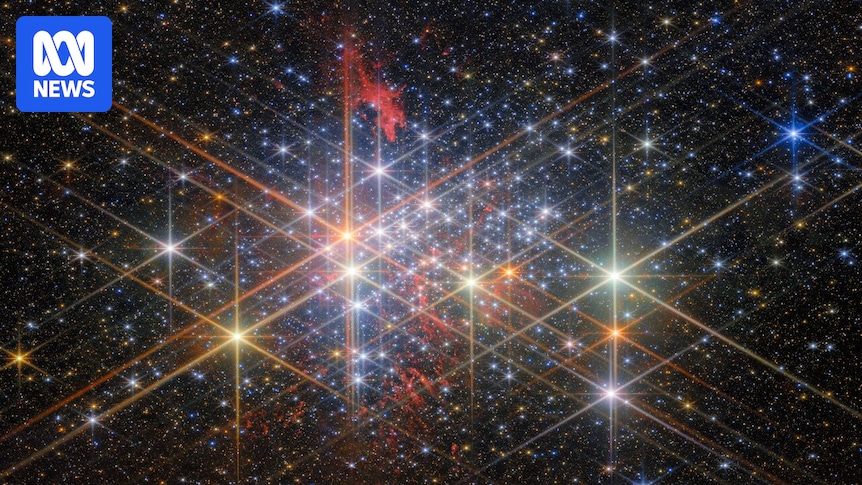
In March 2022, the team released a test image of a star 2,000 light-years away, surrounded by ancient galaxies billions of light-years distant. This image provided a glimpse of the JWST’s capabilities. “It was: ‘Oh my gosh, it’s so beautiful,’ but also, ‘Oh my gosh, this is so much better than we thought,'” Milam says. The telescope’s ability to capture such detailed images exceeded expectations, setting the stage for its future discoveries.
Unveiling the Universe
On July 12, 2022, then-US President Joe Biden unveiled the JWST’s first official image, a dark sky dotted with galaxies from near the dawn of time. Australian astronomer Robin Cook described it as the “closest thing astronomers got to Christmas in July.” The following day, the JWST team released a series of breathtaking images, showcasing the telescope’s power and precision.
Milam, as the JWST’s project manager for policy and science community, was part of the team selecting images for public release. One of the first images she saw was the planetary nebula, a giant bubble of gas surrounding a small star. “It’s just so beautiful and it’s so much better than anything else I’ve ever seen,” she says. The Carina Nebula image, in particular, moved her to tears, symbolizing the culmination of years of hard work and dedication.
Science Behind the Beauty
The JWST’s scientific achievements have been as impressive as its images. The telescope uses two cameras to capture images in the near- and mid-infrared ranges, beyond human vision. This data is processed to create color images and made available in a public database for anyone to explore. One of Milam’s favorite images, capturing Jupiter’s auroras, was processed by a data scientist as a hobby, demonstrating the collaborative spirit fostered by the JWST project.
Each year, the team marks the telescope’s science anniversary with special images, often with an animal theme. These include “The Penguin and The Egg,” depicting two merging galaxies, and “The Cat’s Paw Nebula,” celebrating the JWST’s third science anniversary. Behind these stunning visuals, the JWST has been achieving significant scientific milestones, providing unprecedented views of auroras on Jupiter, Saturn, and Neptune, and studying the rings around Uranus.
Unexpected Discoveries and Future Prospects
The JWST has also provided new insights into the atmospheres of exoplanets, revealing unexpected phenomena. “There are huge planets that are called super puffs,” Milam explains. “They have huge atmospheres, but they’re so close to the star, there’s no reason they should have an atmosphere. It should have been annihilated.”
Perhaps most exciting are the revelations about the early universe. According to cosmologist Karl Glazebrook of Swinburne University, the JWST has detected galaxies that formed between 200 million and 260 million years after the Big Bang, challenging previous assumptions about the universe’s early development. “The Universe was ‘going gangbusters’ much earlier than we thought,” Glazebrook notes, suggesting potential new science about black holes or dark matter.
As the JWST continues its mission, Milam looks forward to solving mysteries like the red dots among galaxies and exploring exoplanet atmospheres in search of an Earth 2.0. “That’s a long time for a scientist,” she says, “but it’s fantastic to think of the next generation coming in and owning that science and new research with a telescope that you once got to play a role in.”
The James Webb Space Telescope, a Christmas gift to humanity, continues to illuminate the cosmos, promising decades of discovery and wonder.