




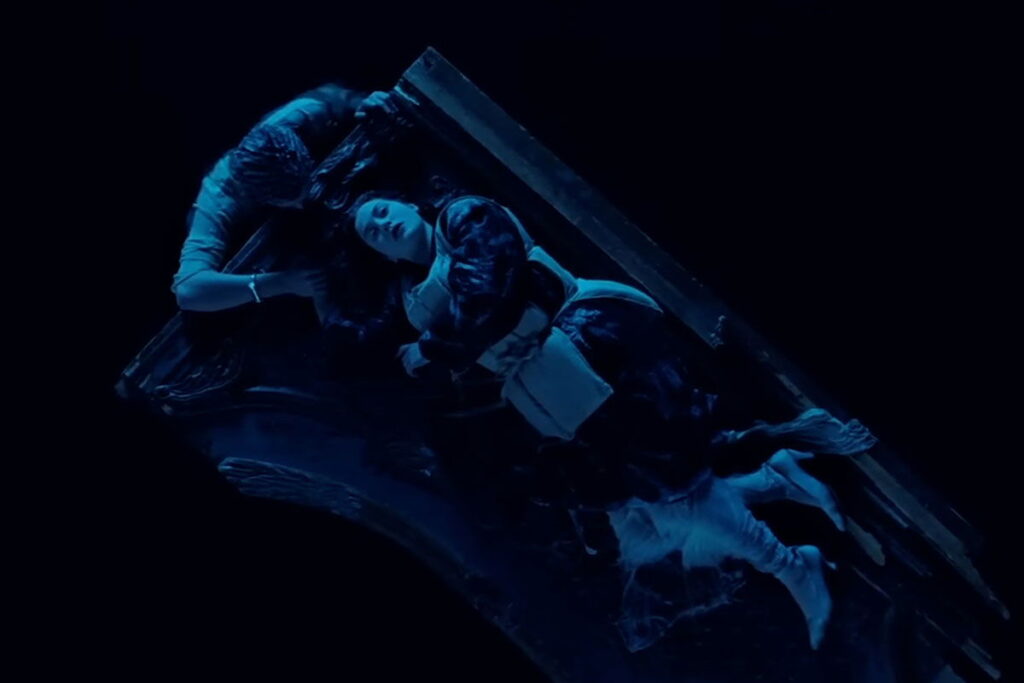
One of the most enduring debates in modern cinema has finally been put to rest. James Cameron, the celebrated director of the 1997 blockbuster “Titanic,” has declared he is done addressing the controversy surrounding the film’s climactic scene. The debate centers on whether both Jack and Rose, played by Leonardo DiCaprio and Kate Winslet, could have survived on a makeshift raft fashioned from a floating door after the ship’s tragic sinking.
The film concludes with Jack sacrificing himself to the icy waters of the Atlantic, ensuring Rose’s survival. Since its release, audiences have argued that the door was large enough to support both characters, sparking endless discussions and theories. In early 2023, Cameron collaborated with National Geographic to create a documentary special aimed at scientifically resolving the issue. The documentary featured a series of experiments to test the viability of two people surviving on the door under the given circumstances.
The Experiment and Its Findings
In a bid to settle the debate once and for all, Cameron employed two stunt performers with similar body dimensions to DiCaprio and Winslet during filming. The team recreated the infamous raft scene in a controlled pool environment, exploring various scenarios to determine if survival for both characters was feasible.
The findings were conclusive. According to the tests, it was virtually impossible for both Jack and Rose to survive on the door, except under a highly unlikely set of conditions. Cameron explained that even if Jack had possessed an expert understanding of hypothermia, which was improbable in 1912, survival would have required extraordinary luck.
“The answer is, if Jack somehow was an expert in hypothermia and somehow knew what science now knows back in 1912, it is theoretically possible, with a lot of luck, that he might have survived. Therefore, the answer is no, he could not have. There’s no way. The conditions were not met. He couldn’t have known those things.”
Cameron’s Final Word
Three years after the documentary, as Cameron wraps up his promotional work for “Avatar: Fire and Ash,” he has made it clear that he will no longer entertain questions about the “Titanic” ending. Speaking on THR’s Awards Chatter podcast, Cameron expressed his frustration, stating, “Don’t ask me about the f—ing raft, people!” He emphasized that despite the extensive efforts to address the question through scientific inquiry, many still refuse to accept the evidence presented.
The announcement comes as “Titanic” continues to hold its place as one of the most successful films in cinematic history. Nearly three decades after its release, the film’s gross of $2.3 billion remains a testament to its enduring appeal, a record only surpassed by Cameron’s own “Avatar” in 2009.
Legacy and Impact
“Titanic” not only captivated audiences worldwide with its compelling narrative and groundbreaking effects but also sparked conversations about historical accuracy and survival scenarios. The film’s success has cemented Cameron’s reputation as a master storyteller capable of blending romance, drama, and historical events seamlessly.
Meanwhile, the debate over the door has become a cultural touchstone, referenced in countless discussions and parodies. It highlights the power of storytelling to engage audiences long after the credits roll, prompting them to question and explore the narrative’s nuances.
As Cameron closes the chapter on this particular debate, “Titanic” continues to inspire new generations of filmmakers and audiences. Its legacy is a reminder of the enduring power of cinema to evoke emotion, provoke thought, and ignite conversation.
With Cameron’s definitive stance, the “Titanic” door debate may finally be laid to rest, allowing fans to appreciate the film for its artistry and emotional depth rather than its logistical details.