
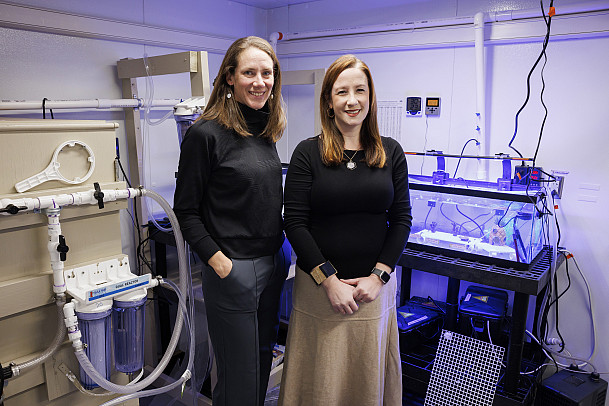
Indiana University Teaching Professor Laura Brown, left and Associate Professor of Biology Julia van Kessel pose for a photo in their “Coral Corral” lab in the Biology Building at IU Bloomington on Thursday, Nov. 6, 2025. (Photo by James Brosher/Indiana University)
In the basement of the Biology Building at Indiana University Bloomington, a groundbreaking effort is underway to combat antibiotic resistance. This pressing issue leads to approximately 2.8 million treatment-resistant infections and 35,000 deaths annually in the United States, according to the Centers for Disease Control and Prevention. At the heart of this initiative are two scientists using small corals in a saltwater tank to spearhead their research.
“A bunch of the corals died last week, which is why we only have three today,” explained Julia van Kessel, an associate professor of biology in the College of Arts and Sciences. She established the coral lab, affectionately known as the “coral corral,” with funding from the National Science Foundation in 2022.
The Fragility and Promise of Coral Research
Corals require a meticulously balanced ecosystem to thrive, making them both a challenge and an opportunity for scientific study. Factors such as the stress of shipment and the pH balance of the water can be fatal to these delicate organisms. Van Kessel and her team vigilantly monitor the lab conditions to ensure the corals’ survival.
This sensitivity is precisely what attracts van Kessel to study coral disease. With oceans experiencing a mass coral reef die-off, the stakes are high. Coral reefs are crucial for marine life, acting as water filtration systems, providing habitats for seafood, and supplying medicinal compounds. The significance of this research also appeals to undergraduates eager to delve into scientific exploration.
Innovative Approaches to Infection Control
Beyond the coral lab, van Kessel co-founded a startup, Quornix, with Laura Brown, a teaching professor of Chemistry. Established in 2023, Quornix aims to market innovative infection-fighting molecules through the study of “quorum sensing,” a process by which bacteria communicate. Their focus is on Vibrio, a marine pathogen harmful to coral, fish, shrimp, oysters, and even humans.
Bacteria sense other bacteria by counting emitted small molecules. When sufficient molecules are detected, they trigger an infection. “Disease is a nutritional strategy; Vibrio are trying to get nutrients from cells they’re infecting,” van Kessel noted. “If you were a bacterium and your goal was to cause disease, would you do it by yourself or wait until you had a bunch of friends around to help you?”
Van Kessel hypothesizes that interrupting quorum sensing could treat or prevent infections without antibiotics. Using research from Brown’s Arts and Sciences Undergraduate Research Experience course, they experiment with compounds that might inhibit Vibrio’s communication. If successful, the bacteria won’t activate genes that cause infection.
“We’re teaching students how to do chemistry, how to do research, how to do biology, so we’re taking the slow approach,” van Kessel said. “But by doing that, we’re getting a lot of value out of the basic scientific research.”
From Coral to Commercial Success
Quornix has made significant strides in using quorum-sensing disruption to combat Vibrio infections in shrimp. Chelsea Simpson, an IU alumna, serves as Quornix’s general manager and principal investigator. Her passion for translational science is evident in her dual role in business and research.
Shrimp are a vital source of protein globally, yet farmers lose about 40% of their yield to disease annually. “Infected shrimp cost the aquaculture industry around $4 billion a year,” Simpson stated. “Farmers aren’t just losing out on profit from the devastated crop of shrimp; they’re also losing out on the resources they put toward setting up the ponds where the shrimp hatch.”
Quornix’s leaders aspire to extend their therapeutics to other aquaculture species and potentially humans. Their work earned them the 2025 Cade Prize for Inventivity’s environmental award and Grand Prize.
Bridging Biosciences and Business
The startup benefits from local support, notably from students in the Kelley School of Business’ Certificate in the Business of Life Sciences. Each semester, senior lecturer George Telthorst selects a local bioscience startup for students to engage with in his class, “The Life Sciences Industry from Research to Patient.”
This semester, students are working with Quornix, presenting solutions to business and marketing challenges. Having completed the course and certificate herself in 2024, Simpson sees this collaboration as mutually beneficial. Quornix gains fresh perspectives, while students gain hands-on experience with real-world problems.
Van Kessel and Brown cherish working with undergraduates at IU. “Research was a formative experience for me when I was an undergrad, and that’s why I made it a priority to bring it to more students here,” Brown shared. “It’s fun working with students because you tell them that their experiments might save the world, and they get so fired up about tackling research problems.”
“Some of these projects go on for years, so it’s inspiring to see that enthusiasm with each new group of students,” Brown added. “That’s what we’re working toward and that’s what keeps us enthusiastic.”