

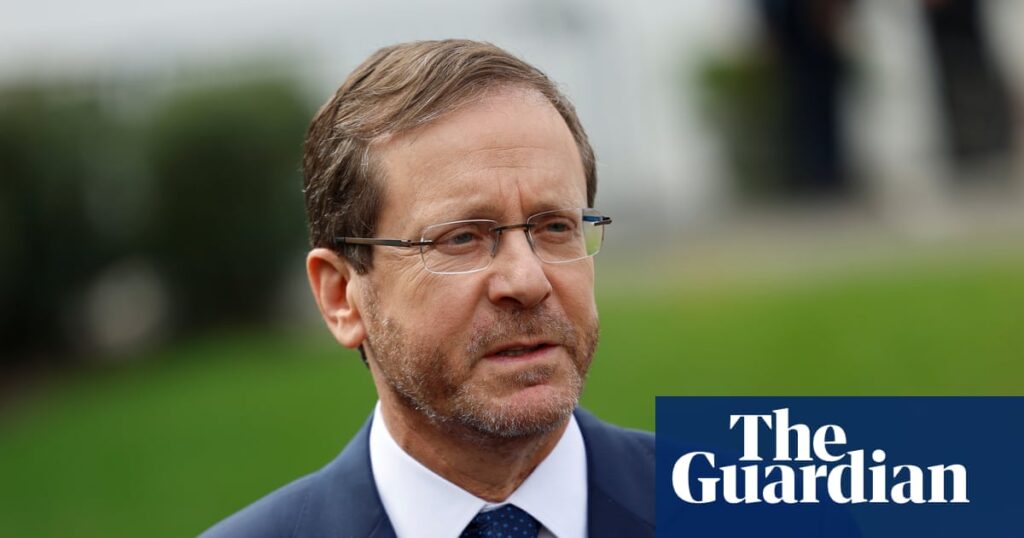
When Israel’s president, Isaac Herzog, arrives in Australia next week, he will be greeted with a warm welcome from the government and a promise of mass protests from demonstrators opposed to his country’s actions in Gaza. Major Jewish organizations and federal and state governments have hailed Herzog’s visit as “a moment of profound significance.” However, other groups, including some Jewish Australian organizations, argue that the president should be barred from entering the country, accusing him of inciting genocide against Palestinians.
Herzog was invited to Australia by the federal government following an antisemitic massacre in Bondi last December, where 15 people were killed by two gunmen allegedly inspired by the Islamic State. Prime Minister Anthony Albanese has stated, “We need to build social cohesion in this country,” emphasizing that Herzog’s visit is intended to foster “a greater sense of unity.”
Divided Reactions to Herzog’s Visit
The Australia/Israel & Jewish Affairs Council (Aijac) claims to represent the majority of Jewish Australians in welcoming Herzog’s arrival as “a powerful message of solidarity and support” following the tragic events at Bondi and the rise of antisemitism across the country. However, others argue that Herzog’s presence could sow discord rather than unity.
Palestinian groups have called for mass protests against Herzog’s visit, with thousands pledging to march in Sydney despite restrictions imposed by the NSW police commissioner. Several groups have filed complaints with the Australian Federal Police, demanding an investigation into Herzog for allegedly inciting genocide in Gaza, an allegation he vehemently denies.
The liberal Jewish Council of Australia (JCA) has described Herzog’s invitation as an “outrage,” arguing that his presence will “fuel the flames of division.”
Who is Isaac Herzog?
Isaac Herzog is a name synonymous with Israel’s modern history. The current president is the son of Chaim Herzog, who served as president from 1983 to 1993, and the grandson of Rabbi Yitzhak Halevi Herzog, the chief rabbi of Palestine and then Israel from 1936 to 1959. A lawyer by training, Isaac Herzog led Israel’s Labour party and the Zionist Union coalition, which unsuccessfully challenged Benjamin Netanyahu’s Likud in the 2015 general election. Before becoming president in 2021, he chaired the Jewish Agency for Israel.
Herzog’s political stance has shifted over time. Once seen as a centrist, he has aligned with the Gaza policies of Netanyahu’s rightwing coalition since becoming head of state. Formerly an advocate for a two-state solution, Herzog has suggested his view has changed since the October 7 attack. In Davos last year, he remarked that it was “not realistic at all” for Israel to withdraw from settlements in the illegally occupied West Bank.
“It’s an entire nation out there that is responsible,” Herzog said, referring to Palestinians in the context of the Hamas attack.
Herzog later clarified his statement, acknowledging that “there are many, many innocent Palestinians who don’t agree” with Hamas’s actions. However, the UN commission viewed this as an attempt “to deflect responsibility for the initial statement.”
Implications and Protests
Opinion on Herzog’s visit is sharply divided, including within Australia’s Jewish community. Aijac views the visit as an opportunity to “strengthen the Australia-Israel relationship through constructive dialogue and renewed engagement.” Colin Rubenstein, Aijac’s executive director, expressed sadness over attempts to politicize the visit, stating, “Our view is that, after Bondi, Herzog’s visit is not only appropriate, but an essential part of the healing process.”
Conversely, Palestinian groups are fiercely opposed to Herzog’s visit. Nasser Mashni, president of the Australia Palestine Advocacy Network, argues that “Australia’s political elite is siding with genocide” by welcoming Herzog. Protests are planned in Sydney, Melbourne, and other cities, with the NSW police commissioner extending protest restrictions in central Sydney due to “significant animosity” surrounding Herzog’s arrival.
The JCA has stated that Herzog’s arrival will “rightly spark mass protests.” Its executive officer, Sarah Schwartz, contends that “growing numbers of Jews in Australia and globally oppose the actions of the Israeli government and reject its attempts to speak in our name.”
Legal and Political Tensions
Even within the government that invited him, support for Herzog’s visit is not universal. The ruling Labor party’s Friends of Palestine group claims Herzog “works hand in hand” with Netanyahu, for whom the International Criminal Court has issued arrest warrants for war crimes and crimes against humanity. Although the ICC has not issued warrants for Herzog, the Australian Centre for International Justice (ACIJ) has lodged a formal request with the AFP to investigate him.
“At a time when the federal government is criminalizing hate speech, a person alleged to have incited hate to commit the ultimate crime – genocide – must not be allowed to enter Australian territory without facing accountability,” said Rawan Arraf, ACIJ’s executive director.
Three additional organizations have filed complaints urging that Herzog be investigated and refused entry, arguing that welcoming him would be “an affront to justice, a threat to community safety, and a violation of Australia’s international legal duties.”
Details of Herzog’s itinerary remain undisclosed, except for commitments to meet “bereaved families of the victims of the terror attack,” as well as the governor-general and prime minister. The controversy surrounding his visit underscores the deep divisions and complex dynamics at play in Australia’s response to international figures linked to contentious geopolitical conflicts.