

Hundreds of women participated in a marathon on Iran’s resort island of Kish in early December, wearing matching shirts and leggings with hair loosely tied back. In a country where defying dress codes can lead to hefty fines and prison sentences, these runners focused on the course ahead, ignoring government directives and the complimentary headscarf provided in the marathon starter pack.
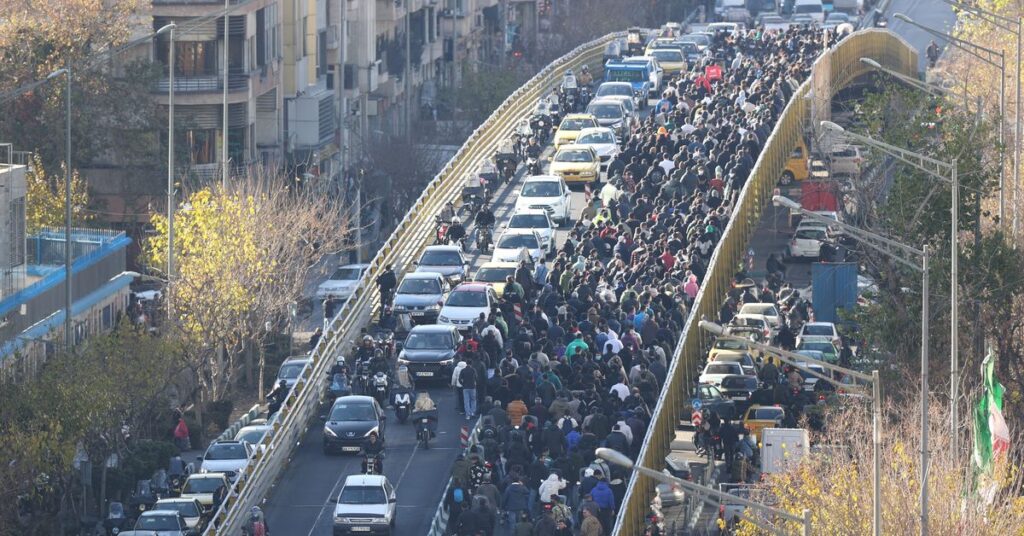
In October, a band played the “Seven Nation Army” riff to a headbanging crowd on the streets of Tehran, a moment that went viral on social media and was reposted by Jack White, the American guitarist behind the White Stripes hit. This week, shopkeepers, bazaar merchants, and students took to the streets in several Iranian cities, chanting anti-regime slogans due to their inability to pay rent after the currency hit record lows.
Protests and Economic Strain
The protests are the largest since the 2022 nationwide uprising sparked by the death of 22-year-old Mahsa Amini in police custody for allegedly wearing her headscarf improperly. The US State Department expressed concern over reports of protesters facing “intimidation, violence, and arrests,” urging Iranian authorities to end the crackdown.
“First the bazaars. Then the students. Now the whole country. Iranians are united. Different lives, one demand: respect our voices and our rights,” the State Department stated on its Farsi account on X.
Despite being limited so far, these protests mark the latest chapter in growing discontent in Iran, as the population quietly reclaims public spaces and personal freedoms through uncoordinated acts of defiance. The Islamic theocratic regime, long opposed to Western cultural influence, appears to be overlooking the growing civil disobedience to focus on its own survival.
Leadership and Strategic Challenges
At the helm is Iran’s ailing 86-year-old Supreme Leader Ayatollah Ali Khamenei, who has spent decades fortifying his regime against domestic and foreign threats. Now, he must contend with a failing strategy. Domestically, a frustrated youth shows unprecedented defiance of Islamic norms, the national currency has plummeted to record lows, Iranian cities are running dry, and protests are emerging. Outside its borders, arch-enemy Israel continues lobbying the US for further military action against the Islamic Republic.
With limited options, Khamenei is adopting a cautious waiting game, avoiding major decisions and drastic strategies despite the mounting domestic challenges.
“Many observers relay a sense of no one being at home; no one making any big decisions, or rather that Khamenei is not permitting any real decisions,” said Mohammad Ali Shabani, editor of Amwaj.media.
The Supreme Leader was reportedly incommunicado and confined to a secure underground bunker for his safety during a 12-day war with Israel in June, a conflict that caught Tehran off guard despite decades of preparation. Khamenei emerged with a weakened military, a heavily damaged nuclear program, and a population rapidly losing faith in his policies.
Economic and Environmental Crises
Iran’s struggling population has watched their nation grow increasingly dysfunctional with mounting crises. Persistent electricity blackouts, record inflation, and soaring unemployment have left citizens disillusioned by their powerless leadership. Smog fills Iran’s skies after the government, desperate to keep power on this winter, switched to cheaper, lower-quality fuel.
Twenty provinces across Iran suffered this year through the country’s worst drought in more than 40 years. The water crisis has become so dire that President Masoud Pezeshkian has proposed evacuating Tehran to ease the massive strain on the capital’s dwindling supplies.
The rial hit historic lows this month, triggering protests by shopkeepers as basic necessities spiral out of reach. Years of heavy money printing have devalued the currency so dramatically that the government’s latest budget ran into the quadrillions of rials.
Iran’s once innovative foreign policy has stalled, with no diplomatic breakthrough in sight as Western powers tighten sanctions. The Revolutionary Guard’s network of militant proxies, a cornerstone of Iran’s regional influence, is weakened amid near-daily targeting from Israel, and a key territorial advantage was lost when Syrian rebels overthrew the Iran-aligned Assad dynasty last year.
Weathering the Pressure
The Islamic Republic of Iran has long been accustomed to crises and relentless pressure. Soon after the 1979 revolution, the country became locked in an eight-year war with Saddam Hussein’s Iraq, enduring the conflict with fierce determination. Inheriting a nation wrecked by war, a younger Khamenei faced the daunting task of resurrecting his fractured economy and society while preserving revolutionary ideals.
As current crises deepen, the older Supreme Leader watches on, sticking rigidly to his familiar playbook: churning out missiles and drones, scrambling to rebuild battered regional proxies, and refusing Western preconditions for negotiations.
“Everybody in Iran wants change. The hardliners want a return to the past, the reformists a shift to the future, and many moderates want any change. Nobody is happy with the status quo,” said Shabani.
Khamenei’s inevitable end, whether by death or overthrow, will mark a monumental moment that could profoundly alter Iran’s trajectory, depending on who comes after him.
“Undoubtedly his departure would be the most pivotal moment in the history of the Islamic Republic … and there would be an opportunity in changing Iran’s geostrategic direction, but it depends on who and what comes after Khamenei,” said Ali Vaez, director of the Iran Project at the International Crisis Group.
It remains unclear whether the establishment is set on a successor to the Supreme Leader. Analysts cite potential candidates like Mojtaba Khamenei, his son, or Hassan Khomeini, grandson of the 1979 Revolution’s founder.
“The outside world has very little influence on who would come next, and it really depends on the internal dynamics and the balance of power between internal forces,” Vaez added.
Amid protests, civil disobedience, and converging disasters, Khamenei faces another external threat with Israeli Prime Minister Benjamin Netanyahu urging the US to take more aggressive action against Iran’s ballistic missile program.
“Netanyahu’s pivot to missiles should be read not as the discovery of a new threat, but as an effort to manufacture a replacement casus belli after the nuclear argument collapsed,” said Sina Toossi, a senior non-resident fellow at the Centre for International Policy.
As Iran navigates these turbulent times, the international community watches closely, contemplating the potential for change and the implications of Iran’s future direction.