



Paul Deacon jokes he “still has nightmares” about it every time he walks his dog. But Michael Maguire’s pre-season training sessions in 2010 were no laughing matter, particularly those infamous sessions at Haigh Hall, near Deacon’s home. The rigorous regime marked the beginning of a transformative era for the Wigan Warriors under Maguire’s leadership.
Pat Richards, a key player for Wigan between 2006 and 2013, vividly recalls his first session under Maguire at Haigh Hall. It was the start of the 2010 pre-season, and Maguire, who had honed his coaching skills under Craig Bellamy in Melbourne, was taking over from former Great Britain coach Brian Noble. Although the Warriors knew of Maguire’s role at the Storm, he was largely an unknown entity.
“I suppose no one really knew who Madge was,” Richards said, echoing the sentiments of Sean O’Loughlin, a Wigan legend with over 450 games to his name. “We didn’t know what we were going to get, to be honest,” added Deacon, who was new to Wigan alongside Maguire.
The Grueling Pre-Season
What they encountered was a pre-season Deacon described as “horrific.” “It was probably the hardest thing I’ve ever done without a shadow of a doubt,” he said. The players endured eight weight sessions a week and ran countless kilometers, including a memorable five-kilometer run through the forests surrounding Haigh Hall, with only five minutes of rest before another five kilometers.
“Madge was there watching us, hiding in the bushes and things like that,” Richards laughed. “The boys were absolutely cooked.” After the runs, they went straight into wrestling sessions, a testament to Maguire’s relentless pursuit of excellence.
The Brutal Army Camps
Following the forest runs were two army camps, both equally grueling. The first was in Lancashire, but the second, in Scotland’s top-end, was particularly brutal with push-ups on snow-covered concrete and 20-kilometer hikes with backpacks full of bricks. “Both as horrific as each other,” Deacon cackled.
Despite the hardships, the players acknowledged the necessity of such a tough regime. O’Loughlin noted that while it was a “tough time,” it was something the team needed and wanted. “He was a breath of fresh air to everyone,” O’Loughlin said, highlighting the hunger for success that Maguire instilled in them.
The Cultural Shift
Maguire was Wigan’s 11th coach since the Super League’s inception in 1996, a period that saw the end of a dominant era for the Warriors. St Helens had eclipsed Wigan, who had only one Super League and Challenge Cup win since 1996. The ultimate humiliation came in 2005 when St Helens defeated Wigan 75-0 in the Challenge Cup quarter-final.
“That was unheard of, like absolutely unheard of,” said James Graham, a former St Helens player. “They changed coaches, they brought in big name players but they just couldn’t seem to turn it around and then they go and sign this relatively unknown coach from Australia.”
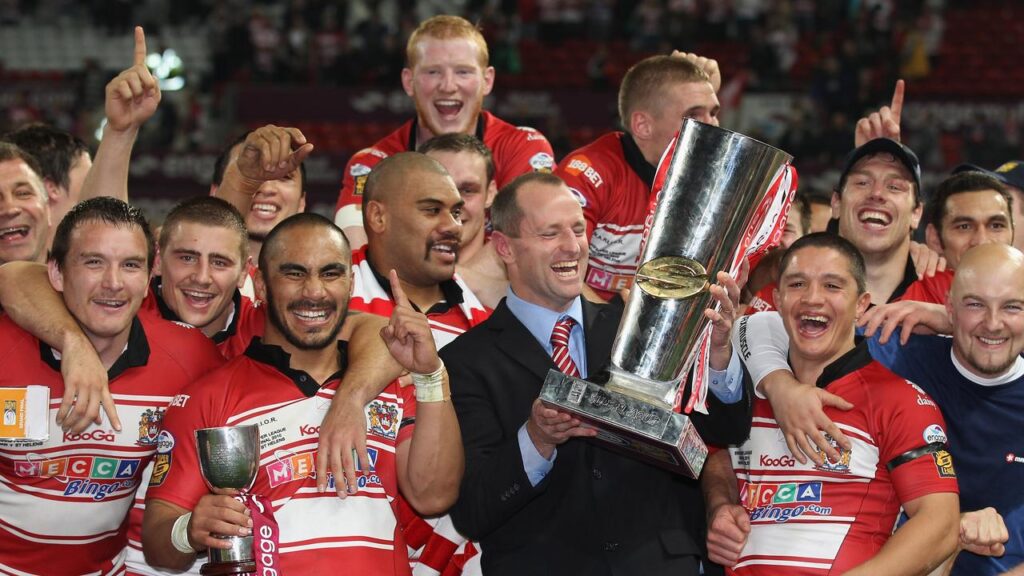
“Within a year, that relatively unknown coach from Australia was at the center of a sea of red, lifting the trophy at Old Trafford after taking Wigan to its first Super League title since 1998.”
Graham noted Maguire’s impact extended beyond the pitch, transforming the club’s culture and setting new standards. “He changed the culture of the club without a shadow of a doubt,” Deacon said. “The work ethic, the mindset, he transformed Wigan and in my opinion, he transformed the game over here as well in England.”
The Power of Maguire’s Methods
Radlinski, Wigan’s CEO and Maguire’s former right-hand man, described Maguire as a “strict disciplinarian” who demanded the best from his players. But Maguire also led by example, creating a “self-policing system” where players held each other accountable.
“Everybody soon realised that in order to be successful you have to make sacrifices, make commitments and be committed to each other,” Radlinski said. “It’s just a good old-fashioned group of blokes committed to each other and working hard for each other.”
Legacy and Lasting Impact
As Maguire prepares to lead another team to potential glory, his legacy at Wigan remains profound. The players from the 2010 squad still share a WhatsApp group, where they reminisce and support each other, a testament to the bonds forged under Maguire’s leadership.
“It was like two worlds collided with Madge and Wigan. He came at the right point,” Deacon added. “He was the character that the club needed.”
As Maguire stands on the brink of another grand final, he might reflect on that first triumph, a memory that, unlike the ashes scattered at Headingley, will remain with him and his players forever.