




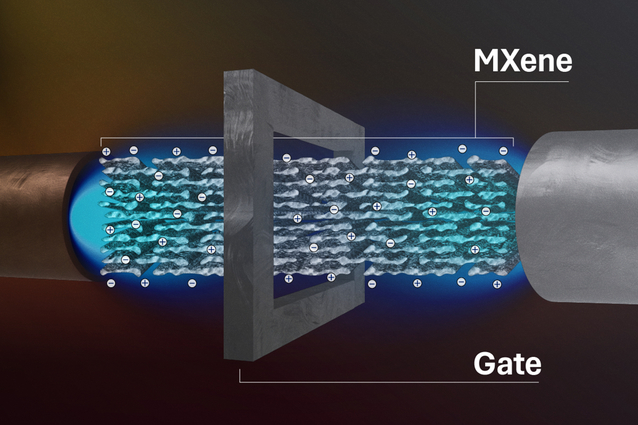
Researchers at Lawrence Livermore National Laboratory (LLNL) have made a groundbreaking discovery in the field of ion separation by using voltage to control a new “transistor” membrane. This advancement, published in Science Advances, allows for real-time tuning of ion separations, a feat previously deemed impossible. The implications of this research are vast, potentially enhancing efficiency in water treatment, drug delivery, and rare earth element extraction.
The innovative membranes are constructed from stacks of MXenes, which are two-dimensional sheets only a few atoms thick. Ions navigate through nanoscale channels formed between these stacked MXene layers. Until this discovery, the properties of MXene membranes were considered intrinsic and immutable once fabricated. The rate of ion transport was believed to be a fixed characteristic.
Breakthrough in Membrane Technology
This development marks a significant leap forward, as the research team has demonstrated that MXene membranes can function like transistors. The electrically conductive nature of MXenes allows an electric field to alter the efficiency of molecular transport through the membrane. According to lead co-author and LLNL scientist Aleksandr Noy, “This work was inspired by the transistor’s ability to regulate current through a device by applying a gate voltage. It’s just like how you can regulate the flow through a garden hose with a valve, or by using your foot to step on it.”
Similar to transistors that manage electrical current with voltage, these membranes regulate molecular flow with an applied electric field. The surface electrical charge determines the number of ions that can fit between the MXene layers and their ease of movement. This transistor-like behavior enables the MXene membrane’s transport properties to be dynamically controlled throughout a separation process.
Advancements and Applications
Co-author Aaditya Pendse, a former LLNL postdoctoral researcher, explained, “We also demonstrated that by applying an alternating positive and negative voltage, we were able to enhance the ion transport through the membrane and make it essentially self-pumping. That increases the efficiency of the ion travel through the membrane.”
This oscillating voltage approach is a particularly significant discovery, as it allows the membrane to actively drive molecular transport rather than relying solely on passive diffusion. Arjun Yennemadi, a graduate student at the Massachusetts Institute of Technology, noted, “This represents a major step forward in membrane technology.”
Future Implications and Research Directions
Looking ahead, the research team plans to explore the potential of these membranes for transporting and separating rare earth element ions. These materials are critical for maintaining a robust U.S. supply chain, highlighting the broader economic and strategic importance of this research. The ability to efficiently separate and transport these ions could revolutionize industries reliant on these vital resources.
The announcement comes as industries worldwide are seeking more efficient and sustainable methods for resource extraction and processing. The potential applications of this technology are vast, offering new pathways for innovation in various fields. As the research progresses, the team at LLNL and their collaborators aim to refine the technology further and explore its full range of capabilities.
Meanwhile, the scientific community is taking note of this breakthrough, as it challenges long-held assumptions about the fixed nature of membrane properties. The discovery opens up new avenues for research and development in membrane science, with potential ripple effects across multiple sectors.
As this technology continues to evolve, it promises to play a pivotal role in addressing some of the most pressing challenges in resource management and environmental sustainability. The future of ion separation and membrane technology looks promising, with the potential to transform industries and improve efficiencies on a global scale.