




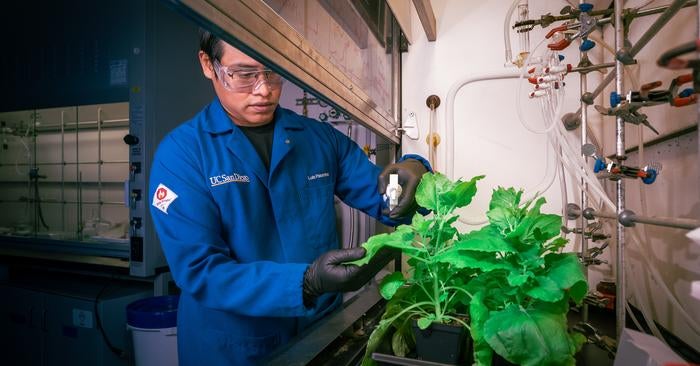
On a warming planet, the future of food security hinges on crops capable of withstanding heat, drought, and rapidly spreading diseases. Engineers at the University of California San Diego have developed a groundbreaking spray-on shield for plants, offering them protection against bacterial infections and dry spells. This innovative solution, detailed in ACS Materials Letters, suggests a future where farmers can safeguard their fields with a simple mist instead of relying heavily on chemicals.
The research highlights a shift towards leveraging plants’ innate defenses rather than replacing them, potentially transforming agricultural practices. As bacterial diseases cause significant crop losses globally, the need for new protective measures becomes increasingly urgent.
Why Plants Need a New Kind of Armor
Bacterial pathogens, both Gram-negative and Gram-positive, are responsible for devastating diseases like wilt, blight, speck, and canker in major crops. With rising temperatures, these pathogens are spreading to new regions, presenting unfamiliar threats each season. Concurrently, droughts are becoming more frequent and severe, leaving plants vulnerable to infections. This dual threat endangers food supplies and drives up grocery prices.
Current solutions, such as pesticides and antibiotics, pose their own challenges. They can harm non-target organisms, leave residues, and lose efficacy as microbes develop resistance. There is a pressing need for plant-friendly tools that are effective against bacteria yet gentle on the environment.
Building a Plant-Safe Antibacterial Spray
To address these challenges, researchers from the labs of Jon Pokorski and Nicole Steinmetz at UC San Diego’s Jacobs School of Engineering collaborated to create a coating that adheres to leaves, eradicates bacteria, and allows plants to breathe. The team engineered a synthetic polymer with positively charged chemical groups that interact with and disrupt bacterial membranes, effectively killing a wide range of harmful microbes.
Co-first author Luis Palomino, a chemical and nanoengineering Ph.D. candidate, explained, “Typically, polymers are synthesized using organic solvents that are toxic to plants. What we did differently here is we made the polymer in buffer conditions in water.” This approach allows the material to be dissolved in water and sprayed without harmful solvents, making it a more environmentally friendly option.
Testing the Coating on Living Plants
The scientists tested their formulation on Nicotiana benthamiana, a plant commonly used in labs and molecular farming. When challenged with Agrobacterium, a bacterium that can act as a pathogen, the coated plants resisted infection. The spray also suppressed Gram-negative Escherichia coli and Gram-positive Staphylococcus aureus in separate tests, indicating its potential to protect various crops in the field.
“Full leaf coverage was not necessary to achieve protection,” said co-first author Patrick Opdensteinen, a postdoctoral researcher. “We can spray just a small part of the leaf, and that translates to bacterial immunity for the whole plant. That was a really cool outcome.”
How a Small Spray Sparks Whole Plant Defense
The intriguing aspect of this research is how treating just a small patch of the plant can shield the entire organism. The team discovered that the polymer induced a mild spike in hydrogen peroxide, an early stress signal in plants. This molecule acts as a signaling agent, alerting the plant to stress and potentially priming its defenses.
Palomino noted, “Hydrogen peroxide is not just a disinfectant in your bathroom cabinet. In plants, it also works as a signaling molecule that spreads the message that stress has arrived. In this study, the signal was short-lived, then declined as the plant returned to a healthy state.”
This response suggests that the coating not only kills bacteria on contact but may also enhance the plant’s alertness, providing a dual protective effect. For consumers, this efficiency means farmers might require less material per acre, reducing costs and environmental impact.
Helping Plants Ride Out Dry Spells
The spray offers another significant benefit: resilience against drought. When water was withheld for four days, treated plants remained greener and less wilted than untreated ones. The polymer likely acts as a thin barrier, reducing water loss from leaves while triggering deeper drought tolerance pathways.
For farmers, a single treatment that combats disease and aids in drought resistance could be invaluable during heatwaves and irrigation failures. For consumers, this means more stable crop yields even in challenging conditions.
What Comes Next For This Technology
While promising, this technology is in its early stages and has only been tested under controlled conditions. The team plans to further investigate how the polymer triggers plant immunity and drought resilience. Environmental safety is another priority, with efforts to improve the polymer’s biodegradability and assess its impact on beneficial microbes and wildlife.
“Our hope is to use this in the field to benefit agriculture, and this is the first step,” Opdensteinen said. “There’s a lot of potential for plant protection.”
If successful in real-world applications, this spray could become a crucial tool in sustainable agriculture, complementing other strategies like improved breeding, soil health, and efficient irrigation. While it won’t solve every agricultural challenge, it could help sustain crop production and food security in a changing climate.
Practical Implications of the Research
For farmers, a water-based, gas-permeable antibacterial coating offers a new method to protect crops without relying heavily on conventional chemicals. The ability to confer whole-plant protection from partial coverage could lower application costs and reduce environmental impact.
For scientists, this research opens new avenues for exploring how synthetic materials can interact with natural plant signaling. Understanding this interaction may lead to innovative treatments that combine physical protection with enhanced immunity and drought resilience.
For society, this approach could bolster global food security as climate change intensifies disease pressures and water scarcity. A simple spray that helps plants resist infection and retain moisture longer could stabilize yields, reduce losses, and support farmers in vulnerable regions.
Research findings are available online in the journal ACS Materials Letters.