



A groundbreaking solar and battery project, seeking federal environmental approval in Queensland’s South Burnett region, promises to revolutionize renewable energy infrastructure with a low-profile, concrete-free panel mounting system. This innovative approach aims to significantly reduce the project’s physical and ecological footprint.
The Tumuruu solar and battery energy storage system (BESS) is poised for development in the town of Taromeo, featuring a 400 megawatt (MW) photovoltaic array and an up to 2 gigawatt-hour (GWh) battery energy storage system. The project joined the Environmental Protection and Biodiversity Conservation (EPBC) queue for assessment last Thursday.
Revolutionary Construction Techniques
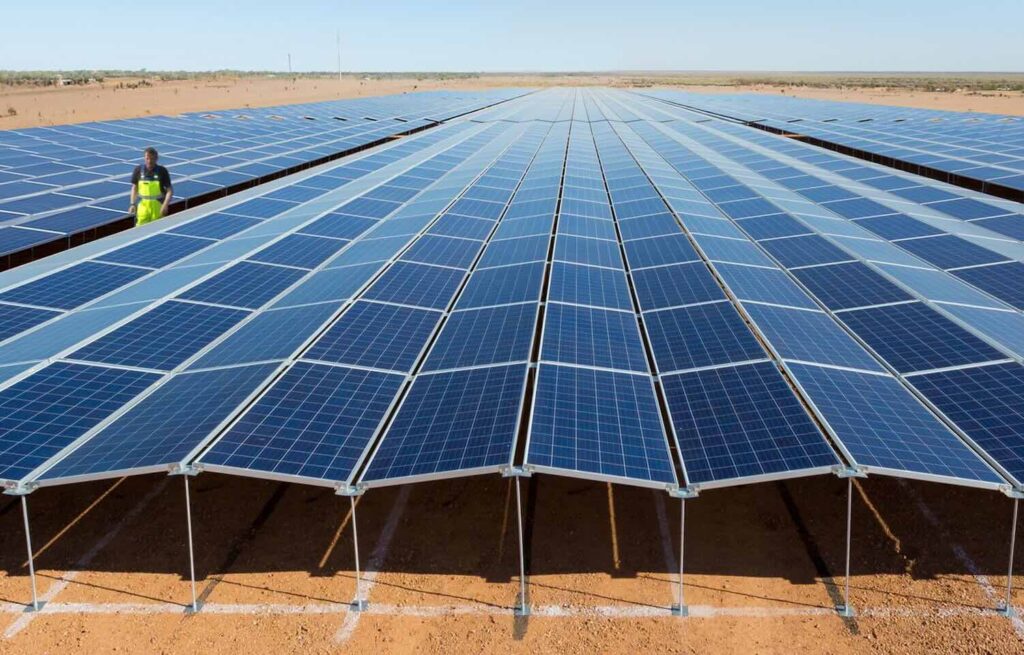
Local developer Australia Solar Enterprises (ASE) plans to utilize the PEG system from German company Jurchen Technology. This system, or a similar alternative, is designed to minimize the environmental impact while optimizing energy output. The PEG system employs a “self-stabilizing” grid of steel rods and plates to secure solar panels in a wave-like pattern, approximately one meter above the ground. This design facilitates east-west facing generation.
Unlike traditional methods, the PEG system’s thin rods can be driven into the earth without concrete footings, reducing steel usage by approximately 75%. According to ASE CEO Chris Elder, this design offers high land utilization rates, reduces ground disturbance, and minimizes visual impact due to its low height profile and fixed pitch panels, which generate significant energy per hectare.
Logistical and Economic Advantages
The lightweight and compact nature of the PEG system eliminates the need for B-double trucks and reduces freight deliveries compared to conventional concrete-footed technology. A consultation report on the project notes that the PEG system can cut supply, logistics, and installation time by up to 40%.
Another advantage is the system’s installation simplicity, which requires only basic hand tools. This feature could potentially employ a larger number of unskilled local workers, offering economic benefits to the community. Elder highlighted that the PEG system has been successfully implemented in over 500 MW of projects globally, including more than 15 projects in Australia, such as the 8.9MW Baroota project in South Australia’s Spencer Gulf region, completed in just eight weeks.
Regulatory and Community Support
ASE, founded in 2021, has secured the approval of the South Burnett Regional Council and submitted its grid application to Powerlink and the Australian Energy Market Operator (AEMO). The company aims to receive an offer to connect later this year. State development approval was granted in late 2023, prior to recent governmental changes affecting renewable energy legislation.
According to Elder, ASE has initiated discussions with potential engineering, procurement, and construction (EPC) contractors for equipment supply, civil works, and installation, alongside support for high voltage connection works. The current focus is on obtaining the remaining permits and approvals necessary to commence construction.
Site and Environmental Considerations
The Tumuruu project is proposed for construction on privately owned freehold land leased to ASE for an initial 30-year period, with an option to extend for another 20 years. The site is currently used for cattle grazing and is intersected by two existing 275 kV transmission lines, facilitating energy supply to Brisbane and other parts of southeast Queensland.
Located approximately 18 km from the Meandu coal mine and Tarong coal power stations, the project is positioned in a region with a mix of traditional and renewable energy sources. Last month, federal energy minister Murray Watt approved an extension to Stanwell’s Meandu King 2 East open-cut coal mine, a decision met with concern by the Queensland Conservation Council.
This development represents a significant step forward in sustainable energy practices, potentially setting a precedent for future projects. As ASE moves towards securing the necessary approvals, the Tumuruu project stands as a testament to innovative engineering and environmental stewardship in the renewable energy sector.