




Every year, over 100 billion nitrile rubber gloves are produced globally, primarily for the healthcare sector. These gloves, made from synthetic polymers related to plastic and derived from crude oil, are typically discarded after a single use, contributing to a massive amount of material waste worldwide. However, a groundbreaking study by Simon Kildahl, a postdoctoral researcher at Aarhus University, offers a promising solution to this environmental challenge.
In a recent publication in the journal Chem, Kildahl and his colleagues demonstrated a novel method to transform waste rubber gloves into a material capable of capturing carbon dioxide (CO2). This innovative approach not only addresses the issue of waste but also contributes to climate change mitigation efforts.
From Waste to Resource: The Science Behind the Transformation
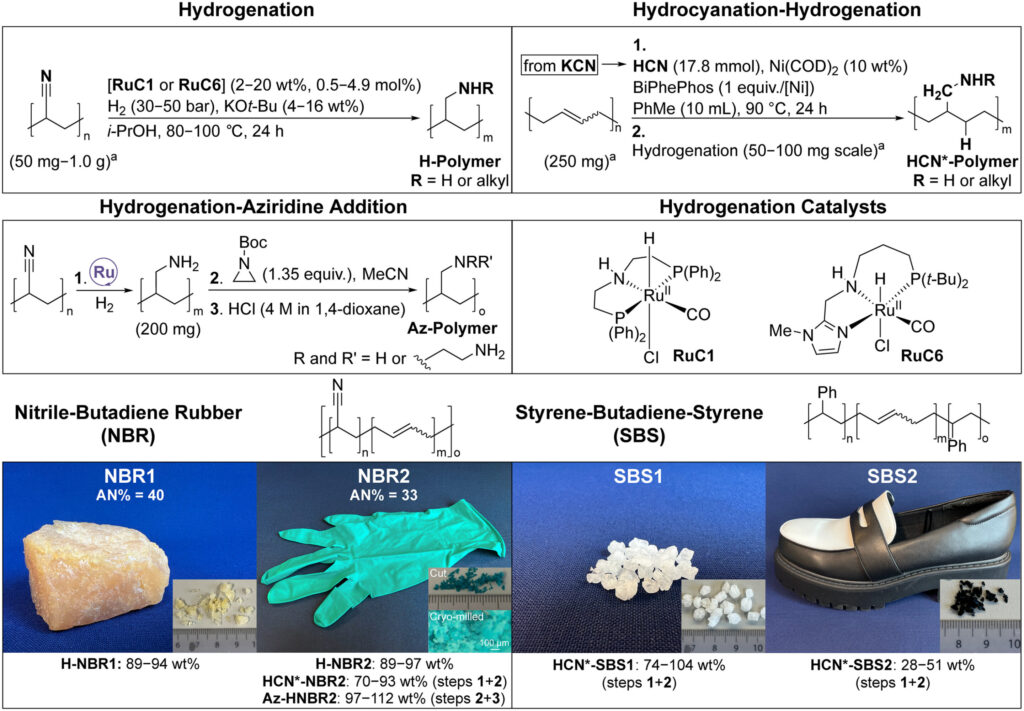
The process of recycling rubber gloves into CO2 adsorbents involves several steps. “A plastic bottle can be recycled relatively easily, as we know from deposit-return systems. But other plastic materials are problematic because they cannot be reused in the same way. Therefore, they often end up being burned, which is currently the case for rubber gloves,” Kildahl explains.
“In our experiments, we converted the glove so that it can capture CO2 instead of becoming a waste product that releases CO2 and other harmful gases during incineration,” he adds. This method involves shredding the rubber gloves into small pieces, which then react with a ruthenium-based catalyst and hydrogen gas, enabling the material to capture CO2 from simulated flue gas.
Innovative Approaches in Carbon Capture
Kildahl is part of the Skydstrup Group under the Novo Nordisk Foundation CO2 Research Center (CORC), a global collaboration of universities focused on CO2 capture and conversion technologies. The group has previously succeeded in recycling materials such as polyurethane foam from mattresses and epoxy and glass fibers from wind turbine blades. Their success with rubber gloves marks another significant milestone.
The method’s novelty lies in its use of waste material that would otherwise be incinerated or landfilled. When heated, the rubber product releases the captured CO2, which can then be stored underground or used in Power-to-X applications, while the material itself is refreshed and ready for reuse.
Climate Impact and Future Prospects
The potential climate benefits of this technology are substantial. According to the UN Intergovernmental Panel on Climate Change (IPCC), removing 5–16 billion tons of CO2 from the atmosphere annually by 2050 is crucial. “That is why it is smart to utilize a waste material available in such large quantities, rather than extracting more oil from the ground,” Kildahl points out.
“With the rubber glove, we can create a CO2 capture material where almost every atom in the product comes from waste, except for a small amount of hydrogen, which can ideally be obtained from water via Power-to-X.”
Currently, the experiments are at the laboratory stage, with the goal of making the process scalable and economically viable. On a technology readiness level scale from early idea (TRL 1) to fully implemented commercial technology (TRL 9), the research is currently at level 3 or 4. “We are working on a gram scale right now, and reactions can look and behave differently when we scale up to kilograms. But our results look very promising,” Kildahl says.
Challenges and Economic Viability
Despite the promising results, several challenges remain. The process needs to become more cost-effective, as the catalyst currently used is expensive. Additionally, scaling the technology from laboratory to industrial levels poses technical challenges that need to be addressed.
However, the potential impact of this innovation on both waste reduction and climate change mitigation makes it a compelling area for further research and development. As the world seeks sustainable solutions to environmental challenges, technologies like this could play a crucial role in shaping a more sustainable future.
The next steps involve refining the process to reduce costs and increase efficiency, with the ultimate aim of commercializing the technology. As Kildahl and his team continue their research, the world watches with anticipation, hoping for a breakthrough that could turn a common waste product into a valuable tool in the fight against climate change.