




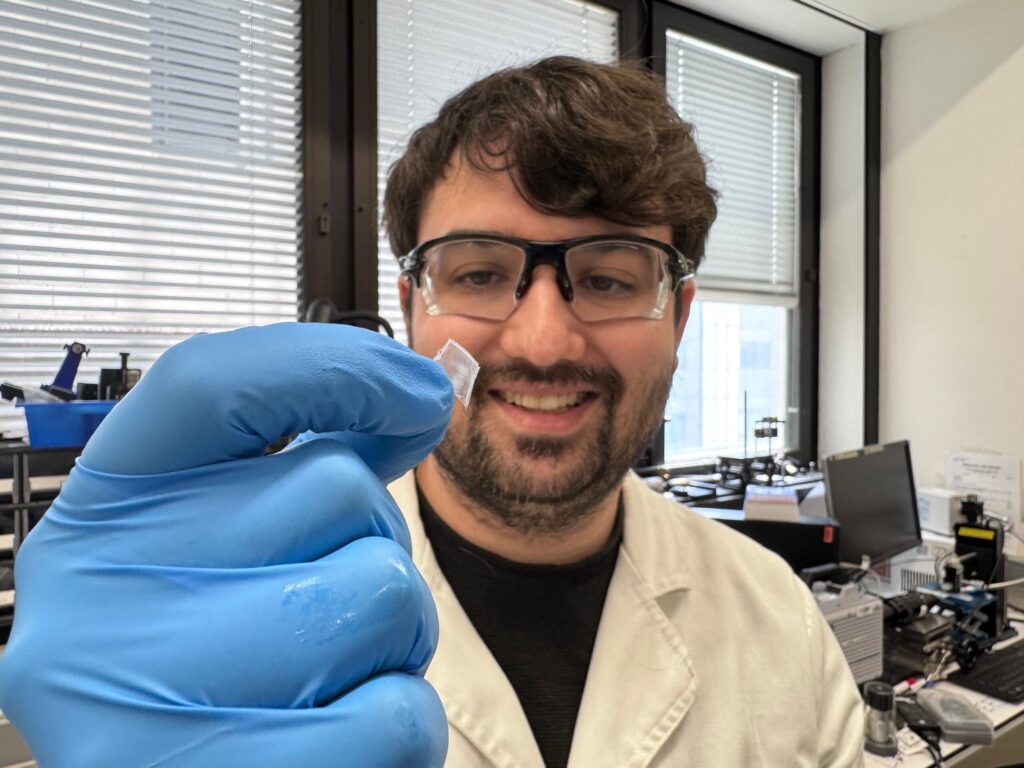
A thin sheet of nylon might not appear groundbreaking at first glance. However, researchers at RMIT University have developed a nylon film that continues to generate electricity even after being folded, stretched, and run over by a car multiple times. This remarkable toughness is crucial because the film’s basic mechanism is simple: when compressed, it produces an electric charge. Such materials are known as piezoelectric, derived from the Greek word for “to press.” Quartz, certain ceramics, and even bone exhibit similar behavior.
Piezoelectric components are already present in modern vehicles, including fuel injectors, parking sensors, and airbag systems. The RMIT team’s goal is to create a flexible alternative that can withstand real-world stress and harvest energy from everyday pressure and motion.
Turning Tough Nylon into an Energy Generator
The research, led by Distinguished Professor Leslie Yeo and Dr. Amgad Rezk from RMIT’s School of Engineering, along with RMIT PhD researcher Robert Komljenovic, focuses on a durable industrial plastic called nylon-11. Known for its resilience and heat resistance, nylon is used in demanding applications such as aircraft carrier arrestor cables, military equipment, and space suits. While nylon-11 can theoretically be piezoelectric, its performance has been challenging to unlock.
A significant obstacle is that nylon-11 can crystallize into several phases. The phase with the most promising piezoelectric behavior has been difficult to achieve and organize using traditional methods like stretching or solution processing. The RMIT method introduces two forces simultaneously during film solidification: intense mechanical vibration and a strong electric field. This process involves nanometre-amplitude surface reflected bulk waves at 10 MHz on a lithium niobate substrate while a nylon-11 precursor solution dries under ambient conditions.
Professor Yeo explained the potential of this approach: “This method could power next-generation devices that need to survive real-world stresses, whether that’s wearable tech, sensors, or smart surfaces,” he said.
What the Measurements Show
The study delves into the film’s structure and performance. Using advanced techniques like operando synchrotron grazing-incidence wide-angle X-ray scattering and infrared spectroscopy, the team reports that their process enhances long-range crystal ordering, improves hydrogen-bond network ordering, and aligns molecular dipoles, all contributing to stronger piezoelectric behavior.
One measure of long-range ordering, Herman’s orientation function, rose to about 0.32 for the electromechanical approach, while the solvent-cast control film showed no preferential long-range order.
Electrical output during compression testing further distinguished the films. Under cyclic compression, the electromechanically processed film generated 110 pC of charge, compared to 0.6 pC for a solvent-cast control and 3.7 pC for a film made with mechanical vibration alone.
The team reports a macroscale piezoelectric coefficient d33 of 11.26 ± 0.3 pC N−1 for the electromechanical film, along with a peak-to-peak voltage of about 0.65 V at 4 GΩ. In terms of power, the electromechanical films achieved a power density of 12.5 μW cm−3, representing a 400-fold increase over the mechanically processed film.
Surviving a Car is Not the Whole Story
The film’s durability extends beyond lab tests. The electromechanical film retained its function after being tapped by a finger, compressed under a moving vehicle with a load of about 14,000 N, and tapped again. Over 20,000 loading cycles under an in-contact force change of 48 N, the films maintained a consistent response.
Mechanical measurements support these findings. Nanoindentation showed a compressive modulus Y3 of 1.99 GPa for the electromechanical film, compared to 0.91 GPa for the solvent-cast control. The improved strength is linked to a more ordered hydrogen-bonded network, supported by shifts in infrared peaks and other measurements.
Limitations and Reality
Despite the promising results, the team acknowledges limitations. Performance decreases with heat and humidity. For instance, a d33 value of 11.4 pC N−1 at 25°C and 35% relative humidity dropped to 3.55 pC N−1 at 60°C and 1.04 pC N−1 at 80°C. At 25°C, increasing humidity to 91% reduced d33 to 6.4 pC N−1 due to dipole relaxation and device delamination under humid conditions.
Even so, one number stands out for energy harvesting. The study reports a piezoelectric voltage coefficient g33 of 427 × 10−3 Vm N−1, surpassing values previously reported for piezoelectric polymers.
Dr. Rezk emphasized the industry’s potential: “We’re excited to see where prospective industry partners could take this technology, from flexible electronics to sports equipment,” he said. Komljenovic highlighted the film’s resilience: “The thin-film devices are so robust, you can fold them, stretch them, even run a car over them, and they keep making power,” he noted.
Practical Implications of the Research
If the method scales as hoped, it could enable self-powered sensors in locations where changing batteries is challenging. Roads and infrastructure, which experience constant compression from traffic, are obvious targets. The same pressure-to-power behavior could also benefit wearables or smart surfaces that endure frequent bending and tapping.
The study also positions nylon-11 as a non-fluorinated alternative to PVDF, a polyfluorinated alkyl substance and environmental hazard. This makes the material choice significant, not just the processing method.
The next step involves scaling up the technology for larger applications and exploring industry partnerships to bring it to market. The research findings are available online in the journal Nature Communications.
The original story “Flexible nylon film generates electricity from compression” is published in The Brighter Side of News.
Related Stories:
- Scientists transform Styrofoam cups and containers into nylon products
- Scientists generate electricity using Tesla turbine-inspired technology
- New transparent window material could cut building energy loss by 50%
Like these kinds of feel-good stories? Subscribe to The Brighter Side of News newsletter.