
Lahore: In a significant legal development, a Pakistani court has sentenced former Prime Minister Imran Khan and his wife, Bushra Bibi, to 17 years in prison each. The ruling, announced on Saturday, pertains to a corruption case involving the acquisition of luxury state gifts at undervalued prices, according to court documents and statements from Khan’s legal team.
The latest conviction compounds Khan’s existing legal challenges. He has been incarcerated since August 2023, serving a 14-year sentence in a separate land corruption case. This new sentence will commence following the completion of his current term, as confirmed by Information Minister Attaullah Tarar.
Legal Troubles Mount for Former Prime Minister
Imran Khan, who was ousted from office in 2022, faces a multitude of legal battles. These include charges ranging from corruption to anti-terrorism and breaches of state secrets. Khan has consistently denied any wrongdoing, asserting that the charges are politically motivated. His party, Pakistan Tehreek-e-Insaf (PTI), echoes this sentiment.
According to Khan’s family lawyer, Rana Mudassar Umer, the court issued the sentence without adequately hearing the defense. The special court of Pakistan’s Federal Investigation Agency imposed 10 years of rigorous imprisonment for criminal breach of trust and an additional seven years under anti-corruption laws.
“The court announced the sentence without hearing the defence and sentenced 17 years imprisonment to Imran Khan and Bushra Bibi with heavy fines,” said Rana Mudassar Umer.
Details of the Corruption Case
The case centers on luxury watches gifted to Khan by Saudi Arabia’s Crown Prince Mohammed bin Salman during official visits. Prosecutors allege that Khan and his wife acquired these gifts from the state at significantly reduced prices, contravening Pakistan’s regulations on state gifts. This transaction reportedly resulted in substantial financial losses for the state.
Zulfi Bukhari, a spokesperson for Khan, criticized the verdict, stating it undermines fundamental justice principles and serves as a “tool for selective prosecution.” Khan has instructed his legal team to appeal the decision at the Islamabad High Court, according to Salman Safdar, another lawyer representing him.
Implications and Political Reactions
This ruling is distinct from an earlier state gifts prosecution that led to Khan’s arrest in August 2023. Previous sentences of 14 years for Khan and seven years for Bushra Bibi were suspended upon appeal. The cases, colloquially known as the Toshakhana cases, refer to the state repository for gifts received by public officials.
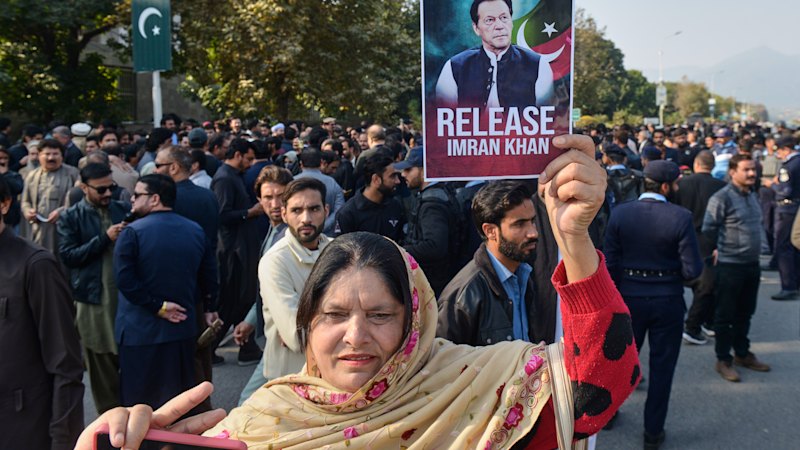
Following the verdict, Khan’s PTI party announced plans for protests across Punjab. The party also claims that routine family and legal visits have been obstructed, despite court orders. However, authorities deny any mistreatment, asserting that Khan receives all standard prisoner amenities.
Khan remains a polarizing figure in Pakistan, with his legal struggles continuing as his party remains sidelined from power.
Historical Context and Future Outlook
Imran Khan, a former cricket star turned politician, has long been a contentious figure in Pakistan’s political landscape. His rise to power was marked by promises of anti-corruption and reform, yet his tenure was marred by controversies and legal disputes.
The current legal proceedings against Khan reflect broader political dynamics in Pakistan, where former leaders often face legal challenges post-tenure. Observers note that these cases highlight the intricate relationship between politics and the judiciary in the country.
As Khan’s legal team prepares to appeal the latest verdict, the implications for Pakistan’s political future remain uncertain. The outcome of these legal battles could influence the political landscape, potentially affecting upcoming elections and the balance of power within the country.
For now, the focus remains on the Islamabad High Court, where Khan’s appeal will be heard. The decision could either reinforce or challenge the current judicial narrative surrounding Khan and his political legacy.