



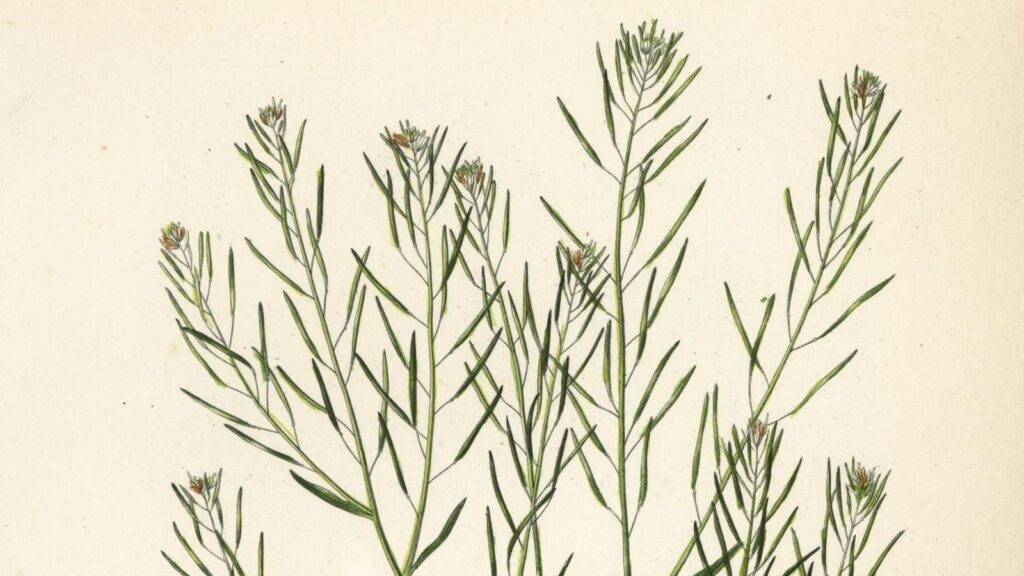
When we picture mathematics, we typically imagine calculators, computers, formulae, and abacuses. What almost no one on Earth imagines is a plant performing division in the dark. Yet, that is precisely what one unassuming species of weed has evolved to do. Arabidopsis thaliana, or the thale cress, is a tiny flowering plant that has all but rewritten our understanding of what living organisms are capable of achieving.
The thale cress uses its nightly arithmetic to perfectly time a chemical ambush, a discovery that has intrigued scientists and expanded our perception of intelligence in the natural world.
How Thale Cress Performs Division
At first glance, the thale cress is nothing special. It’s just a rosette of modest green leaves, easily overlooked. But once the sun dips below the horizon, an elegant biochemical computation begins inside its cells. According to 2013 research published in eLife, during the day, Arabidopsis gathers sunlight and converts it into starch, which serves as its energy reserve. As night falls, the thale cress relies entirely on that stored starch to survive.
Instead of burning it at a constant rate, a random rate, or all at once, Arabidopsis performs a simple yet sophisticated calculation: it divides the total amount of starch it has stored by the number of hours left until dawn.
Stored starch ÷ hours until expected dawn = nightly consumption rate.
When necessary, it even accounts for exceptions. If the night comes early, the thale cress recalculates and slows its consumption to avoid running out of energy.
Why This Plant’s Counting Skills Matter
If the thale cress mismanages its starch reserves, it could face several problems that threaten its survival. Burning its reserves too fast risks starvation before dawn, while burning too slowly wastes leftover starch, a missed opportunity for growth. Mismanagement, in general, leaves the cress vulnerable to stress or damage.
By leveraging its ability to perform real-time arithmetic, the thale cress ensures that its energy lasts exactly as long as needed. This precision is vital for efficient growth and long-term health.
The Chemical Defense Strategy
Arabidopsis’s talent for arithmetic isn’t solely about conserving energy; it’s also central to its defense strategy. Starch consumption isn’t the only biological process it precalculates. It also ramps up the production of glucosinolates, potent chemical compounds used as a defense mechanism against predators, primarily insects.
As a 2019 study in Plant Physiology explains, Arabidopsis times the production of these defensive chemicals with mathematical precision. During the small hours of the night, as herbivores begin to stir or dawn approaches, the thale cress’s glucosinolate levels rise, synchronized to its internal clock and starch budget, optimizing its defense machinery for maximum protection.
How Does a Brainless Plant Do Math?
Arabidopsis accomplishes its nightly mathematics through a biochemical network rather than neurons or a brain. Key elements of this network include:
- A circadian clock: An internal molecular timekeeper tracks sunrise and sunset, similar to humans. Each cell “knows” the time of night.
- Starch sensors: Chemical signals detect the amount of starch remaining in energy reserves.
- Specialized enzymes: The enzyme PWD modifies starch granules and regulates their breakdown.
The discovery of Arabidopsis’s arithmetic skills has far-reaching implications. Understanding how plants manage energy at night could prove invaluable to breeders engineering crops for better survival under unpredictable light conditions or stress. Similarly, these principles could be repurposed in engineered microbes or cells to build biological timers or systems that “compute” with molecules.
Most importantly, this discovery suggests that intelligence may not be exclusive to organisms with brains. Instead, it might be possible for any entity capable of processing information and responding adaptively. This challenges long-held assumptions about what constitutes “thinking.” Life, in its broad and inventive forms, often thinks in ways we haven’t learned to notice.
Arabidopsis has provided a surprising example: a plant that counts, calculates, defends itself, and ultimately survives using a single, rudimentary equation.