




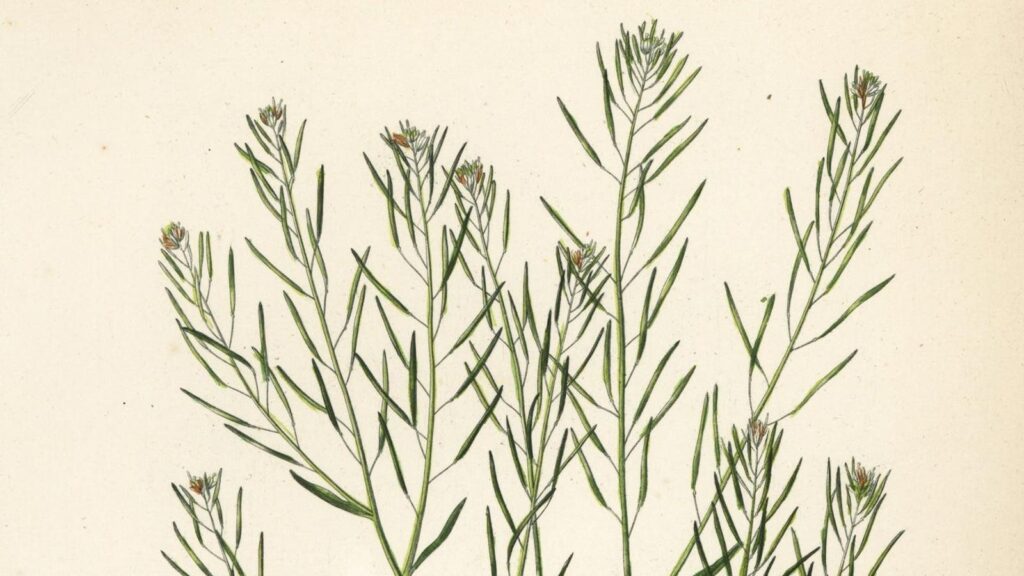
When we think of mathematics, images of calculators, computers, and abacuses often come to mind. Rarely would anyone consider a plant capable of performing division in the dark. Yet, Arabidopsis thaliana, commonly known as the thale cress, is doing just that. This unassuming weed has evolved a remarkable ability that has rewritten our understanding of plant capabilities.
Arabidopsis thaliana, a tiny flowering plant, uses its nightly arithmetic to time a chemical ambush with precision. This discovery has intrigued biologists and opened new avenues in understanding plant intelligence.
How Thale Cress Performs Division
At first glance, the thale cress appears ordinary—a simple rosette of green leaves easily overlooked. However, as night falls, an elegant biochemical computation begins within its cells. According to 2013 research published in eLife, during daylight, Arabidopsis gathers sunlight and converts it into starch, its energy reserve. Once night descends, it relies entirely on this stored starch to survive.
Instead of depleting its reserves at a constant or random rate, Arabidopsis performs a sophisticated calculation: it divides the total starch by the number of hours until dawn. This ensures a steady consumption rate, allowing the plant to efficiently manage its energy.
Stored starch ÷ hours until expected dawn = nightly consumption rate.
Remarkably, if night arrives earlier than expected, the thale cress recalculates and adjusts its consumption rate, demonstrating an adaptive strategy crucial for its survival.
Why Arithmetic Skills Matter for Survival
If Arabidopsis mismanages its starch reserves, it risks starvation or wasted growth opportunities. Rapid depletion could lead to starvation before dawn, while slow consumption might leave excess starch unused. Such mismanagement can leave the plant vulnerable to stress or damage.
By leveraging its arithmetic ability, the thale cress ensures its energy lasts precisely as needed, supporting efficient growth and long-term health. This precision is vital for its survival and resilience.
Timing the Chemical Defense
Beyond energy conservation, Arabidopsis’s arithmetic skills play a crucial role in its defense strategy. The plant doesn’t just calculate starch consumption; it also synchronizes the production of glucosinolates, potent chemical compounds that serve as a defense mechanism against predators.
As a 2019 study in Plant Physiology details, Arabidopsis times glucosinolate production with mathematical precision. During the night, as herbivores become active or dawn approaches, glucosinolate levels rise. This synchronization with its internal clock and starch budget optimizes its defense, providing maximum protection at peak threat moments.
The Biochemical Network Behind the Math
Arabidopsis achieves its nightly calculations through a biochemical network rather than a brain. Key elements of this network include:
- Circadian clock: An internal molecular timekeeper tracking sunrise and sunset, akin to human biological clocks.
- Starch sensors: Chemical signals that detect remaining starch reserves.
- Specialized enzymes: Enzymes like PWD modify starch granules and regulate their breakdown.
The discovery of Arabidopsis’s arithmetic abilities has far-reaching implications. Understanding plant energy management at night could aid in engineering crops for better survival under variable light conditions or stress. These principles might also be applied to engineered microbes or cells, creating biological timers or molecular computing systems.
Most importantly, this discovery challenges the notion that intelligence is exclusive to organisms with brains. It suggests that intelligence could manifest in any entity capable of processing information and responding adaptively. Arabidopsis provides a surprising example of a plant that counts, calculates, and defends itself with a simple equation.
This revelation prompts a reevaluation of what constitutes “thinking.” Life, in its diverse forms, often exhibits intelligence in ways humans have yet to fully recognize. Arabidopsis has offered a compelling example of this hidden complexity, expanding our understanding of the natural world.