


One of 2025’s biggest hits, spending eight weeks atop the Australian charts, is by a fictional K-pop group. HUNTR/X and their global chart-topper “Golden” is lifted from the Netflix animated musical KPop Demon Hunters, which is nothing short of a cultural phenomenon. How did we get here? The answer might trace back to a stocky man in a powder-blue jacket doing a goofy horse dance.
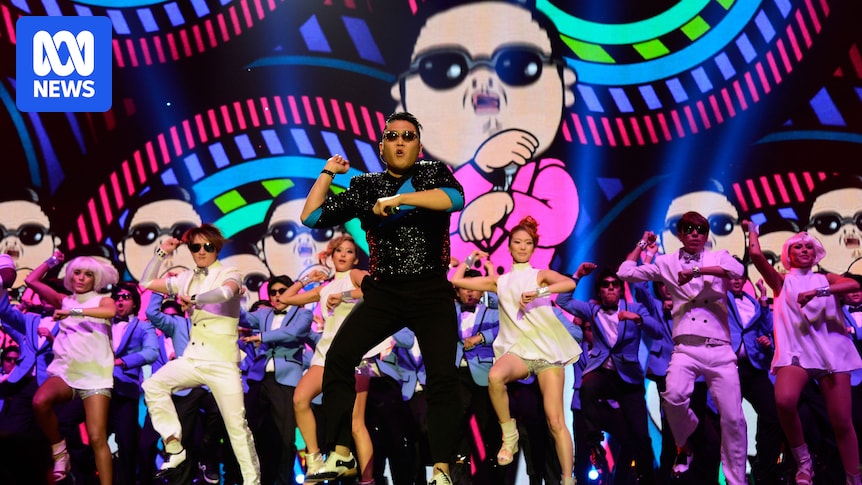
On July 15, 2012, South Korean musician Psy — real name Park Jae-Sang — debuted atop the South Korean charts with his garish, satirical single “Gangnam Style.” While topping domestic charts was not unusual for Psy, the song swiftly exploded in popularity and captured the global Zeitgeist. By the end of the year, it had topped charts in more than 30 countries, including Australia, and became the highest-charting South Korean song in the US, peaking at #2 behind Maroon 5’s “One More Night.”
The Viral Phenomenon
“Gangnam Style” achieved the kind of breakthrough global success that had mostly eluded K-pop acts, despite their burgeoning popularity in East and South-East Asia. This was largely thanks to the song’s music video, which less than six months after its release, became the first YouTube video to reach a billion views. The loud, colorful clip — and Psy’s signature choreography — was inescapable, becoming an endless source of memes, parodies, and reaction videos, supercharging an internet culture that has since become common pop music practice.
It even crossed over into the political sphere. Former prime minister Kevin Rudd attempted the trademark dance, as did then-United Nations secretary-general Ban Ki-Moon, who hailed the song as a force for world peace. Meanwhile, Psy was awarded the Okgwan Order of Cultural Merit, one of South Korea’s highest cultural honors.
Not Your Typical K-pop Idol
Born in Gangnam to a successful executive father and restaurateur mother, Psy spent his 20s in America, studying at Berklee College of Music before returning to Seoul in 2000 to start his career. By the 2010s, he was firmly established as a rapper, dancer, TV personality, and pop troublemaker in South Korea. When “Gangnam Style” broke, the chubby 35-year-old didn’t look or act much like your typical, highly manufactured K-pop talent.
“There’s really no one like him. He’s intentionally different and strange,” says Dr. Sarah Keith, senior lecturer in media at Macquarie University. “He was an outlier.”
“I believe hallyu would have happened anyway without Psy, but he accelerated it,” says Dr. Keith, who lived in Korea in the 1980s and has been studying its culture since the 2010s.
The Satirical Subtext
Beneath its over-the-top presentation, “Gangnam Style” is charged with social commentary. It lampoons Seoul’s affluent Gangnam district, where the nouveau riche waste wealth on keeping up with its fashions and lavish lifestyle. In the video, Psy — styled in colorful suit jackets, sunglasses, and slicked-back hair — busts out his ridiculous equestrian-themed moves in stables, subway platforms, parking garages, and several real-life Gangnam locations. Throughout, he’s made to be the butt of the joke.
“It’s definitely a video that’s meant to be comedic,” says Dr. Keith, who notes Psy has a track record for musical sarcasm. Before “Gangnam Style,” he was “poking fun at Korea’s suffocating nine-to-five office culture” on 2010’s “Right Now,” complete with a video where he dances through gridlocked commuter traffic and staff cubicles in a muscle suit.
The Next Wave
In the 13 years since “Gangnam Style,” K-pop is no longer niche. It’s a cultural juggernaut that’s developed blockbuster South Korean acts. Chart-busting groups like Blackpink, Twice, NewJeans, and Stray Kids have achieved even bigger global reach, selling out stadiums and ruling social feeds, with some intriguing Australian connections. Then there’s BTS, the Korean boy band whose unprecedented success outstrips Beatlemania. They credit Psy for cracking the door to overseas markets they eventually kicked wide open.
“He paved the way for K-pop in the US, which meant we were able to follow his footsteps with ease,” said BTS member Suga, who collaborated closely with Psy on “That That,” the lead single from his latest album.
Despite its ubiquitous success, Psy has spoken about the negative impact “Gangnam Style” had on him personally and professionally, pressured to produce another global smash. “When the song is a hit then your songs need to continue to be hits,” he once told CNN. “When the person is a hit the success is more sustainable. In this case, I’m the former and BTS is the latter.”
After living for years in Los Angeles, Psy has since moved back to Gangnam, where he fosters the next generation of K-pop stars under P Nation, his music label and management company. There are now more than 300 clips in YouTube’s Billion Views Club, but “Gangnam Style” was the first. Currently at 5.7 billion views and counting, it remains among the top 10 most viewed videos in the platform’s history.
The hallyu wave has swelled beyond music and spilled over into the historic Oscar winner Parasite, record-breaking Netflix productions Squid Game and the aforementioned K-Pop Demon Hunters, and Tony Award-winning Broadway musical Maybe Happy Ending. The booming influence of South Korean culture is the focus of Hallyu!, a new exhibition at the National Museum of Australia. Upon entry, the first item on display is a suit worn by Psy in “Gangnam Style.”
“It’s the most recognizable image,” notes Dr. Keith. “It cuts right across generations, from eight-year-olds to 80-year-olds.”
“Gangnam Style’s” viral success presaged the modern ways we consume media — a metrics-driven attention economy obsessed with streaming figures where algorithms serve us up the next big thing. Today we’re accustomed to digital platforms enabling “more-or-less instant, more frictionless distribution of global culture,” says Dr. Keith. “And proven it can succeed globally in quite unexpected ways and places.”