


For decades, Hawaiian Airlines has been synonymous with warm island hospitality, offering seamless connectivity between the Hawaiian Islands, the US mainland, and various international destinations. However, as premium travel expectations continue to rise, the airline has faced stiff competition from global carriers in terms of onboard premium products. Beginning in 2028, Hawaiian Airlines plans to introduce a comprehensive overhaul of its Airbus A330 fleet, along with significant investments in passenger experience. These changes, highlighted by the airline’s first-ever true premium economy cabin and a fully redesigned first-class product on its A330s, are generating excitement among frequent flyers and promise to usher Hawaiian into a new era.
Introduction of Premium Economy Cabin
Starting in 2028, Hawaiian Airlines’ fleet of 24 Airbus A330-200s will undergo a complete refurbishment. A key feature of this upgrade is the introduction of a brand-new premium economy cabin, a first for Hawaiian. Premium economy, often described as a blend between economy and business class, has rapidly become one of the fastest-growing cabin classes worldwide. Hawaiian’s new premium economy aims to offer enhanced space, greater comfort, and improved amenities at a more affordable price than business class.
Historically, Hawaiian Airlines has not offered a true premium economy cabin. Instead, its A330s are equipped with 88 ‘economy comfort’ seats, providing passengers with 36 inches of pitch and six inches of recline—an improvement over the standard 31-inch pitch in regular economy. The new premium economy cabin will represent a significant upgrade, aligning Hawaiian more closely with international carriers and premium domestic aircraft operated by airlines like Delta.
Redefining First Class with New Suites
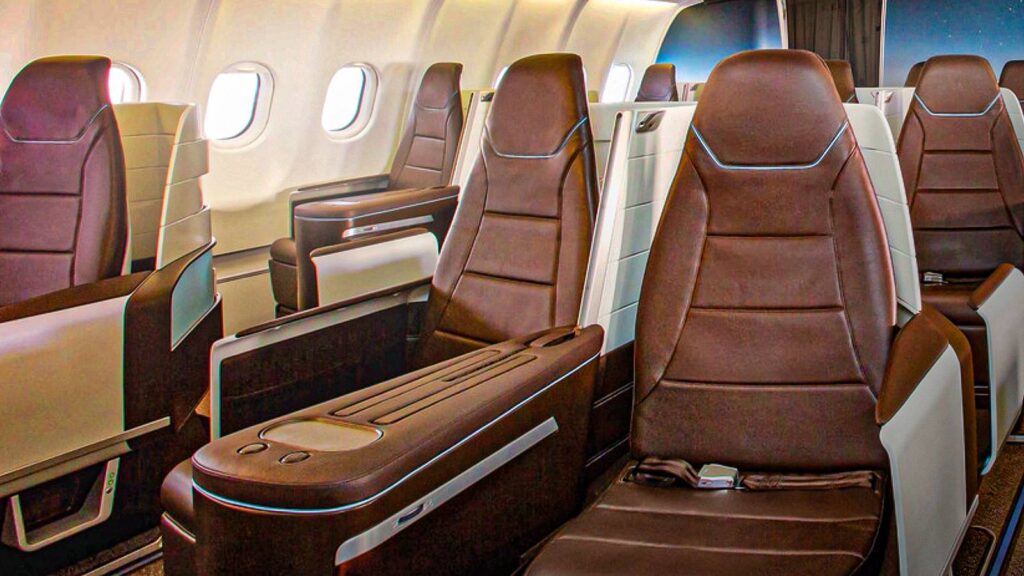
In addition to the premium economy cabin, Hawaiian is investing in its A330 first-class product. Currently, the A330s feature a lie-flat first-class product, similar to international business class, but branded as first class for most domestic routes. These cabins have just 18 seats arranged in a dated 2-2-2 configuration, leaving window seat passengers without direct aisle access—a key feature in today’s premium cabins.
The planned refresh will introduce new business class seats, likely mirroring those found on Hawaiian’s 787-9s, which are being transferred to Alaska Airlines as part of their recent merger. According to Alaska Air Group Chief Commercial Officer Andrew Harrison, the reconfiguration of the A330 will increase the first-class capacity, generating significantly more revenue in the coming years.
“We’re going to be reconfiguring the A330 and increasing the first class, the J cabin. Over the next few years, [the new first class and premium economy] will generate significantly more revenue than they do today.”
Enhancing the Inflight Experience
Beyond seating, Hawaiian Airlines is set to upgrade its inflight amenities. The A330 overhaul will include new high-definition seatback entertainment screens with Bluetooth audio connectivity, similar to the 12-inch HD touchscreen monitors on Hawaiian’s 787-9s. Complementing these screens, Hawaiian has introduced fast, free onboard WiFi powered by Starlink technology, available on all A330 and A321neo aircraft. Historically, Hawaiian did not offer inflight WiFi, making this partnership a notable advancement.
Additionally, Hawaiian will launch an updated mobile app to enhance passenger service. This app will simplify booking and trip management, offering self-service features like flight changes and award travel redemptions. For Hawaiian employees, new technology investments will support their roles across the airline’s operations, including merging its passenger service system with Alaska Airlines by late April.
The $600 Million Kahu’ewai Hawai’i Investment Plan
Hawaiian’s fleet overhaul is part of the $600 million Kahu’ewai Hawai’i upgrade plan, a five-year initiative aimed at enhancing the airline and benefiting Hawaiian communities. Starting in 2026, renovations will begin at all five Hawaiian airports served by the airline, including Honolulu (HNL), Līhu’e (LIH), Kahului (OGG), Kona (KOA), and Hilo (ITO). These upgrades will improve passenger flow and comfort, featuring open, bright spaces and more seating options.
Furthermore, Hawaiian has announced a new 10,600 square foot first-class lounge at Honolulu’s Daniel K. Inouye International Airport (HNL), the airline’s busiest hub. This lounge will feature light cream and blue colors, wood accents, and native Hawaiian plants, reflecting the local culture and environment.
Fleet Evolution and Strategic Positioning
As Hawaiian Airlines enters 2026, its fleet of 75 aircraft continues to evolve. The airline finalized an order for 10 Boeing 787-9 Dreamliners in 2018, with deliveries beginning in 2024. However, these aircraft are now primarily operated by Alaska Airlines on international routes, a shift resulting from the two carriers’ $1.9 billion merger agreement in 2024.
This leaves Hawaiian with 34 Airbus A330 aircraft, including 24 A330-200s and 10 A330-300s used for cargo operations. Despite the transfer of the 787s, Hawaiian’s A330s, with an average age under 13 years, remain a vital part of its operations, ensuring the airline’s continued presence in the premium travel market.
Ultimately, Hawaiian Airlines’ upcoming A330 transformation represents more than a routine cabin refresh; it marks a turning point for the airline as it redefines its role following its merger with Alaska Airlines. With the introduction of a true premium economy cabin, modernized first class, industry-leading WiFi, and sweeping airport investments, Hawaiian is aligning its onboard experience with the expectations of today’s premium travelers. Once these upgrades roll out later this decade, they promise to make the long journey to and from the Hawaiian islands more comfortable while maintaining the Aloha spirit.