



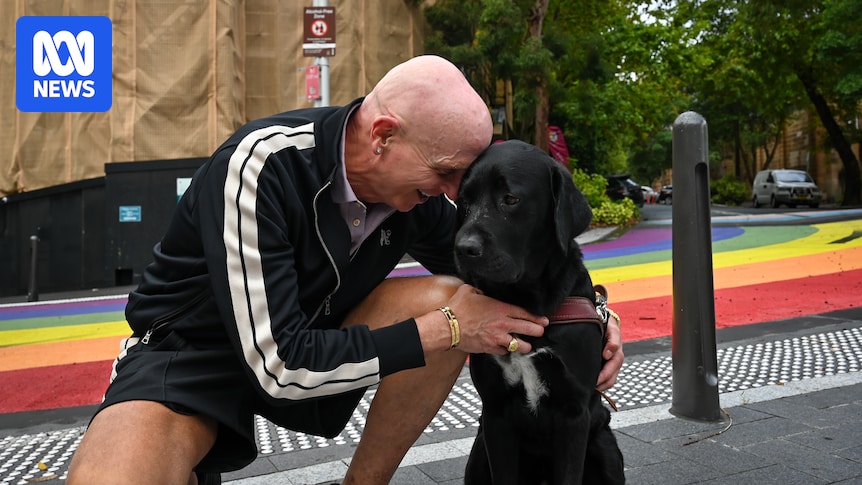
Scott Dixon-Smith, a blind man with a newfound sense of confidence, is set to march in tonight’s Sydney Gay and Lesbian Mardi Gras Parade, thanks to his guide dog, Pretzel. This marks the first parade for both Dixon-Smith and Pretzel, who has been his loyal companion for over a year.
“It just felt like a natural thing to do,” Dixon-Smith expressed. “What a great way to demonstrate to others how easy it is and how effortless it can be with a guide dog … he’s just amazing.”
To ensure Pretzel’s comfort during the march, Dixon-Smith plans to carry a bag filled with the dog’s favorite treats, such as kangaroo and chicken tenderloin, along with extra water. “I am not worried,” he said. “However, I am familiar with the signs and if it looks like he is getting stressed out, we will take some time away.”
From Closet to Pride Parade
Having spent years concealing his sexuality, Dixon-Smith never imagined he would be part of a pride parade, let alone in front of thousands. “But when I walked through the closet door, I closed it and never looked back,” he shared.
During the parade, Dixon-Smith and Pretzel will join the Guide Dogs NSW/ACT group, with Pretzel donning a special harness for visibility. This moment represents a significant personal triumph for Dixon-Smith, who has navigated numerous challenges throughout his life.
Diagnosed with Retinitis Pigmentosa
Dixon-Smith’s journey began at the age of 20 while studying at Westminster College in the US on a sports scholarship. It was during this time that he started missing tennis balls, a symptom that led to a diagnosis of retinitis pigmentosa, a degenerative eye disease.
“[It’s] kind of like a little Pac-Man running around and eating up the retinal cells,” he explained.
Forced to abandon his dream of a professional tennis career, Dixon-Smith transitioned into a marketing role at IBM, where he faced the dual challenges of blindness and a corporate culture unwelcoming to his sexuality.
Corporate Challenges and Personal Growth
In the 1980s, accessibility in corporate America was limited, but Dixon-Smith’s workplace made accommodations for his vision impairment. “They took all my course materials and increased the font size. The color of the page, they dimmed it to make it easier [to read],” he recalled.
Despite these adjustments, Dixon-Smith felt compelled to hide his sexuality due to the prevailing attitudes of the time. “I knew at the time going into corporate America, it wasn’t something that was readily approved of,” he said, noting the derogatory comments he overheard from colleagues.
Eventually, Dixon-Smith found the courage to live authentically after starting his own company. “When somebody would ask me if I were married or if I was dating, I would let them know — ‘Yes, and his name is so-and-so,'” he said. “I felt good about that … If somebody else has an issue with that, that issue belongs to them, not to me.”
Embracing Life with Pretzel
By age 40, Dixon-Smith had lost his vision completely. Although he considered a guide dog in the past, he lacked the time for training until his work demands lessened. In September 2024, he met Pretzel, and the connection was instantaneous.
“You cannot even begin to imagine the amazing difference it has made in my life,” Dixon-Smith said.
With Pretzel by his side, Dixon-Smith folded up his cane and embraced a new way of navigating the world. “I had no hesitation. I grabbed the harness and off I went. I thought ‘OMG’ — you could not take the smile off my face,” he said.
Before Pretzel, Dixon-Smith would never venture out alone. Now, he confidently explores the city, navigating escalators and stairs with ease. “It’s amazing — we navigate escalators [and] stairs with the greatest of ease,” he remarked.
Breaking Barriers and Inspiring Others
Pretzel and Dixon-Smith’s participation in the Mardi Gras Parade symbolizes more than just personal achievement; it is a testament to breaking barriers and embracing one’s true self.
“I hope it gives them [parade attendees] the opportunity to say, ‘Hey I’d like to talk to him’, because I would love for anybody to reach out to me and I welcome that conversation,” Dixon-Smith said.
Reflecting on his past, Dixon-Smith is proud of his journey and hopes to inspire others with vision impairments to engage more in community events. “There should never be a barrier, and we should be proud of who we are,” he stated. “The only barrier is the one we set for ourselves — and we are better than that.”