


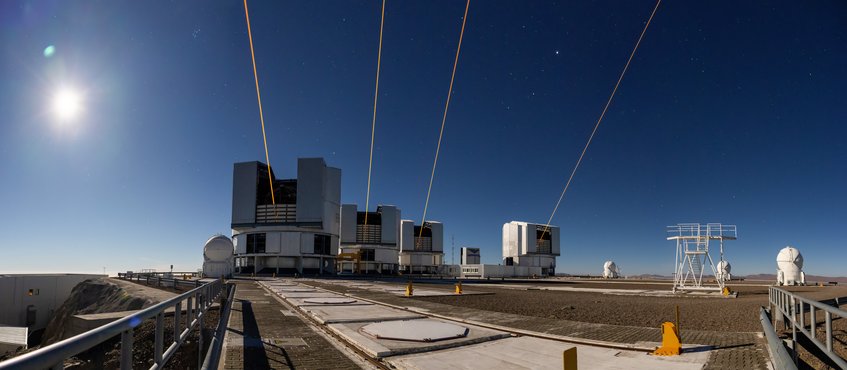
In a groundbreaking advancement for astronomical observation, four powerful lasers have been activated at the European Southern Observatory’s (ESO) Paranal site. These lasers are designed to create artificial stars, facilitating the correction of atmospheric distortion and enhancing the observational power of the Very Large Telescope Interferometer (VLTI).
The GRAVITY+ project, spearheaded by the Max Planck Institute for Extraterrestrial Physics, represents a significant leap in astronomical research. By integrating the four 8-meter ESO Very Large Telescopes into a single, giant virtual telescope through interferometry, GRAVITY+ promises to boost performance by several orders of magnitude. This enhancement will enable more precise measurements of black hole masses and support studies of the Galactic Center and early Universe quasars.
Revolutionizing Observational Capabilities
The installation of new lasers at the previously unequipped 8-meter telescopes marks a pivotal upgrade to the VLTI. These lasers allow for precise atmospheric corrections across the southern sky, significantly expanding the VLTI’s observational range. The project, developed by a consortium of European institutes and led by the Max Planck Institute for Extraterrestrial Physics (MPE), builds upon the success of the original GRAVITY instrument.
GRAVITY has already revolutionized high angular resolution astronomy, enabling precision tests of general relativity with the black hole at the center of the Milky Way, imaging exoplanets and young stellar objects, and determining the masses of supermassive black holes across the universe. With GRAVITY+, the telescopes and underground beam combiner have undergone numerous upgrades, including the installation of state-of-the-art wavefront sensors.
“The VLTI with GRAVITY has already enabled so many unpredicted discoveries, we are excited to see how GRAVITY+ will push the boundaries even further,” says GRAVITY+ principal investigator and director at MPE, Frank Eisenhauer.
Technological Advancements and Their Implications
MPE’s leadership in the GRAVITY+ project included the development and installation of four new wavefront sensors, which observe the artificial stars created by the laser guide stars. This advanced adaptive optics correction compensates for the blurring effects caused by Earth’s atmosphere, a critical improvement over previous reliance on bright natural reference stars.
The ability to create artificial stars anywhere in the sky is a game-changer. The laser light excites a small spot in a layer of atmospheric sodium atoms, approximately 90 kilometers above the Earth’s surface, creating a laser guide star. This innovation significantly expands the VLTI’s observational reach, granting access to the entire southern sky.
Exploring the Galactic Center and Beyond
The MPE Infrared Group plans to utilize the new adaptive-optics systems for pioneering studies in two major research areas: the Galactic Center and early Universe quasars. In the Galactic Center, enhanced sharpness and sensitivity will allow for the detection and tracking of fainter stars orbiting the supermassive black hole at the heart of the Milky Way, paving the way for a direct measurement of the black hole’s spin.
Furthermore, the enhanced capabilities will enable researchers to spatially resolve the gas swirling around supermassive black holes in distant galaxies. This method, applicable across cosmic time, leads to a direct measurement of black hole mass. According to MPE astronomer Taro Shimizu, “These upgrades open up the instrument to observations of objects in the early distant Universe, less than a few hundred million years after the Big Bang.”
First Observations and Future Prospects
The first laser target for the GRAVITY+ and ESO teams at Paranal was a cluster of massive stars at the center of the Tarantula Nebula, a star-forming region in the Large Magellanic Cloud. Guillaume Bourdarot from MPE explains, “Already these very first observations revealed that a bright object in the nebula, thought to be the most massive single star known, actually is a binary of two stars close together.”
This discovery underscores the stunning resolving power and scientific potential of the upgraded VLTI. The laser system, first envisioned in 1986, represents a long-awaited breakthrough in astronomical observation. As noted in the final report of the “Very Large Telescope Project,” coauthored by MPE director and Nobel prize winner Reinhard Genzel, “If it could work in practice, it would be a breakthrough.”
Consortium and Collaboration
The GRAVITY+ consortium comprises several esteemed institutions, including:
- Max Planck Institute for Extraterrestrial Physics (MPE); Max Planck Institute for Astronomy; University of Cologne (Germany)
- Institut National des Sciences de l’Univers, French National Centre for Scientific Research; Institut de Planétologie et d’Astrophysique de Grenoble; Laboratoire d’instrumentation et de recherche en astrophysique (LIRA); Lagrange Laboratory; Centre de Recherche Astrophysique de Lyon (France)
- Instituto Superior Técnico’s Centre for Astrophysics and Gravitation (CENTRA); University of Lisbon; University of Porto (Portugal)
- University of Southampton (UK)
- Katholieke Universiteit Leuven (Belgium)
- University College Dublin (Ireland)
- Instituto de Astronomia – Universidad Nacional Autónoma de México (Mexico)
- European Southern Observatory
As the GRAVITY+ project continues to unfold, the astronomical community eagerly anticipates the new discoveries and insights it will bring, pushing the frontiers of our understanding of the universe.