




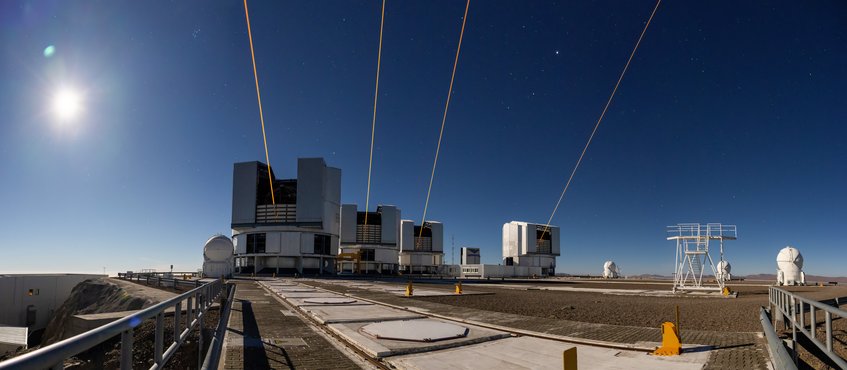
In a groundbreaking advancement for astronomical observation, four powerful lasers have been activated at the European Southern Observatory’s (ESO) Paranal site in Chile. These lasers are part of the GRAVITY+ project, a collaborative effort led by the Max Planck Institute for Extraterrestrial Physics, which aims to enhance the observational capabilities of the Very Large Telescope Interferometer (VLTI).
The GRAVITY+ project integrates the four 8-meter ESO Very Large Telescopes into a single, virtual telescope with unprecedented resolution through a technique known as interferometry. This enhancement significantly boosts the performance of the VLTI, allowing for more accurate measurements of black hole masses and facilitating studies of the Galactic Center and early Universe quasars.
Transformative Power of Lasers
The newly installed lasers at each of the 8-meter telescopes create artificial stars, enabling precise atmospheric corrections anywhere in the southern sky. This development dramatically expands the VLTI’s observational range, overcoming previous limitations that relied on natural reference stars for atmospheric correction.
GRAVITY+, developed by a consortium of European institutes, represents a substantial upgrade to the VLTI and the original GRAVITY instrument. The project has already revolutionized high angular resolution astronomy, facilitating precision tests of general relativity and enabling the imaging of exoplanets and young stellar objects.
“The VLTI with GRAVITY has already enabled so many unpredicted discoveries, we are excited to see how GRAVITY+ will push the boundaries even further,” says GRAVITY+ principal investigator and director at MPE, Frank Eisenhauer.
Technological Advancements and Research Implications
The Max Planck Institute for Extraterrestrial Physics (MPE) played a pivotal role in the development of GRAVITY+, leading the overall design and installation of new wavefront sensors. These sensors observe the artificial stars created by the laser guide stars, providing advanced adaptive optics correction for the VLTI.
Before the laser installation, atmospheric correction at the VLTI depended on bright natural stars, limiting the number of observable objects. The new lasers allow for the creation of artificial stars anywhere in the sky, significantly expanding the VLTI’s reach and enabling access to the entire southern sky.
Exploring the Galactic Center and Beyond
The MPE Infrared Group plans to utilize the new adaptive-optics systems for pioneering research in the Galactic Center and early Universe quasars. The enhanced sharpness and sensitivity will enable the detection and tracking of faint stars orbiting the supermassive black hole at the Milky Way’s core, potentially leading to a direct measurement of the black hole’s spin.
These capabilities will also allow researchers to resolve gas around supermassive black holes in distant galaxies, providing direct measurements of black hole masses across cosmic time. This breakthrough opens up new opportunities for observing objects in the early Universe, less than a few hundred million years after the Big Bang.
“These upgrades open up the instrument to observations of objects in the early distant Universe, less than a few hundred million years after the Big Bang. We will be able to measure black hole masses more precisely than ever before,” says Taro Shimizu, an MPE astronomer.
Historical Context and Future Prospects
The concept of using lasers for atmospheric correction was first proposed in 1986, long before the VLT and VLTI existed. The realization of this vision marks a significant milestone in astronomical research, fulfilling a decades-old aspiration.
The GRAVITY+ consortium includes partners from Germany, France, Portugal, the UK, Belgium, Ireland, Mexico, and the European Southern Observatory. This international collaboration underscores the global effort to push the boundaries of astronomical observation.
As the GRAVITY+ project continues to evolve, it promises to unlock new frontiers in our understanding of the Universe, from the dynamics of the Galactic Center to the formation of the earliest cosmic structures. The enhanced capabilities of the VLTI will undoubtedly lead to further groundbreaking discoveries in the years to come.