


Throughout history, musicians have played pivotal roles in protest movements, from anti-war anthems to advocating for immigration rights. At the 2026 Grammy Awards, several artists demonstrated their commitment to speaking truth to power, using their moment in the spotlight to address pressing social issues.
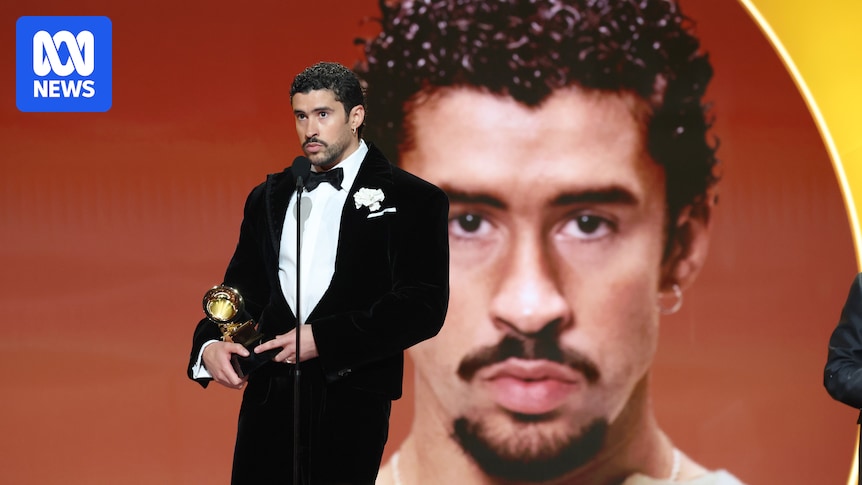
Puerto Rican singer Bad Bunny, accepting his award for Best Música Urbana Album, made a bold statement against the U.S. Immigration and Customs Enforcement (ICE). “Before I say thanks to God, I’m gonna say ‘ICE out’,” the superstar, whose real name is Benito Ocasio, declared to a cheering audience. His speech continued with a call for more love and less hate, even when confronting those who cause harm.
“I know it’s tough not to hate on these days … The hate gets more powerful with more hate. The only thing that is more powerful than hate is love. We need to be different. If we fight, we have to do it with love. We don’t hate them, we love our people, we love our family, that’s the way to do it – with love. Don’t forget that please.”
Artists Take a Stand
This development follows a history-making moment for Bad Bunny, who is set to perform as the first Latino and Spanish-speaking solo headliner at the Super Bowl in just seven days. The choice of entertainment has already drawn criticism from U.S. President Donald Trump, who told the New York Post in January, “I’m anti-them. I think it’s a terrible choice. All it does is sow hatred. Terrible.”
Last year, Bad Bunny notably omitted America from his world tour, citing concerns about ICE’s presence at concerts. “There was the issue of, like, f****** ICE could be outside [the concert],” he told i-D Magazine, highlighting the tension between artists and immigration enforcement.
Meanwhile, Bruce Springsteen recently released a surprise protest song against “the state terror being visited” on Minneapolis by the enforcement agency, illustrating the widespread discontent with ICE’s actions.
Billie Eilish and Others Join the Chorus
Song of the Year winner Billie Eilish dedicated her entire speech to the plight of immigrants in the U.S. today. “I don’t feel like I need to say anything, but that no-one is illegal on stolen land,” she stated while accepting the award for her song “Wildflower.”
“It’s really hard to know what to say and what to do right now. I feel like we just need to keep fighting and speaking up and protesting. Our voices really do matter, and people matter, and ‘f*** ICE’ is all I want to say.”
Olivia Dean, fresh from her Hottest 100 victory last weekend, was more subtle but equally firm while accepting her award for Best New Artist. “I’m up here as the granddaughter of an immigrant,” she said, emphasizing the importance of celebrating immigrant contributions. “I’m a product of bravery, and I think those people [immigrants] deserve to be celebrated. We’re nothing without each other.”
Accepting the award for Record of the Year for her collaboration with Kendrick Lamar on “Luther,” SZA appealed to viewers to maintain hope and faith. “Please don’t fall into despair,” SZA urged. “We can go on, we need each other, we need to trust each other and trust ourselves. Trust your heart. We’re not governed by the government, we’re governed by God.”
Reflecting the Shifting Sound of Pop
The Grammys this year highlighted a significant shift in the music industry. Bad Bunny’s “Debí Tirar Más Fotos” became the first Spanish-language album to win Album of the Year in the Grammy’s 68-year history. This win comes at a time when many Spanish-speaking Americans are feeling increasingly marginalized.
The night marked a potential shake-up of U.S. pop dominance, with the success of artists like Bad Bunny, K-Pop Demon Hunters, and former Blackpink singer Rosé throughout 2025. The winners’ podium was not dominated by Western musicians and styles, though some legacy favorites still managed to edge out a full-scale shift.
Eilish’s “Wildflower” deserved its accolades, but alongside K-Pop Demon Hunters’ “Golden,” Rosé’s “APT.,” and Bad Bunny’s “DtMF,” this year felt like a significant embrace of non-Western pop music. A reflection of this at the Grammys would have been noteworthy.
SZA and Kendrick Lamar’s win for Record of the Year with “Luther” also addressed the historical snubbing of hip hop in the main Grammy categories, adding to the night’s significance.
Aussies at the Grammys
In a solid year for Australian representation at the Grammys, results were mixed. Kevin Parker added to his trophy shelf with a win for Best Dance/Electronic Recording for Tame Impala’s track “End Of Summer.” This marked his first Grammy win for Tame Impala alone, following a previous win as a guest on Justice’s “Neverender.”
However, Melbourne punks Amyl & The Sniffers missed out on Best Rock Performance, losing to Yungblud’s version of Black Sabbath’s “Changes.” Similarly, RUFUS DU SOL missed out on the Best Dance/Electronic Album award, which went to British singer FKA twigs for “EUSEXUA,” rounding out an up-and-down night for Australians.
The Grammy Awards 2026 not only celebrated musical achievements but also served as a platform for artists to voice their concerns and advocate for social change, reflecting the evolving landscape of the music industry and its intersection with global issues.