




A small brown line snakes its way through the rainforest in northern Sumatra, carving 300 meters through dense patches of meranti trees, oak, and mahua. This modest access road, picked up by satellites, is set to extend 2 kilometers to connect with the Tor Ulu Ala pit, an expansion site of Indonesia’s Martabe mine. While this road aims to unlock valuable gold deposits worth billions in today’s market, it poses a significant threat to wildlife, particularly the world’s rarest ape, the Tapanuli orangutan.
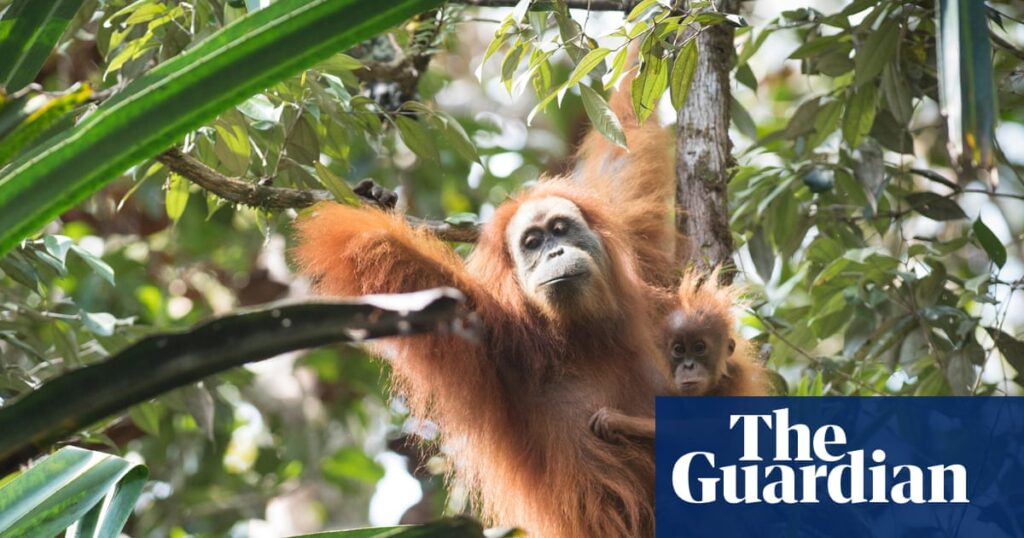
The network of planned access roads will cut through critical habitat essential for the survival of the Tapanuli orangutans, scientists warn. This species, unique to Indonesia, was only identified as distinct from its Sumatran and Bornean relatives in 2017. With fewer than 800 individuals remaining in an area covering just 2.5% of their historical range, all are found in Sumatra’s fragile Batang Toru ecosystem, bordered by the Martabe mine, operational since 2012.
The Economic Drive vs. Environmental Concerns
For Jardine Matheson, which acquired the mine in 2018, expansion is vital for financial sustainability. In 2020, the company announced plans to open a new pit and build infrastructure to extract at least 460,000 additional ounces of gold from Tor Ulu Ala. With gold prices soaring to over $4,000 per ounce, this venture could generate nearly $2 billion.
“While we understand the concerns of some critics, without the mine, which is now the income for approximately 3,500 employees—70% of whom are locals—the alternative will be worse,” says Ruli Tanio, vice-president director of PT Agincourt Resources. “Being responsible miners, we can provide some opportunity for the orangutan in terms of funding.”
“This is absolutely the wrong place to be digging for gold,” says Amanda Hurowitz, coordinator of the forest commodities team at Mighty Earth. “And for what? So mountains of gold bullion bars can sit in the vaults of the world’s richest countries.”
Impact on the Tapanuli Orangutan
Many scientists argue that the mine’s expansion could drive the critically endangered Tapanuli orangutans to extinction within a few generations. Erik Meijaard, director of the scientific consultancy Borneo Futures, emphasizes the species’ vulnerability, noting that even a 1% annual population decline could lead to extinction, as orangutans reproduce every six to nine years.
Concerns extend beyond the scientific community. Last year, Norway’s $1.6 trillion sovereign wealth fund divested from three Jardines firms, citing severe environmental damage concerns.
“It doesn’t take much—especially if you start killing orangutan females—for the population to go extinct,” says Meijaard.
Conservation Efforts and Challenges
The Tapanuli orangutans, with their frizzy, cinnamon hair and wide faces, represent the oldest lineage of orangutan species, tracing back over 3 million years. In Batang Toru, they exist in three populations across a forest area roughly the size of Rio de Janeiro.
Even before the mine’s proposed expansion, the Tapanuli faced threats from development, including a Chinese-owned hydroelectric project on the Batang Toru River. This dam could impact an area with the highest density of Tapanuli orangutans, about 42 individuals, according to a 2019 assessment.
PT Agincourt plans to expand the Martabe mine by about 250 hectares, including clearing 48 hectares of primary forest in a key biodiversity area. The company has pledged to set aside a 2,000-hectare conservation zone within its concession and create an “offset” protected area 40 kilometers from the mine site.
“Without the [mining] revenue from this small area, it will be very hard to carry out the conservation work and the restoration work that is planned,” says Christopher Broadbent, a UK-based sustainability consultant to PT Agincourt.
Looking Ahead: Conservation vs. Economic Development
Environmental advocates and the International Union for Conservation of Nature (IUCN) have urged delaying new construction until a protection plan is agreed upon. Jardine Matheson had previously paused construction, engaging with the IUCN’s Avoid, Reduce, Restore and Conserve (ARRC) taskforce, but this agreement expired in December 2022.
Recently, PT Agincourt signed a new memorandum with the ARRC taskforce, allowing independent input on development plans. The company has temporarily paused road construction for three weeks for an IUCN review.
“You cannot say that any great ape species is better with mining than without,” says Genevieve Campbell, leader of the ARRC taskforce.
For Meijaard, no compensation can truly mitigate the mine’s impact on the orangutans. “If we really want to protect the species, we have to aim for zero losses,” he asserts.
The debate over the Martabe mine’s expansion highlights the ongoing conflict between economic development and environmental conservation, with the future of the Tapanuli orangutan hanging in the balance.