



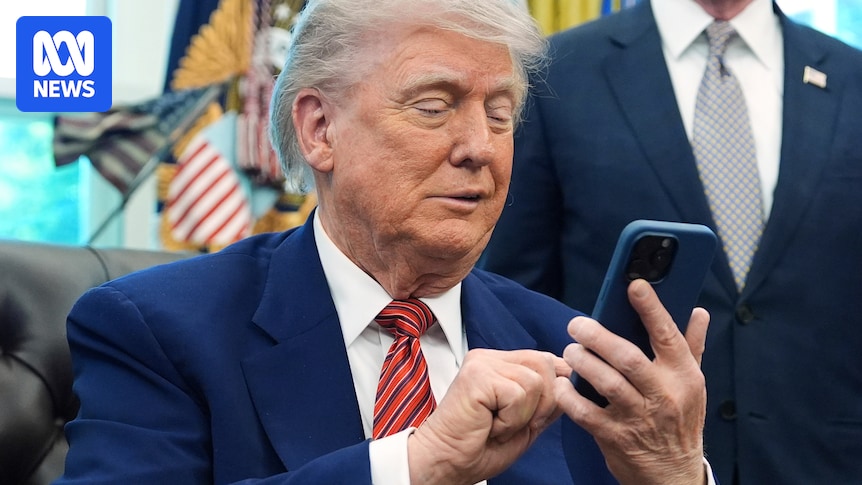
In a bold move to position the United States as a leader in the next wave of mobile technology, former President Donald Trump announced a strategic push to lead the global “6G race.” This initiative, unveiled in a statement on Friday, sets a one-year timeline for the U.S. government to begin laying the groundwork for 6G networks. The president authorized the clearance of national radio frequencies currently used by federal agencies, paving the way for private companies to commence planning and testing.
“The next generation of mobile communications networks (6G) will be foundational to the national security, foreign policy, and economic prosperity of the United States,” Trump stated. He emphasized that 6G technology will be crucial in advancing emerging technologies such as artificial intelligence, robotics, and implantable technologies, while also enhancing national security and public safety through faster and more secure communication networks.
The Promise and Potential of 6G Technology
As the world anticipates the dawn of 6G, experts are weighing in on what this new generation of mobile computing might entail. Jay Guo, a distinguished professor from the University of Technology Sydney, highlights three key differences that will set 6G apart from its predecessor, 5G.
- Integration of terrestrial and non-terrestrial networks: This involves combining existing mobile networks with satellite and drone technologies to expand coverage beyond land, reaching into air and space.
- Network sensing: New technologies will enable networks to detect and respond to environmental factors, such as predicting weather patterns and potential floods.
- AI Native: Artificial intelligence will play a central role in the operation and optimization of 6G networks.
“Australia definitely needs 6G for coverage purposes because we can’t roll out the existing terrestrial networks to cover 100 percent of the land,” Professor Guo told the ABC.
Dr. Ming Ding from CSIRO’s Data 61 Privacy Technology Group added that 6G could revolutionize communications with new platforms and applications, including unmanned aerial vehicles, holographic presence, and intelligent healthcare.
U.S. Strategy and Global Collaboration
Trump’s statement outlined a comprehensive strategy for the U.S. to secure a leadership position in 6G development. This includes a detailed study of federal radio frequencies through 2025 to identify those suitable for 6G without compromising national security. Assistant Secretary of Commerce for Communications and Information Arielle Roth has been tasked with overseeing this effort, with a report due by December 2026.
Furthermore, Trump instructed Secretary of State Marco Rubio to form a coalition of industry and international partners to support U.S. positions on 6G. This initiative underscores the importance of international collaboration in setting global standards for the technology.
However, experts like Professor Guo caution against unrealistic expectations. “This mobile telecommunications technology follows a global standard. The standardization activity just started this year. It will take at least four years to complete,” he noted.
“America is quite often pretending to be first on things when they’re not,” commented technology commentator Trevor Long, highlighting the U.S.’s tendency to overstate its technological advancements.
Australia’s Role in the Global 6G Landscape
In February 2024, Australia joined a coalition of countries, including the U.S., Canada, and several European nations, in a joint agreement to share research and development efforts for 6G. This collaboration aims to address challenges in 6G development while prioritizing national security, privacy, and environmental sustainability.
Despite this progress, tensions with China remain a concern. In November, Chinese state media accused Australia of perpetuating negative narratives about China’s 6G development. This followed comments by former government cyber adviser Alastair MacGibbon, who warned of potential national security risks in collaborating with Beijing.
Professor Guo emphasized the strategic importance of developing domestic capabilities, noting the risks of relying on foreign companies for satellite communications. Prime Minister Anthony Albanese assured that any 6G rollout would be carefully assessed for national security implications.
Future Prospects for 6G in Australia
Currently, Australia lacks a 6G network, with major telecommunications companies like Telstra, Optus, and Vodafone providing extensive 5G coverage. The transition from 3G to 4G and now 5G has been gradual, and experts predict a similar trajectory for 6G.
Professor Guo estimates that Australia may not see 6G coverage until at least 2030, citing the need for higher data rates in urban areas and comprehensive satellite coverage in rural regions. Trevor Long echoed this sentiment, pointing to the lengthy process of 5G development as a precedent.
According to Luke Coleman, CEO of the Australian Telecommunications Alliance, 6G has the potential to significantly enhance connectivity by replacing existing networks. However, he cautioned that the high cost of spectrum licenses could hinder progress. “Every dollar spent on spectrum is a dollar that can’t be invested in mobile coverage and capacity,” Coleman warned.
“Higher spectrum costs reduce the pool of capital available to support investment commitments. An increase of this magnitude will inevitably constrain the funds available to invest in 5G Advanced, and in future, 6G,” he added.
As the global race for 6G intensifies, Australia stands at a crossroads, balancing the need for technological advancement with strategic considerations in a rapidly evolving digital landscape.