



Physical inactivity remains a significant global public health issue, contributing to disease, mortality, and healthcare costs. Despite its impacts being comparable to smoking or obesity, it has not garnered adequate political attention. In 2012, physical inactivity was estimated to contribute to over 5 million deaths annually and account for 6–10% of the global burden of major noncommunicable diseases.
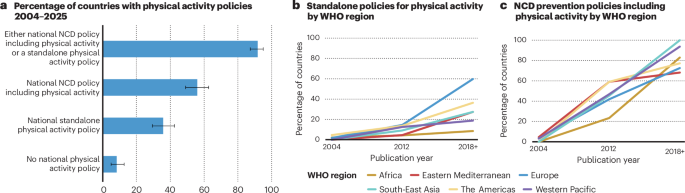
Since 2004, many countries have developed national physical activity policies or incorporated physical activity into broader noncommunicable disease strategies. However, population-level physical activity has not increased significantly in most regions. The World Health Organization’s target of a 15% relative reduction in physical inactivity by 2030 appears increasingly unlikely to be achieved. This disconnect raises questions about why policy has not translated into meaningful action and what continues to limit implementation.
Challenges in Policy Implementation
Interviews with policy leaders and experts reveal that physical activity is considered a ‘low but increasing’ policy priority, rarely perceived as urgent. An analysis of policy documents from 200 countries indicates that while most report some form of physical activity policy, these are often aspirational and lack clear targets, dedicated funding, timelines, and accountability mechanisms. Few are comprehensive, multisectoral policies assigning cross-sector responsibilities.
Four related challenges help explain this gap: physical activity is largely framed as an individual health issue, limiting policy ownership beyond the health sector; the wider benefits such as mental, social, environmental, and economic outcomes remain under-emphasized; governance lacks a clear administrative or budgetary home or leadership; and coalition-building beyond physical activity and health communities is limited. These factors contribute to weak implementation and modest or delayed population-level impacts.
Expert Insights and Analysis
According to a global analysis of national physical activity policy documents from 200 countries, conducted by the Global Observatory for Physical Activity–GoPA!, these challenges are prevalent. The study, which included interviews with 46 key informants from government, academia, international organizations, and health and non-health related sectors, applied an established political priority framework to examine how physical activity is defined, framed, governed, and supported through coalitions.
“Physical inactivity is a silent epidemic that requires urgent political commitment and resources to address effectively,” stated Dr. Maria Neira, Director of the Department of Public Health, Environmental and Social Determinants of Health at WHO.
The study identified structural and political factors that contribute to policies stalling at the adoption stage rather than being implemented effectively. These findings highlight the need for sustained resources, coordination, and political commitment to drive meaningful change.
Implications and Future Directions
The implications of continued inaction on physical activity are profound, not only for public health but also for social, economic, and environmental outcomes. Addressing these issues requires a shift in how physical activity is perceived and prioritized within political agendas. This includes recognizing its broader benefits and integrating it into multisectoral strategies with clear targets and accountability mechanisms.
Moving forward, countries must prioritize coalition-building beyond traditional health sectors to include education, transportation, urban planning, and environmental agencies. This holistic approach can help create environments that support active lifestyles and promote well-being.
As the world grapples with the dual challenges of noncommunicable diseases and climate change, integrating physical activity into broader policy frameworks offers a unique opportunity to address multiple issues simultaneously. The time for action is now, and the stakes could not be higher.