




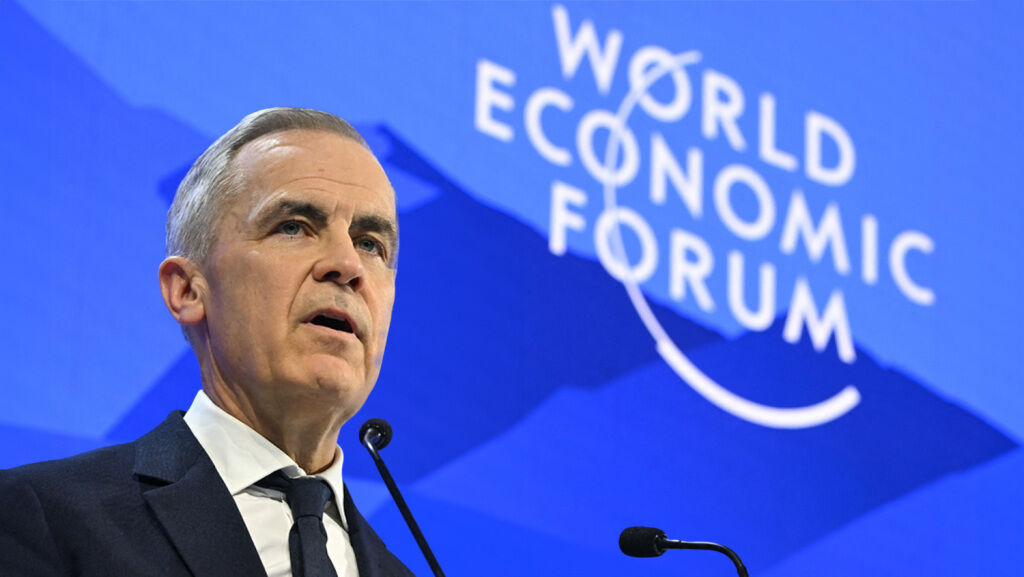
“Today I will talk about a rupture in the world order, the end of a pleasant fiction, and the beginning of a harsh reality,” declared Canadian Prime Minister Mark Carney at the World Economic Forum in Davos on Tuesday. His stark message underscored a shifting geopolitical landscape, where the rules-based order is waning, and power dynamics are reshaping global alliances.
Carney, the former governor of the Bank of Canada and the Bank of England, emphasized that “intermediate powers” such as Canada, Australia, and the United Kingdom, which have traditionally thrived under American dominance, must now seek alternative alliances. He pointed to China and the European Union as potential partners in what he termed “diversifying” and “buying insurance.”
Emergence of Economic Blocs
The speech painted a picture of a world transitioning into “fortresses” or economic blocs, which Carney warned would lead to economies becoming “poorer, more fragile, and less sustainable.” To counteract this, he is advocating for new trade agreements with Mercosur and India, aiming to bolster economic resilience.
Carney’s remarks have not gone unnoticed in the United States. President Donald Trump responded by disinviting Carney from the newly formed Board of Peace, an America-led initiative intended to replace the United Nations, which Trump has criticized as corrupt and anti-American.
Economic Warning Signs
Carney’s speech coincides with mounting global economic warning signs and growing skepticism about the post-gold-standard monetary system. On Friday, the price of gold nearly reached $5,000 per ounce, while silver surpassed the $100-per-ounce mark for the first time in history.
“When the price of gold jumps, it is a sign that people are worried. When it doubles in less than a year—and is up 10 times in value in 15 years—it is a warning that something is seriously wrong.”
Ray Dalio, manager of the world’s largest hedge fund, echoed these concerns at Davos, highlighting a “breakdown of the monetary order.” He posed a critical question: “Do you print money or do you let a debt crisis happen?” With America’s national debt exceeding $38 trillion and unfunded social liabilities surpassing $100 trillion, the stakes are high.
Shifting Trust in Fiat Currencies
Dalio noted that trust in fiat currencies and debt as a store of wealth is eroding. Central banks are reflecting this shift, with Poland’s recent announcement to purchase an additional 150 tons of gold as a hedge against geopolitical instability.
“Our primary goal is to build an appropriate portfolio for these unstable geopolitical times, one that will guarantee Poland stability, security, and credibility,” said Artur Sobon of the Bank of Poland.
Poland is not alone in this strategy. Central banks worldwide have increased gold purchases, wary of the ease with which Russia’s foreign dollar reserves were frozen following its invasion of Ukraine. Gold, stored domestically, is seen as a safer asset.
Historical Context and Future Prospects
Historically, the transition from the gold standard in the 1970s positioned the U.S. dollar as the world’s reserve currency, granting America significant economic advantages. However, current trends indicate a waning trust in the dollar system, with nations concerned about the security of their dollar reserves.
India, for instance, has reduced its holdings of U.S. treasuries to a five-year low, opting instead to increase its gold reserves. This shift signals a broader reevaluation of the dollar’s role in global finance.
The world appears to be fracturing, with old alliances dissolving and a new order emerging. These trends are likely to continue, as highlighted by Gerald Flurry, editor in chief of Trumpet, who warned of the dangers of division and the intensifying threats facing America and its allies.
“The division developing between our nations is a deadly weakness,” Flurry wrote. “Threats in the world are increasing. … Other nations are betraying and attacking America and Britain and Israel.”
Flurry’s insights, drawn from biblical prophecies, suggest that economic and geopolitical divisions will exacerbate global instability. The solution, he argues, lies not in economic measures but in a return to spiritual values.
As Carney aptly concluded, the world order is indeed rupturing, and while a new one is emerging, it may not align with current expectations. The global community must navigate this uncertain landscape with caution and foresight.