




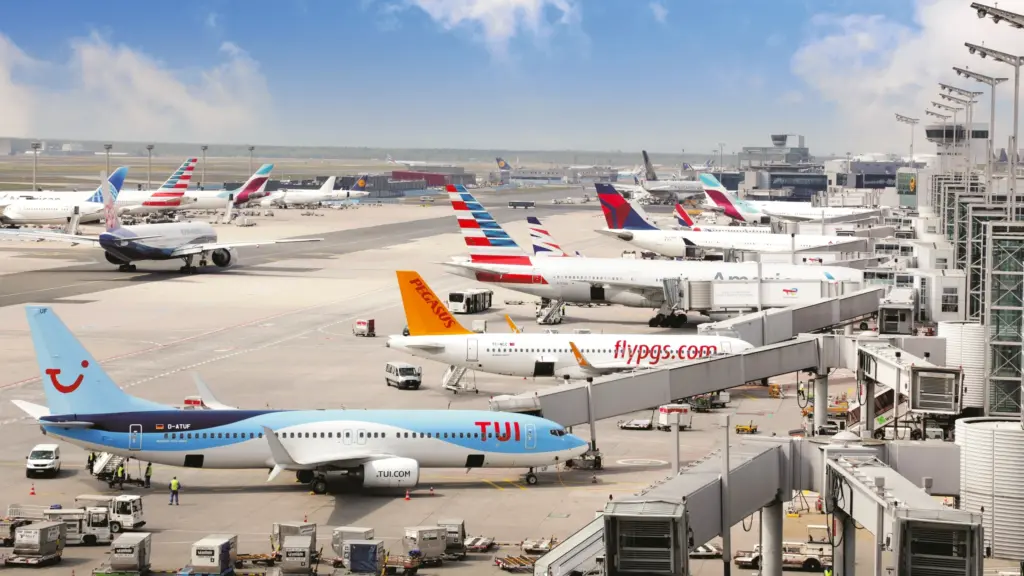
In recent years, the commercial aviation industry has witnessed significant growth, fueled by advances in aircraft technology, operational efficiency, and passenger demand. Modern airlines are now able to maintain extensive fleets that balance fuel efficiency, capacity, and global connectivity. These fleets are not merely numbers on a roster—they reflect an airline’s strategy, market reach, and ability to adapt to evolving travel trends.
As of December 2025, the airlines with the largest fleets include a mix of U.S., Chinese, European, and Middle Eastern carriers, reflecting the global spread of air travel. This article provides an up-to-date snapshot of these carriers’ fleets, from single-aisle workhorses to the most advanced widebody jets, as reported by Aerospace Global News.
United Airlines: Leading the Pack
Topping the list is United Airlines (UA), which operates the world’s largest mainline fleet, with 1,058 aircraft. Headquartered in Chicago, United connects more than 370 destinations worldwide, a network unmatched by any other airline. United’s narrowbody fleet primarily consists of Boeing 737 family jets and Airbus A320/A321 aircraft, alongside a few Boeing 757s. The widebody fleet, meanwhile, is exclusively Boeing, featuring the 767, 777, and 787 Dreamliner.
United’s fleet strategy emphasizes both domestic efficiency and long-haul flexibility. The airline’s latest delivery, a Boeing 737 MAX 9 in December 2025, highlights a continued investment in fuel-efficient aircraft to reduce operating costs and environmental impact. Beyond numbers, United’s fleet diversity allows for a range of route structures. Narrowbodies dominate domestic and regional services, while widebodies support transcontinental and international flights, including routes to Asia, Europe, and South America.
American Airlines: A Close Contender
Closely following is American Airlines (AA), with 1,013 aircraft in its mainline fleet. Headquartered in Fort Worth, Texas, American serves nearly 350 destinations worldwide. The narrowbody fleet is a mix of Airbus A320/A321 family jets and Boeing 737 aircraft, while the widebody fleet is entirely Boeing. This includes 47 Boeing 777-200s, 20 777-300ERs, 37 787-8s, and 33 787-9 Dreamliners.
Such a lineup ensures American can operate both high-frequency domestic routes and long-haul international flights efficiently. American’s recent delivery of a Boeing 737 MAX 8 in December 2025 reinforces its strategy of modernizing the narrowbody fleet. By prioritizing fuel efficiency and operational standardization, American is able to maintain competitive economics across its domestic and international network, which remains critical in a challenging global aviation market.
Delta Air Lines: A Strategic Divergence
Delta Air Lines (DL), headquartered in Atlanta, ranks third with a fleet of 989 aircraft. Delta is the world’s largest airline by revenue and operates over 5,500 daily flights, covering nearly 325 destinations across 52 countries. Delta’s fleet strategy diverges slightly from its U.S. peers: while its narrowbody fleet includes Airbus A220s, A320 family jets, Boeing 717s, 737s, and 757s, the widebody fleet is Airbus-only, comprising 81 A330s and 40 A350-900s.
The airline recently received an Airbus A321neo in December 2025, reflecting a continuous push toward fuel efficiency and passenger comfort on short- and medium-haul routes. The Airbus widebody focus allows Delta to streamline training, maintenance, and operations for long-haul flights. The A350-900, for example, provides extended range and superior fuel economy on high-capacity routes, demonstrating Delta’s strategic fleet alignment with passenger demand and environmental goals.
Global Fleet Trends and Observations
Several trends are apparent when examining the world’s largest airline fleets:
- Single-aisle dominance in short-haul operations: U.S. carriers, Chinese airlines, and Ryanair rely heavily on narrowbody aircraft such as the Boeing 737 and Airbus A320 family for domestic and regional services. These aircraft provide cost-effective, high-frequency connectivity.
- Widebody modernization for long-haul efficiency: Carriers are replacing older widebody aircraft with fuel-efficient models like the Boeing 787 Dreamliner, Airbus A350, and COMAC C919 for long-haul operations. Modern widebodies offer increased range, lower operating costs, and improved passenger comfort.
- Fleet diversity reflects strategic priorities: Airlines like Delta, China Southern, and Turkish Airlines operate mixed fleets that balance domestic reliability with long-haul performance. Meanwhile, low-cost carriers like Ryanair and Southwest benefit from single-type fleets for operational simplicity.
- Integration of domestic aircraft: Chinese carriers are increasingly integrating COMAC-built aircraft into their fleets, signaling a growing domestic manufacturing capability and long-term strategy for cost reduction and fleet independence.
The airlines with the largest fleets in 2026 illustrate the complexity and scale of global aviation. The U.S. “big three”—United, American, and Delta—dominate in fleet size and network reach, while Chinese carriers such as China Southern, China Eastern, and Air China leverage fleet diversity for both domestic and international operations. Regional carriers like SkyWest, alongside European and Middle Eastern airlines like Ryanair and Turkish Airlines, demonstrate the importance of fleet strategy tailored to market positioning, passenger demand, and operational efficiency.
As aircraft technology advances, airlines continue to modernize their fleets, balancing narrowbody efficiency with widebody performance. Looking forward, fleet size will remain a crucial metric of global airline competitiveness, offering insights into an airline’s operational strength, network strategy, and ability to meet evolving passenger expectations.
Stay tuned with us for further updates and follow us on social media for the latest news in aviation.