




Aortic stenosis, a condition marked by the narrowing of the aortic valve, poses a significant health risk, affecting millions globally. Without timely intervention, it can lead to severe health consequences, including fatality. Currently, the only viable treatments are surgical or percutaneous valve replacement, as no effective medical therapies exist to halt its progression.
In a groundbreaking development, researchers have identified common genetic variants linked to the clinical diagnosis of aortic stenosis, offering new hope for early detection and intervention. This study, conducted by a team from UC San Francisco and the Broad Institute of MIT and Harvard, has been published in the prestigious journal Nature Genetics.
Genetic Research and Study Methods
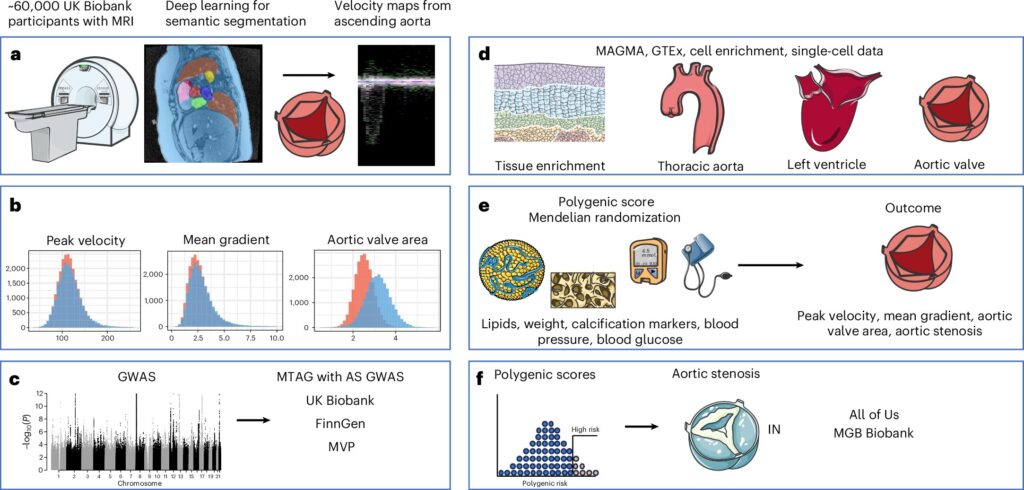
The research aims to unravel the genetic factors contributing to the onset of aortic stenosis. Given the rarity of severe cases in the general population, the researchers turned to continuous measurements of aortic valve function to uncover genetic signals. Their large-scale genetic analysis involved nearly 60,000 healthy participants from the UK Biobank, utilizing deep learning-derived measurements of aortic valve function.
The study focused on three key metrics: peak velocity, mean gradient, and aortic valve area (AVA), derived from MRI scans and genome-wide association studies (GWAS). This approach led to the identification of 61 distinct genetic loci associated with these traits. A subsequent meta-analysis involving over 40,000 cases and 1.5 million controls from various biobanks revealed 91 additional loci.
Through a comprehensive multi-trait analysis, which incorporated both continuous aortic valve measures and disease-based GWAS, the researchers identified 166 genetic loci, with 134 linked to aortic valve function and 134 to aortic stenosis.
Key Findings and Implications
“In this study, we analyzed aortic valve function and disease diagnoses to comprehensively evaluate the common genetic basis for aortic stenosis,” said Dr. James Pirruccello, the study’s senior author and a cardiologist at UCSF. “Our findings suggest that risk for aortic stenosis is conferred at least in part through the same genetic mechanisms that drive normal variation in aortic valve function in the healthy population.”
“The genetic correlation between these measures in healthy people and the aortic stenosis GWAS meta-analysis was substantial: on a scale of 0–1, the correlation with aortic stenosis was 0.64 for the gradient-based measures and 0.50 for AVA.”
Dr. Shinwan Kany, a visiting scientist at the Broad Institute, highlighted the role of deep learning in the study. “Using deep learning to measure normal variation in aortic valve function helped us to identify 134 loci associated with aortic stenosis risk and 166 with aortic valve stenosis or function,” Kany explained. “We observed strong associations between aortic stenosis risk and coronary artery disease, lipoprotein biology, and phosphate handling, suggesting future avenues for research to prevent the development or progression of aortic stenosis.”
Future Directions and Clinical Validation
The study’s authors, including collaborators from Mass General Brigham, the Institute for Molecular Medicine Finland, and Beth Israel Deaconess Medical Center, emphasize the need for clinical validation before implementing any programs aimed at manipulating cholesterol or phosphate levels for aortic stenosis prevention.
Despite the need for further validation, Dr. Pirruccello remains optimistic. “These findings demonstrate the power of jointly analyzing cardiovascular structure and function and their downstream disease outcomes,” he noted.
The announcement comes at a time when the integration of genetics and artificial intelligence is increasingly recognized as a transformative approach in medical diagnostics. The insights gained from this study not only pave the way for improved diagnostic tools but also open up new research pathways for preventive strategies against aortic stenosis.
As the medical community continues to explore these genetic connections, the potential for early intervention and improved patient outcomes becomes increasingly tangible. The move represents a significant step forward in the fight against aortic stenosis, offering hope to millions affected by this condition worldwide.