


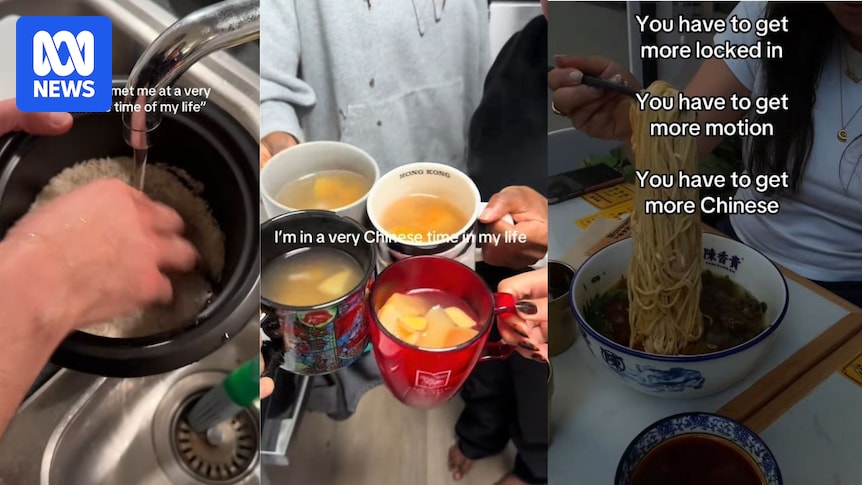
If you’ve been scrolling through TikTok or Instagram recently, you might have stumbled upon videos captioned, “You met me at a very Chinese time in my life.” These clips showcase people “Chinamaxxing” by engaging in activities like drinking Tsingtao beers, wearing slippers indoors, using rice cookers, and avoiding cold foods—practices that nod to Chinese culture and traditions.
Interestingly, this trend isn’t limited to individuals with Chinese backgrounds. Last month, Australian musician Keli Holiday participated in the trend to rally support for his entry in Triple J’s Hottest 100 competition. He joins a growing number of young Westerners who claim to be experiencing a “Chinese” phase, a development that has surprised some observers and suggests a shift in the perception of Chinese culture.
Origins of the Trend
The phrase “You met me at a very Chinese time in my life” is a playful twist on the iconic line from the cult film Fight Club: “You met me at a very strange time in my life.” According to Sow Keat Tok, a lecturer at the University of Melbourne’s Asia Institute, this trend is reminiscent of last year’s viral “six-seven” social media phenomenon.
“It’s come out of nowhere,” Tok remarked. “I think it started off as trying to show the difference between Chinese culture and other cultures. Suddenly, it caught the attention of the wider audience in general, and people started replicating and reproducing.”
Chinese Australian travel content creator Dana Wang believes that social media has reframed China for young consumers, challenging outdated preconceptions about the country. She cites the brief ban of TikTok in the United States last year and the subsequent embrace of the Chinese alternative, Xiaohongshu (Red Note), as pivotal moments for the mainstream consumption of Chinese culture.
Shifting Perceptions of Chinese Culture
While some Chinese Australian content creators view the trend as a double-edged sword, given historical stereotypes, others see it as a positive shift. Culture Club podcast host and content creator Maggie Zhou expressed mixed feelings about the trend, a sentiment echoed by Wang.
“It’s kind of mixed feelings because I’m very happy that people are discovering China,” Wang said. “But also, it’s kind of strange because Chinese culture and China have always been demonised. So it’s a bit shocking that there’s been a change because we’re so used to receiving a lot of hate.”
The Rise of East Asian Pop Culture
In recent years, Japanese music, food, and art have gained popularity in the West, while Korean cultural phenomena, broadly known as “hallyu,” have captivated global audiences. From K-dramas and K-pop to K-beauty and K-lit, Korean popular culture has become mainstream in Western countries.
However, Wang points out that Chinese trends have often been overshadowed. She notes that Japan is frequently romanticized, whereas China is often demonized. Many Chinese cultural elements, such as the origins of the Japanese noodle dish ramen and the douyin makeup trend, are sometimes misattributed to Korean or Japanese cultures.
China-US Rivalry and Cultural Adoption
Many creators of “You’ve met me at a Chinese time in my life” videos are based in the United States, where perceptions of China have been predominantly negative, according to the Pew Research Center. As geopolitical tensions between the US and China escalate, the trend’s adoption by younger people could be interpreted as a subtle critique of US foreign policy.
“It’s a form of response to what is going on in the world today,” Dr. Tok explained. “Given the current context of the America-China rivalry, I think this trend is a sort of a representation of what the United States would lose in this grand scheme of things.”
As this trend continues to unfold, it highlights the complex interplay between cultural exchange and geopolitical dynamics, offering a glimpse into how young people are navigating these global narratives.