

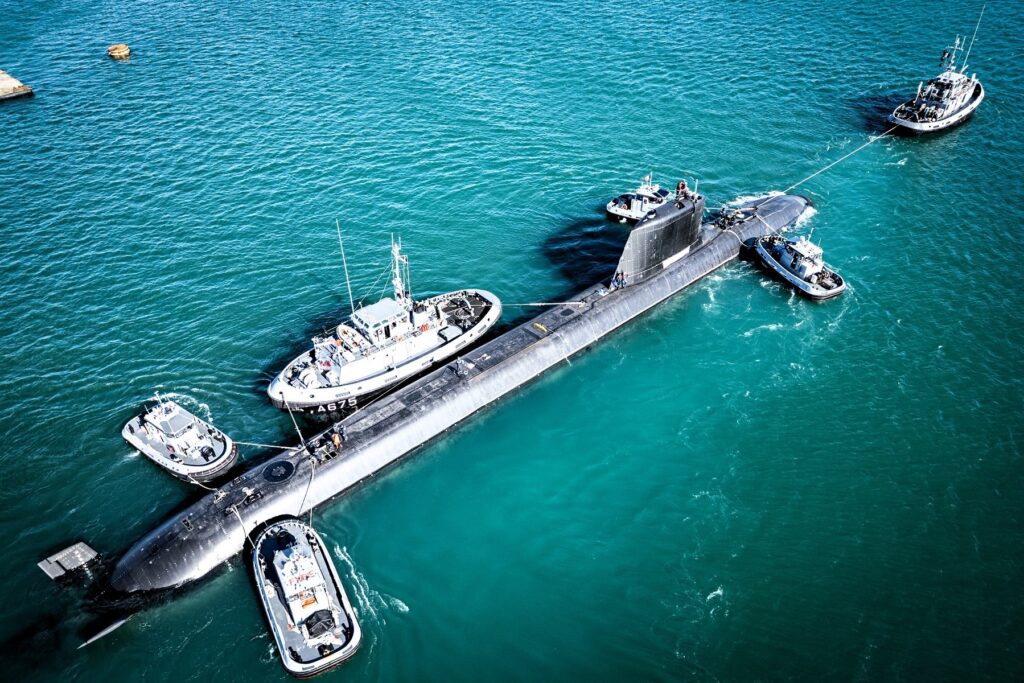
The French Navy’s fourth Barracuda-class nuclear-powered attack submarine, the De Grasse (S638), has embarked on its initial sea trials, known as “Alpha Trials,” off the coast of Cherbourg, Normandy. This significant milestone took place on February 24, 2024, marking a new chapter in France’s naval capabilities.
Named after the esteemed French naval officer Lieutenant général des armées navales François Joseph Paul, Comte de Grasse, the submarine pays homage to his pivotal victory over the Royal Navy at the Battle of the Chesapeake in 1781. The De Grasse is the fourth vessel in the Suffren-class series, designed to enhance the operational prowess of the Marine Nationale.
Technological Advancements in the De Grasse
According to Admiral Xavier Petit, Commander of French submarine forces, the De Grasse incorporates several advancements over its predecessors. Notably, it features an updated combat management system, SYCOBS, which introduces new capabilities, and a next-generation electronic warfare system. These enhancements are expected to significantly boost the submarine’s performance and operational flexibility.
A press release from Naval Group, the company responsible for the submarine’s construction, highlighted the comprehensive dock tests conducted since its launch in May 2025. The successful commissioning of the submarine’s nuclear reactor in December 2025 was a critical step in its development, ensuring all systems were thoroughly evaluated before the sea trials.
The Barracuda Program: A Strategic Asset
The Barracuda program represents a strategic investment in France’s naval defense, with the first three submarines already in active duty. The Suffren, the first of the class, was delivered in November 2020 and completed its first operational deployment in January 2023. The Duguay-Trouin and Tourville followed, entering service in 2024 and 2025, respectively.
These submarines are among the most advanced in the world, offering enhanced stealth, versatility, and firepower. Equipped with MBDA’s naval cruise missiles, they provide precise deep-strike capabilities. Additionally, they carry the F21 heavyweight torpedo and the SM39 anti-ship missile, ensuring a formidable presence in naval warfare.
By the Numbers: Suffren-Class Specifications
- Surface displacement: 4,700 tons
- Diving displacement: 5,100 tons
- Length: 99 meters
- Diameter: 8.8 meters
- Maximum depth: > 350 meters
- Speed: > 25 knots
- Armament: Naval cruise missiles, F21 torpedoes, Exocet SM39 missiles
- Crew: 63 members + approx. 15 commandos
- Endurance: 70 days at sea
- Availability: > 270 days per year
Innovation and Future Prospects
The Suffren-class submarines are designed with cutting-edge technologies that enhance their stealth and combat capabilities. The integration of non-penetrating optronic masts by Safran Electronic and Defense provides unmatched 4K imagery, accessible to every sailor in the Combat Information Center (CIC). These innovations position the submarines as leaders in anti-submarine warfare and intelligence, surveillance, and reconnaissance (ISR) operations.
Furthermore, the submarines are equipped with systems that facilitate the deployment of naval special forces. The Dry Deck Shelter, a removable deck hangar, supports the deployment of the PSM3G swimmer delivery vehicle and a dozen combat swimmers, underscoring the vessel’s versatility in special operations.
As the Barracuda program progresses, the final two submarines, Rubis and Casabianca, are under construction. Rubis is expected to commence sea trials next year, while Casabianca is slated for delivery in 2029, potentially ahead of schedule. This continued development ensures that the French Navy remains at the forefront of naval innovation and defense.
With the De Grasse now at sea, France’s naval capabilities are set to reach new heights, reinforcing its strategic position on the global stage.