




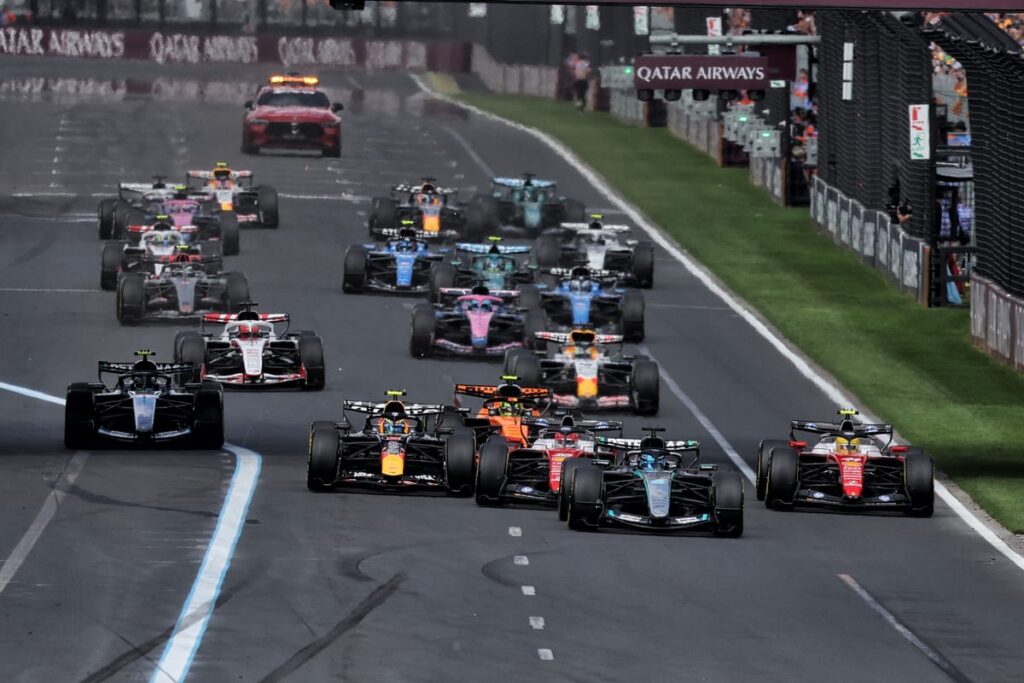
In the wake of the Australian Grand Prix, several Formula 1 drivers have voiced concerns over significant safety issues that were highlighted by a series of near-misses during the race. These incidents have drawn attention to potential risks associated with the new race start procedures and energy deployment systems.
The Australian Grand Prix revealed that discrepancies in race starts could lead to dangerous situations. The engines, equipped with turbos, require precise timing to avoid a lag between throttle input and power delivery. This has been a point of contention since pre-season testing, where drivers expressed apprehension about the potential for incidents on the first lap due to varying start speeds.
Challenges in Race Start Procedures
The current race start procedure involves a five-second pre-start period, followed by the red lights coming on sequentially. However, the final hold before the lights go out is at the discretion of the start lights operator, making it difficult for drivers to accurately time their engine revs. Ferrari’s engine, with its smaller turbo, has shown less vulnerability to these issues, allowing for impressive starts both in testing and during the Melbourne race.
Charles Leclerc, who made a remarkable launch from fourth place to take the lead by Turn 1, noted the unpredictability of the starting lights operator, describing the short hold as “quite cheeky” and surprising to many drivers. This unpredictability was compounded by reports of lower-than-expected battery levels after the formation lap, affecting the deployment of electric power.
“At the start I almost had a massive shunt with Liam as he was stuck on the grid. That was pretty lucky to be honest. Things like that happen but it was just very dangerous and quite sketchy.” — Franco Colapinto
Broader Safety Concerns
Beyond the start, other safety concerns have emerged, particularly regarding speed differentials on straights. Lando Norris highlighted the risk of significant speed differences when cars run out of energy, warning of the potential for severe accidents if a high-speed collision occurs.
“Depending what people do, you can have a 30, 40, 50km/h speed [differential] and when someone hits someone at that speed you’re going to fly and you’re going to go over the fence and you’re going to do a lot of damage to yourself and maybe to others, and that’s a pretty horrible thing to think about.” — Lando Norris
Moreover, the impact of following closely through sections with low-downforce modes has raised concerns. The FIA’s decision to reinstate a straight mode zone after initially removing it due to safety worries has been contentious. Carlos Sainz described it as “really dangerous” during the opening lap and in subsequent racing scenarios.
Expert Opinions and Future Implications
McLaren team principal Andrea Stella has been vocal about the need for further measures to address these safety issues. He emphasized the importance of reducing speed differentials at the start, suggesting that current efforts may not be sufficient to prevent future incidents.
“I think the concern remains today, the start was a bit of a near miss. There were huge speed differentials on the grid. We can hope for the best or we can just do something further to make sure that we reduce this speed differential.” — Andrea Stella
Race winner George Russell also weighed in on the matter, suggesting changes to the straight mode to improve front grip, which he believes could enhance safety during races. However, he acknowledged that some of the more fundamental issues exposed by the race debut will require more complex solutions.
As Formula 1 continues to evolve, addressing these safety concerns will be crucial to ensuring the well-being of drivers and the integrity of the sport. The incidents at the Australian Grand Prix serve as a stark reminder of the potential dangers inherent in high-speed racing, underscoring the need for ongoing vigilance and innovation in safety measures.
Looking ahead, the FIA and teams will need to collaborate closely to develop strategies that mitigate these risks, ensuring that the thrilling spectacle of Formula 1 racing does not come at the expense of driver safety.