




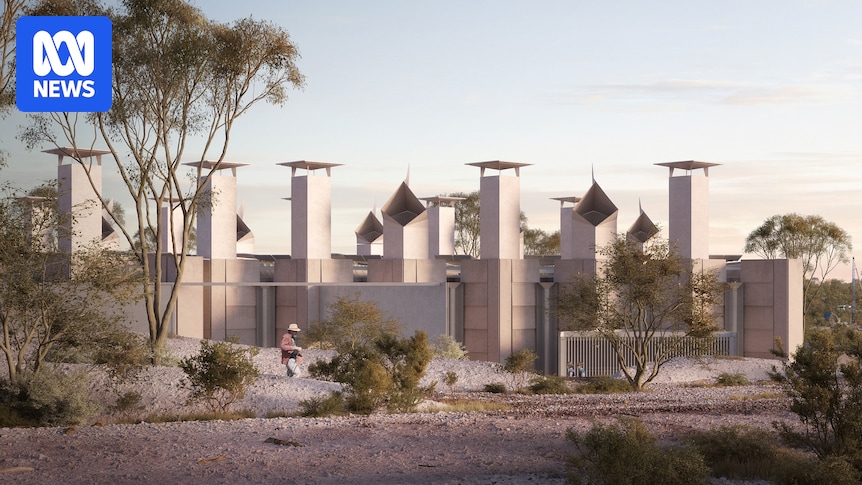
A $37 million monument intended to celebrate Australia’s national gemstone is at risk of becoming a “white elephant” as construction has been indefinitely stalled due to severe financial difficulties. The Australian Opal Centre in Lightning Ridge, which was about 85 percent complete, was initially set to open last year, showcasing the world’s largest public collection of opalised dinosaur fossils and an array of valuable gems.
Envisioned as a major tourist attraction for the north-western New South Wales town, the project attracted $29 million in government funding. However, an independent audit conducted last month raised alarms about the financial health of the not-for-profit organization behind the project, Australian Opal Centre Limited (AOCL).
“A material uncertainty exists that may cast significant doubt on the [AOCL’s] ability to continue as a going concern,” the audit report stated.
David Lane, the recently-appointed AOCL chairperson, told ABC Western Plains Breakfast, “Unfortunately, at this stage, there is not the money available to continue with the build.” He estimated that construction might not resume for another couple of years.
Construction Stalls Amid Financial Strain
Construction at the site came to a halt last May, preceding a $5.4 million cash loss for the AOCL during the 2024-25 financial year. According to Lane, the project suffered from cost overruns and inflationary pressures. Since the halt, AOCL has been paying a monthly site maintenance fee to the builder, amounting to “tens of thousands” of dollars, which has further strained the company’s resources.
The newly appointed AOCL board, which took over in November, has decided to terminate the builder’s contract, though negotiations over an outstanding payment are ongoing. Lane acknowledged the risk of insolvency but expressed hope that settling with the builder would allow the organization to reassess its financial needs and rebuild its business strategy.
A Vision Decades in the Making
The project, described on its website as an energy-efficient “architectural icon” with a semi-underground design, has received substantial financial backing: $9.5 million from the Australian government, $17.5 million from the NSW government, $2 million from Walgett Shire Council, and $1.8 million from community donors and benefactors.
Jenni Brammall, a palaeontologist and gemmologist who has been involved with the AOCL since 2004, expressed the community’s disappointment over the stalled construction. “We really are close and we just need to retain heart, to find a way to completion,” she said.
The idea for the centre originated in the late 1990s, driven by a local group eager to diversify Lightning Ridge’s economy and elevate Australia’s iconic gemstone on a global platform. The project evolved from a small association operating out of a shopfront to a significant initiative with 380 members across Australia and abroad.
Exploring Recovery Options
One potential recovery strategy being considered is transferring the project to the financially challenged Walgett Shire Council. Lane noted that the council might be better positioned to secure additional government and corporate funding. However, Andrew Brown, the council’s general manager, emphasized that any decision would require further government support.
“We accept how important this is for the future of the area,” Brown stated. “However, any decision that council makes needs to be backed by funding from the state and/or federal government.”
As of late 2025, the AOCL estimated that completing construction and a full operational fit-out would require between $6 million and $7 million. In a recent communication to members, Lane outlined several recovery strategies the board is exploring, such as keeping the museum director role vacant, increasing donations, and selling non-core assets.
The announcement comes as the AOCL grapples with a negative cash flow of $5.4 million, having spent $15 million on construction while receiving $9.2 million in government grants. Daily operations also reported a loss exceeding $230,000, primarily due to employee and supplier costs. Although the AOCL still holds nearly $1 million in the bank, 93 percent of that is earmarked for construction-specific grants, leaving little room to cover other expenses.
As the community and stakeholders seek a path forward, the fate of the Australian Opal Centre hangs in the balance, with hopes that a resolution can be found to bring this ambitious vision to fruition.