




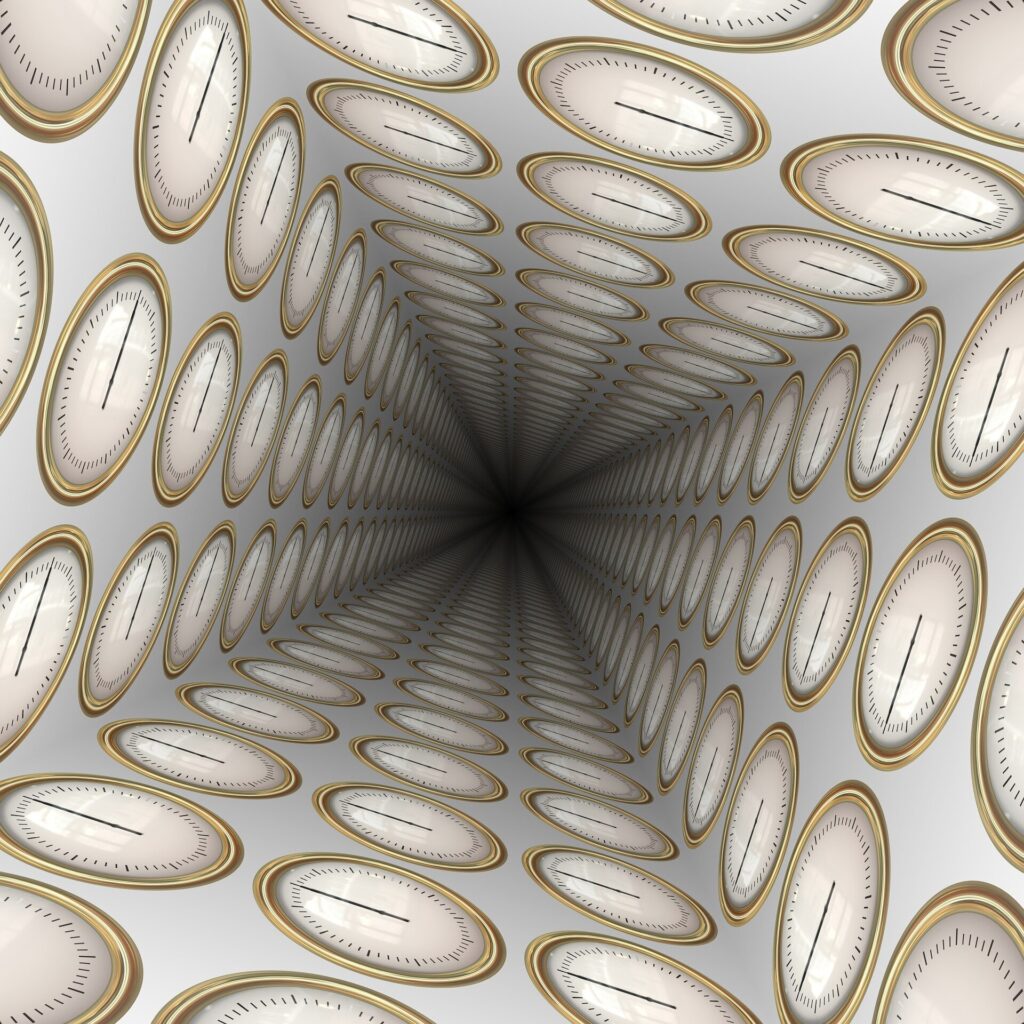
I have a form of time-space synesthesia, so the arrival of the new year is a uniquely physical experience for me. As the calendar turns, I feel a tangible shift, almost as if I am traveling through a structured path. December sits low and to my left, while January rises and moves forward. This transition carries a weight, as if the calendar itself is shifting in space.
Synesthesia is a perceptual condition where one sense triggers an experience in another. For some, sounds evoke colors and shapes, or words might have distinct tastes. For others, like myself, sequences such as months or days occupy specific spatial locations around our bodies. This condition, often developmental, means that “synesthetes” have experienced the world in this manner for as long as they can remember. These experiences are automatic and consistent over time. Today is in front of me, tomorrow to my left, and yesterday to my right. If time were to suddenly relocate, I would feel disoriented.
The Physical Transition of a New Year
For me, the start of a new year feels like a physical transition, a time for new beginnings as we move around the bend of time, leaving the old year behind. Like many, I lose track of days between Christmas and New Year’s, but my time-space synesthesia amplifies this disorientation. The usual mental map I rely on becomes scrambled, leaving me feeling unmoored.
As a cognitive psychologist, I have spent two decades researching synesthesia. I am fascinated by how our minds shape our experiences and how these experiences differ among individuals. Beyond documenting synesthetic experiences, I am interested in their impact on other aspects of life.
Understanding Time-Space Synesthesia
Time-space synesthesia offers a unique window into how the brain organizes time. One benefit of these mental calendars is an enhanced memory for historical events or significant life dates, such as anniversaries or birthdays. People with this form of synesthesia often have cognitive advantages, as their spatial mapping of time serves as a powerful mnemonic aid.
Research shows that synesthetes learn skills like calendar calculation faster and more accurately than non-synesthetes.
This unique mental representation boosts memory and pattern recognition, helping us understand the benefits of representing time spatially and visually rather than linearly. Time-space synesthetes also excel in tasks involving time organization, such as planning, due to their enhanced memory and attention for ordered information.
The Cognitive Edge of Synesthesia
These mental timelines are so ingrained that they can override external cues—a phenomenon known as the spatial Stroop effect. This automatic mapping can subtly influence decision-making when speed and spatial judgment are crucial.
Research has highlighted differences between the brains of synesthetes and non-synesthetes, suggesting that these differences may lead to broader cognitive variations unrelated to sensory experiences. For instance, time-space synesthetes not only have good memories for times and dates but also for other aspects of memory, such as word lists, pictures, or colors. A 2015 study even suggested that time-space synesthesia might be linked to more vivid mental imagery.
The Genetic and Cultural Influences
The question that intrigues me is why synesthesia isn’t universal. It has a genetic basis, affecting about 4% of the population, and is often familial, though the specific senses involved may vary. Environmental factors and learning also play a role in its development. Cultural norms often influence the spatial layout of synesthetes’ mental calendars. For example, those who read from left to right often perceive time moving in the same direction.
My own year shape resembles an oval, with January at one end and August at the other, likely influenced by my upbringing in the UK, where the school year starts in September.
Brain Imaging and Synesthetic Experiences
Brain imaging research is shedding light on what occurs in the brain during synesthetic experiences. Synesthetes’ brains are wired for extra connectivity, with regions handling separate senses communicating more. Imaging studies reveal pathways in the central nervous system linking perception with higher-level thinking, explaining why synesthesia feels seamless.
Brain imaging research published in 2020 shows that synesthetes use spatial-processing regions when working with numbers, indicating that our brains integrate space and sequence.
Time is associated with space in many cultures, with people in the UK, Europe, and the US often perceiving the future as ahead and the past behind. Time-space synesthesia reminds us that even within cultures, there are diverse experiences of time’s “movement.” The new year serves as a reminder that time is not only measured but also inhabited, with personal journeys through time featuring strikingly diverse landscapes.