

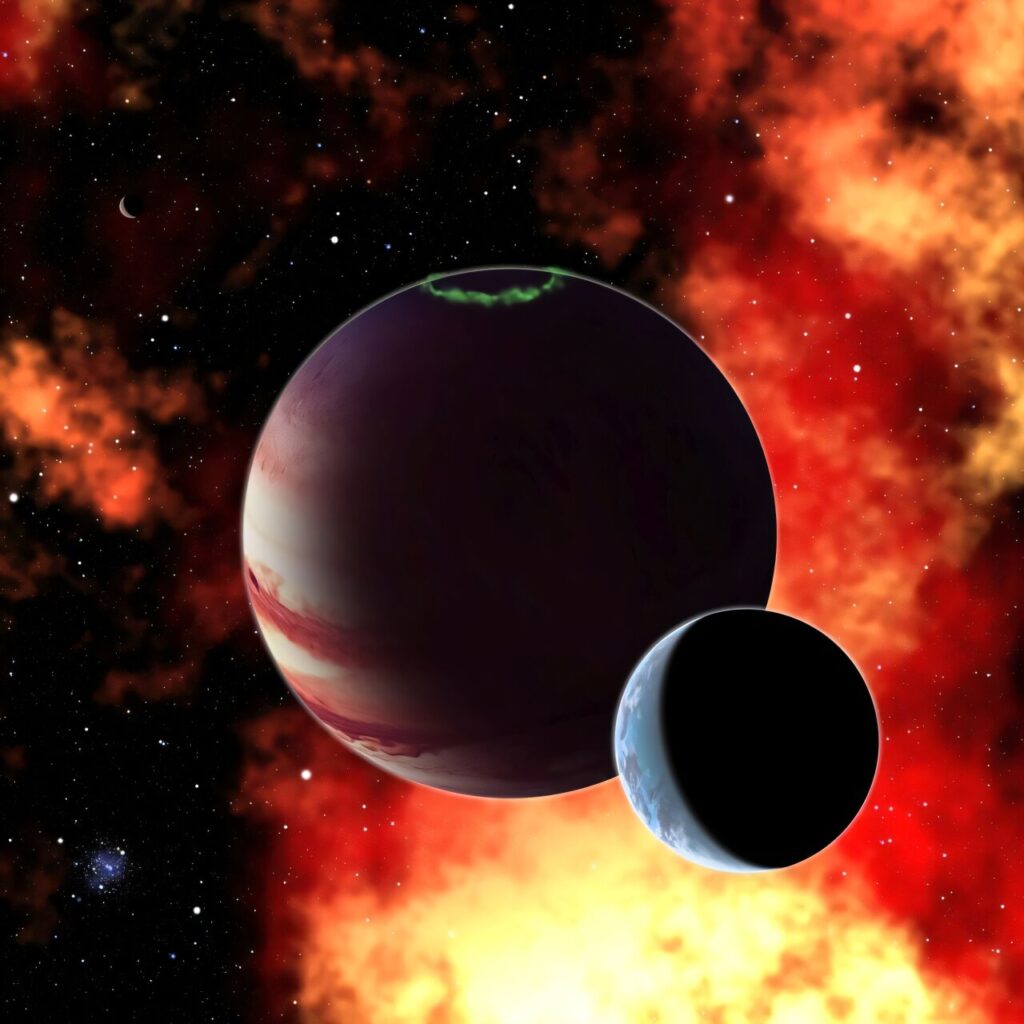
In the quest to discover moons orbiting distant exoplanets, known as exomoons, astronomers have yet to confirm their existence despite several promising candidates. The absence of confirmed exomoons is puzzling, especially given the prevalence of moons in our solar system. A new study, however, suggests that planets within the habitable zones of red dwarfs are unlikely to host such moons, adding a new layer to this cosmic mystery.
The research, titled “Tidally Torn: Why the Most Common Stars May Lack Large, Habitable-Zone Moons,” is led by Shaan Patel from the University of Texas at Arlington. It is set to be published in The Astronomical Journal and is currently available on the arXiv preprint server. The study employs N-body simulations to explore the dynamics of exomoons around Earth-like planets in the habitable zones (HZ) of M-dwarfs, the most common type of star in the Milky Way.
The Role of Moons in Habitability
Moons play a crucial role in planetary systems, as demonstrated by Earth’s moon, which stabilizes our planet’s axial tilt and contributes to the creation of a climate conducive to life. This raises the question: could exomoons around other terrestrial planets also foster conditions suitable for life?
M-dwarfs, or red dwarfs, are known for hosting rocky exoplanets within their habitable zones. However, these stars are small and dim, meaning their habitable zones are much closer to the star compared to brighter stars like our Sun. This proximity often results in tidal locking, where one side of the planet perpetually faces the star, potentially impacting the stability and existence of exomoons.
Simulations and Findings
The study’s simulations varied the mass and semi-major axis of host planets to determine the conditions under which exomoons become unstable. The stability of these moons is linked to the host planet’s Hill sphere, which defines the gravitational domain where a moon can orbit stably. The larger the Hill sphere, the longer a moon can remain in orbit.
“Our findings suggest that HZ Earth-like planets in M-dwarf systems will lose large (Luna-like) moon(s) (if formed) within the first billion years of their existence,” the researchers explain.
The simulations also revealed that the type of M-dwarf star affects the outcome, with 10 classifications from M0 to M9 based on temperature. This classification influences the habitable zone’s location and the strength of stellar tides, which in turn affect exomoon stability.
Implications for Exomoon Detection
The study indicates that massive exomoons likely experience extreme tidal heating, rendering them uninhabitable. However, in rare configurations, such as a large moon orbiting an Earth-mass planet around an M0-dwarf, the moon could survive for up to 1.35 billion years. This timeframe coincides with significant evolutionary milestones on Earth, such as the buildup of atmospheric oxygen.
Despite these findings, the search for exomoons continues. The upcoming Habitable Worlds Observatory, with its potential 6 to 8-meter mirror, could enhance our ability to detect exomoons. Similarly, the Giant Magellan Telescope, expected to begin observations in the 2030s with a 24.5-meter composite mirror, might directly image exoplanets and their moons.
Looking Beyond Red Dwarfs
While the study focuses on M-dwarfs due to their abundance, other star types with more distant habitable zones may offer better prospects for exomoon stability. These moons could play a role similar to Earth’s moon, contributing to the habitability of their planets or even being habitable themselves.
As scientists continue to explore our solar system’s icy ocean moons for signs of habitability, the potential for similar worlds in other systems remains an exciting frontier. The detection and study of exomoons could provide critical insights into the conditions necessary for life beyond Earth.