




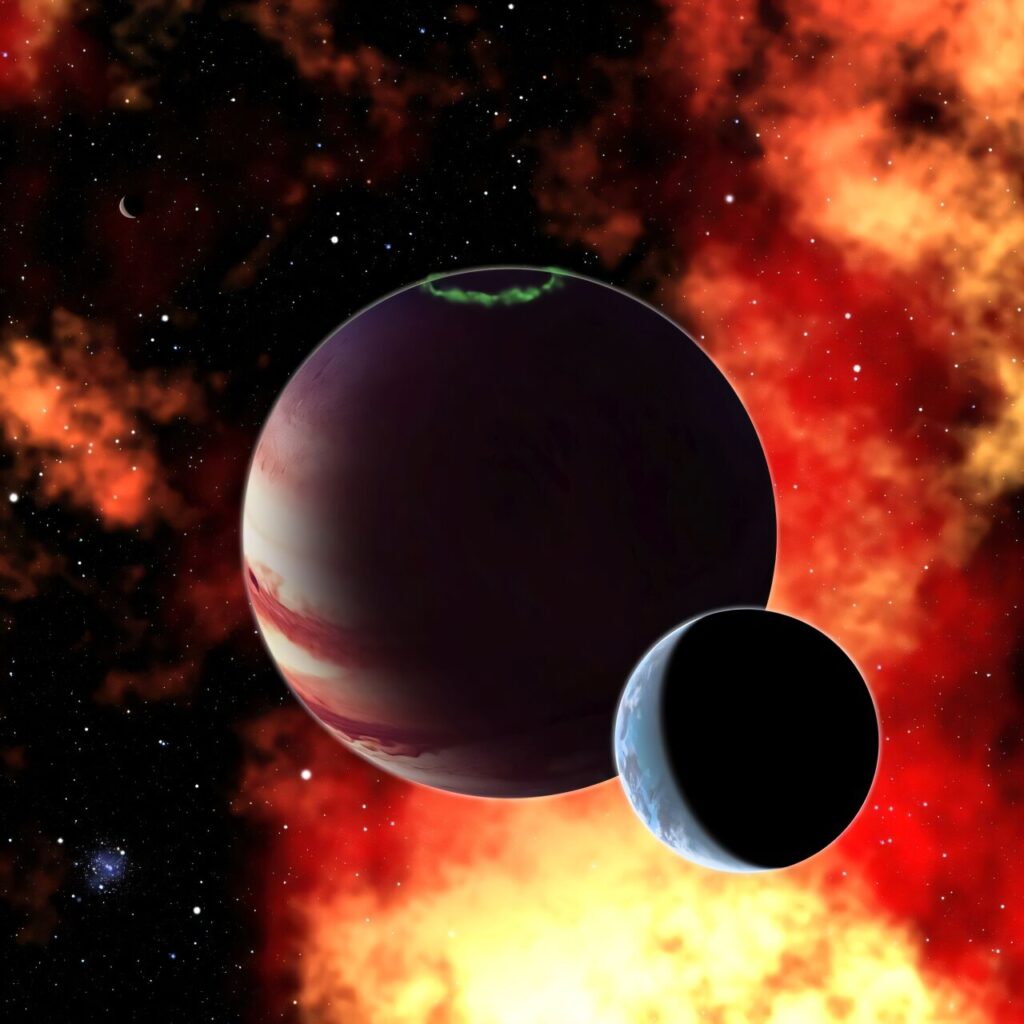
In a groundbreaking study, researchers have suggested that exomoons—moons orbiting planets outside our solar system—are unlikely to exist around habitable zone planets orbiting red dwarfs. This conclusion stems from simulations conducted by scientists, which indicate that such moons would not remain stable over astronomical timescales.
The study, titled “Tidally Torn: Why the Most Common Stars May Lack Large, Habitable-Zone Moons,” is set to be published in The Astronomical Journal. Led by Shaan Patel from the Department of Physics at the University of Texas at Arlington, the research delves into the dynamics of exomoons in the habitable zones (HZ) of M-dwarfs, the most prevalent type of star in the Milky Way.
Understanding the Role of Moons in Habitability
In our solar system, Earth’s moon plays a crucial role in maintaining the planet’s habitability. It stabilizes Earth’s axial tilt, fostering a climate conducive to life, and influences ocean tides, which enrich coastal biodiversity. The question arises: could exomoons around other terrestrial planets perform similar functions?
Despite the absence of confirmed exomoons, the potential for their existence has intrigued astronomers. The James Webb Space Telescope (JWST) has even allocated observation time to search for an exomoon around the rocky exoplanet TOI-700d, suspected of hosting a moon similar to Earth’s Luna.
Simulations and Findings
The researchers employed N-body simulations to explore the stability of large, Luna-like moons around Earth-like planets in the habitable zones of M-dwarfs. These simulations considered variables such as the host planet’s mass and semi-major axis to determine when exomoons become unstable.
“Our findings suggest that HZ Earth-like planets in M-dwarf systems will lose large (Luna-like) moon(s) (if formed) within the first billion years of their existence,” the researchers explain.
The study highlights the influence of the Hill sphere—the region where a planet’s gravity dominates over that of the star—on moon stability. Larger Hill spheres correlate with longer moon lifetimes, but the results indicate that exomoons in these systems are generally short-lived.
Implications for Exomoon Detection
Previous research has shown that massive exomoons likely experience extreme tidal heating, rendering them uninhabitable. This study adds to the narrative, suggesting a general fragility of exomoons in M-dwarf systems.
Nevertheless, there are scenarios where a large moon could survive. For instance, a large moon orbiting a habitable Earth-mass planet around an M0-dwarf could last up to 1.35 billion years. This is comparable to the time when Earth’s atmosphere began accumulating oxygen.
Despite these challenges, advancements in telescope technology could enhance exomoon detection. The proposed Habitable Worlds Observatory and the Giant Magellan Telescope, with its 24.5-meter mirror, could potentially identify exomoons in the coming decades.
Looking Beyond Red Dwarfs
While M-dwarfs are the focus of this study due to their abundance and the rocky worlds they host, other star types with more distant habitable zones may offer better prospects for long-lived exomoons. These moons could contribute to planetary habitability, akin to Earth’s moon, or even possess habitable environments themselves.
As the search for exomoons continues, scientists remain hopeful. The potential discovery of such celestial bodies could revolutionize our understanding of planetary systems and the conditions necessary for life beyond Earth.