

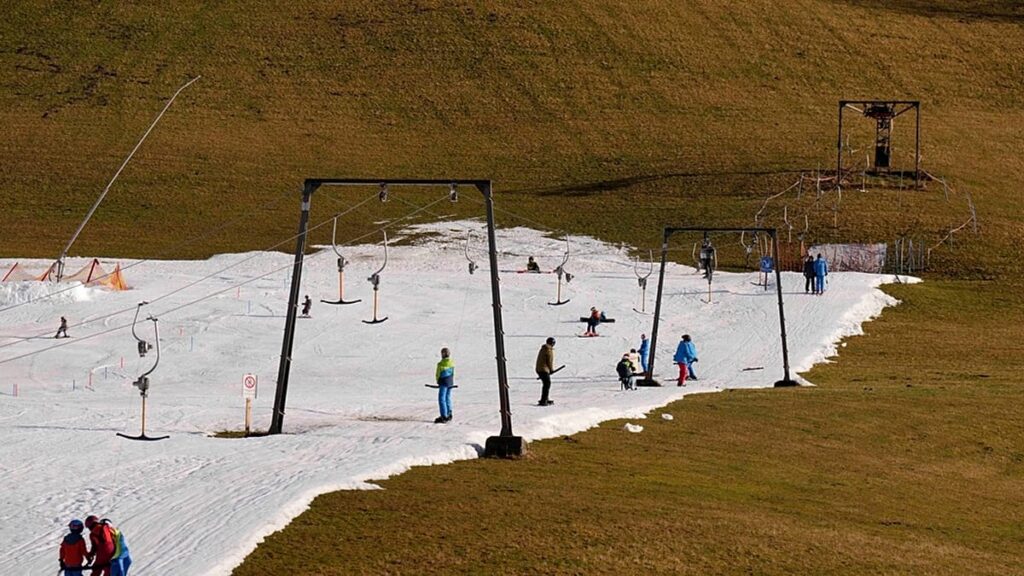
With only weeks remaining before the Winter Olympics in Milan-Cortina on February 6, the slopes of the ‘pearl of the Dolomites’ are blanketed in snow. However, not all tourists and skiers are fortunate enough to witness such a scene. The warming climate has increasingly restricted snow to the slopes, often necessitating artificial snowmaking, which carries significant economic and environmental costs. These costs frequently lead to higher ski pass prices, making snow sports less accessible for many Europeans.
The impact of climate change on winter sports is profound. Even in Italy’s famed ski resort in Belluno, snowfall is becoming less frequent, and temperatures are rising—a challenge faced by the entire Alpine region. The International Olympic Committee (IOC) has acknowledged the effects of global warming, primarily driven by the burning of fossil fuels.
Climate Change and the Future of the Winter Olympics
The geography of the Winter Olympics is inevitably shifting. Since 1924, 21 locations have hosted the Games. Without swift and substantial action to combat climate change, a 2021 study by the University of Waterloo, Canada, published in Taylor & Francis, suggests that by mid-century, only four of these locations—Lake Placid (USA), Lillehammer and Oslo (Norway), and Sapporo (Japan)—will remain suitable.
By 2080, only the Japanese ski resort of Sapporo may still be viable if global temperatures rise by 4 degrees Celsius over pre-industrial levels, a worst-case scenario.
Even if the Paris Agreement succeeds in limiting global warming to 2 degrees Celsius, only nine Olympic locations would be capable of hosting the Games by 2050, with just eight remaining by 2080.
Europe’s Reliance on Winter Sports
While the Winter Olympics occur every four years, the ski economy is a daily reality for those who depend on it. In 2022, Europe’s winter tourism sector generated approximately €180 billion, with the Alps serving as its core. This region is not only a hub for tourism but also home to crucial water resources and biodiversity.
The Alpine region encompasses 48 regions across five EU Member States—Germany, France, Italy, Austria, and Slovenia—alongside Liechtenstein and Switzerland, housing 80 million people, or about 15% of the EU population.
Germany leads Europe with 498 ski resorts, followed by Italy with 349 and France with 317, according to 2020/21 data from Statista.
A 2023 study in Nature Climate Change predicts that 53% of Europe’s 2,234 ski resorts will face high risk of low snow under a 2°C warming scenario. In the French Alps, one-third of resorts could be affected, while in the Pyrenees, the figure could reach 89%.
Economic and Environmental Challenges
The climate crisis is reshaping mountain ecosystems and economies. François Hugues, a researcher at Inrae, explains that European mountain massifs can be categorized into three groups based on their vulnerability to climate change. The inland Alps in France, Switzerland, and Austria have favorable conditions, while the Slovenian Alps and Pyrenees are more vulnerable. The Iberian Peninsula and Apennines in Italy face the greatest challenges.
Many resorts are turning to artificial snow to mitigate the impact. However, a 2007 OECD study highlighted the ‘one hundred days rule,’ which states that a resort must have 100 days of operation with at least 30 centimeters of natural snow to be profitable.
Producing artificial snow is costly. To cover a one-kilometer slope, costs range from €30,000 to €40,000, with snow production costs varying between €2 and €3.8 per cubic meter.
Hugues notes that while the production costs of artificial snow are relatively minor compared to overall resort expenses, environmental concerns related to water resources and electricity consumption are significant. Creating artificial lakes for water storage and the energy needed for snow cannons contribute to greenhouse gas emissions.
The Rising Cost of Skiing
The financial burden of snowmaking is reflected in rising ski pass prices. Since 2015, skiing costs in Europe have increased by an average of 34.8%, surpassing inflation. Switzerland, Austria, and Italy have seen the highest price hikes, making skiing increasingly unaffordable for many.
“Skiing will become a sport for the rich,” warns Christophe Clivaz, a lecturer at the University of Lausanne. “In Switzerland, many families can no longer afford it.”
According to Assoutenti, a daily ski pass for the ‘Dolomiti Superski’ now costs up to €86, compared to €67 in 2021. In Roccaraso, Abruzzo, prices have risen from €47 in 2021 to €60 today. Livigno has seen a 38% increase, from €52 in 2021 to €72 in 2025.
As climate change continues to challenge the ski industry, resorts that remain viable may attract wealthier tourists from further afield, potentially increasing greenhouse gas emissions from travel.
The European Union has emphasized the need for coordinated management of water resources in its revised action plan for the Alpine region, highlighting the importance of integrated water protection and restoration for Europe’s resilience.