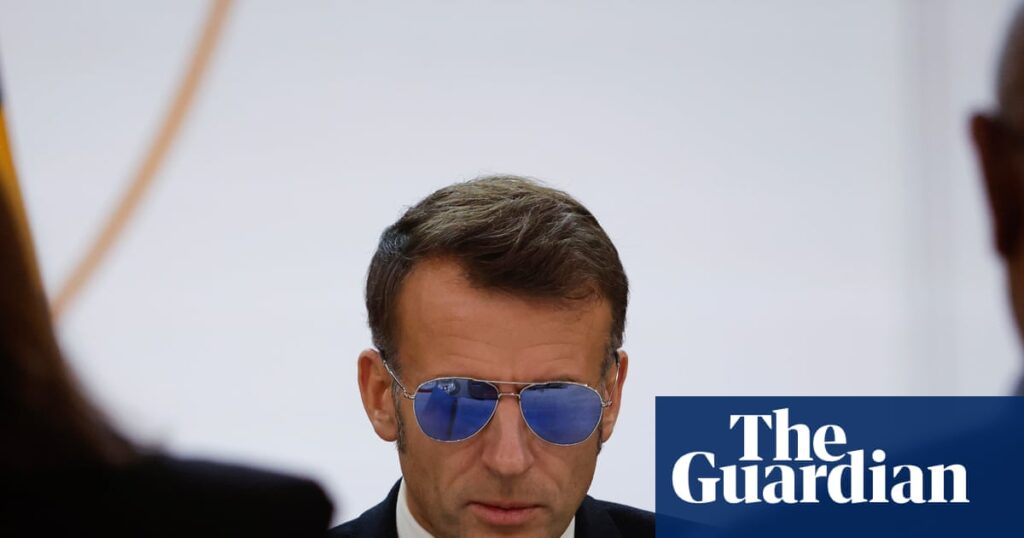
Emmanuel Macron has firmly rejected Donald Trump’s recent threats to impose tariffs on European countries opposing his ambitions for Greenland. The French President declared that “no amount of intimidation” would sway European nations from their stance on the issue. This statement comes in the wake of Trump’s announcement of a 10% tariff on eight European countries starting February 1, escalating to 25% by June 1.
The Swedish Prime Minister, Ulf Kristersson, supported Macron’s position, emphasizing that the European Union would not be “blackmailed” by the US President. In a joint statement, EU leaders warned that these tariffs could “undermine transatlantic relations and risk a dangerous downward spiral.” An emergency meeting of EU ambassadors is anticipated on Sunday to address the escalating tensions.
EU’s Unified Response
The European Parliament is likely to suspend the ratification of last summer’s trade deal with the US. Manfred Weber, head of the European People’s Party, the largest voting bloc in the parliament, indicated that the legal process would be paused. The threatened tariffs target Denmark, Norway, Sweden, France, Germany, the UK, the Netherlands, and Finland—countries that have been vocal against Trump’s Greenland intentions.
While in Paraguay for a significant trade agreement with the Mercosur alliance, European leaders were caught off guard by Trump’s remarks on Truth Social. Trump stated, “This Tariff will be due and payable until such time as a Deal is reached for the Complete and Total purchase of Greenland.”
Macron’s Firm Stand
Macron labeled the tariff threats as “unacceptable,” emphasizing that they had “no place” in the current context, where Europe defends Greenland, a member of the EU and NATO. “France is committed to the sovereignty and independence of nations, in Europe and elsewhere. This guides our choices,” Macron stated. He further linked this commitment to France’s support for Ukraine and involvement in Greenland’s security exercises.
Kristersson echoed these sentiments, asserting, “We will not allow ourselves to be blackmailed. Only Denmark and Greenland decide on issues concerning Denmark and Greenland.”
Transatlantic Relations at Stake
In a joint statement, António Costa, President of the European Council, and Ursula von der Leyen, President of the European Commission, reaffirmed the “shared transatlantic interest in peace and security in the Arctic, including through NATO.” They stressed that “dialogue remains essential” and warned that tariffs could lead to a “dangerous downward spiral.”
Denmark’s Foreign Minister, Lars Løkke Rasmussen, sought to de-escalate the situation, citing “constructive” talks with US Senator Marco Rubio and highlighting the need for increased Arctic security. “That is why we and NATO partners are stepping up in full transparency with our American allies,” Rasmussen said.
Expert Analysis and Historical Context
Mikkel Runge Olesen, a senior researcher at the Danish Institute for International Studies, described Trump’s tariff threats as a “negotiating tactic.” He noted, “I think it is a reaction to the European troops going to Greenland, because if you look at the tariffs, they match the countries who sent troops.”
The EU-US tariff deal, initially agreed upon at Trump’s Scottish golf course, has yet to be ratified by the European Parliament. German MEP Bernd Lange, chair of the trade parliamentary committee, expressed skepticism about continuing the ratification process under the current circumstances.
“In view of the threat of imposing an additional 10% tariff from 1 February, I cannot imagine that we will continue business as usual and I assume that we will suspend our continued work,” Lange stated.
The Socialists and Democrats, the second-largest voting bloc, also withdrew from talks. Kathleen Van Brempt, vice-president for trade, declared, “There can be no trade deal under the given circumstances.”
Looking Ahead
The EU’s firm stance against US tariff threats over Greenland underscores the broader geopolitical tensions between Europe and the United States. As EU ambassadors prepare for an emergency session, the future of transatlantic trade relations hangs in the balance. The situation highlights the EU’s commitment to sovereignty and the principles underpinning international law, as leaders navigate a complex diplomatic landscape.