



The morning after arriving at Munich Hauptbahnhof, the Bavarian capital’s main railway station, I found myself back on a train, this time bound for Dachau. Less than half an hour away, Dachau is the site of the infamous Nazi concentration camp. Upon arrival, visitors, like myself, can choose to walk to the camp instead of taking the free bus. This moving remembrance walk traces the route along which prisoners were routinely marched, in full view of the local townspeople.
Today, tourists take about 45 minutes to complete the remembrance walk, which includes a somber sculpture depicting a Nazi SS-led death march of at least 25,000 prisoners from Dachau as conquering US troops neared the camp. The foundations of an abandoned train platform still exist here, marking a grim reminder of history. At least 1,000 inmates died from disease, malnourishment, and exhaustion. Those unable to continue were beaten or shot by their guards. In total, more than 40,000 people lost their lives at Dachau.
From Vienna to Budapest: A Journey of Contrasts
After leaving Dachau, the journey from Munich to Vienna felt indulgent, especially when considering the decline in quality and availability of food aboard today’s European trains. The concentration camp, ironically, features a lively cafeteria for visitors, offering a wide menu of German cuisine, which seems incongruous at such a solemn site.
Once, dining cars offered a feast in what was one of the most civilized of human traditions. However, nearly all such carriages have been removed by cost-cutting train operators. The more popular rail travel becomes in Europe, the more it adopts an airline-style posture. Unless traveling first-class or aboard the original Orient Express, modern high-speed trains now offer fast food bought at an on-board cafeteria and eaten at your seat.
On this section of the journey, a highlight was visiting Salzburg’s 11th-century Fortress Hohensalzburg via a vertiginous funicular. But the hunt for good food remained on my mind. After arriving in Vienna in the early evening, I planned my next day around a visit to Figlmuller, a restaurant renowned for its wiener schnitzel since 1905. Figlmuller’s recipe for success is a 250-gram cut of tenderloin pork, pounded thin and coated with specially made breadcrumbs.
Crossing into Eastern Europe: Budapest and Beyond
Istanbul was still almost 1,300 kilometers down the line, meaning it wasn’t long before schnitzel was exchanged for goulash as Budapest beckoned. The train journey from Vienna to Budapest took about three hours, revealing a stark contrast between Western and Eastern Europe. Our train arrived not at Budapest’s grand central station, but at a scruffy terminal, a cultural jolt after Vienna’s modern rail terminal.
In Budapest, there was an opportunity to visit the city’s main attractions, including the magnificent Danube-side Hungarian Parliament Building. Despite not staying at a grand Budapest hotel, I spent my day hopping between the city’s historic coffeehouses, which rival those of Vienna in opulence and heritage. A ride on mainland Europe’s oldest underground metro, the quaint Line 1, was also a must.
However, a major railway station beyond Budapest abruptly impeded our progress. Due to politics, protest, and calamity, we transferred to a mini-bus for the journey to Novi Sad. On November 1, 2024, the concrete canopy of Novi Sad’s main railway station collapsed, killing 16 people. Built in 1964 and renovated with support from China’s Belt and Road Initiative, the station’s disaster highlighted government corruption and incompetence, sparking protests across Serbia.
Final Stretch: Belgrade to Istanbul
In Belgrade, the ubiquity of anti-government protest signs was impossible to ignore. Only days later did I learn of a demonstration outside the capital’s parliament house, where shots were fired. Despite the unrest, Belgrade, set around the confluence of the Danube and the Sava, impressed with its vibrant atmosphere.
After Belgrade, the journey continued to Bulgaria, with a brief stop in Sofia before reaching Plovdiv. Plovdiv, one of Europe’s most ancient cities, was a revelation with its cobbled old town and well-preserved Roman amphitheatre. That evening, we bid Bulgaria farewell, taking the Sofia-Istanbul Express night train. Despite the interruptions by border guards, the train offered a nostalgic rail experience.
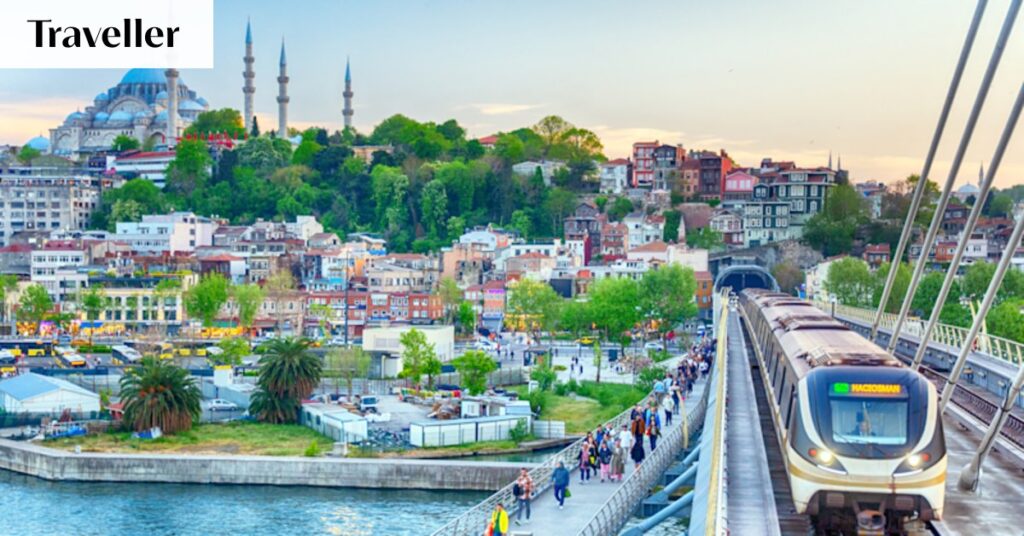
Arriving at Istanbul’s Halkali Station, the journey concluded with a transfer to the city center. After seven countries, as many trains, and nearly 3,000 kilometers, the journey ended not with an Orient Express-style limo, but a comfortable people mover, fitting for the Express to the Orient.
Five More Things to See and Do
- Sample a Strasbourg delicacy: Try Flammekueche, a flatbread topped with fromage blanc, onions, and lardons, in Strasbourg, Alsace’s capital.
- Pause for a senior moment in Vienna: Visit Vollpension, a cafe where Viennese seniors share baking secrets over coffee and cake.
- Where rivers run through it: In Belgrade, take a guided tour from Ulica kneza Mihaila to Kalemegdan Fortress, overlooking the Danube and Sava Rivers.
- Go Roman in Sofia: Explore Bulgaria’s capital, Sofia, with its tree-lined boulevards and Roman ruins.
- Satisfy your Constantinople craving: End your journey with a tour of Old Istanbul, including the Blue Mosque and the Hippodrome.
The Details
Tour
Intrepid Travel’s 15-day small group tour includes all rail tickets, three overnight hotel stays, and one night aboard the Sofia to Istanbul train. The Budapest to Belgrade section is set to reopen this year with a new, direct train service.
Book
Prices start from $6,995, excluding flights. Departures run between April and October, with a visa required for Turkey. A rail transfer from London to Paris is optional. Visit intrepidtravel.com for more details.
Fly
Singapore Airlines offers flights from Sydney and Melbourne to Paris and Istanbul. Visit singaporeair.com for more information.
The writer traveled as a guest of Intrepid Travel and with the assistance of Singapore Airlines.